WELCOME TO CEREBRAL BOINKFEST!

WELCOME TO CEREBRAL BOINKFEST!

A blog about the arts, books, flora and fauna, vittles, and whatever comes to mind!

Note: Comments are moderated. If you include a link, your comment will not be published. As you will note, I do not accept ads on my website and that includes in comments.


Wednesday, May 18, 2011

Sex Slaves and Benefactresses

Hürrem aka Roxolana and the Sultan Süleyman the Magnificent
by Anton Hickel, 1780, courtesy of the Landesmuseum Mainz.

When my mother was a girl growing up in Athens, Greece, in the 1930s/early 1940s she and her friends were often warned to be very careful when they were out in public because they might get kidnapped and put in a harem.  The connotation of a harem is a place where women are kept captive and used as sex slaves, wasting away with boredom.  Even though women were secluded, they exercised their power through agents.  The traveler and historian Ibn Battuta remarked in 1336 that Turk and Tatar women enjoyed "a very high position".

Pool in a Harem by Jean-Léon Gérôme, circa 1876.
Writers and artists of this period strove to keep the mystique of the
harem, instead of being factual, to give the public what they wanted.

Although harem women were slaves they were never married to the sultan, however their children were considered legitimate if recognized by the father.  The Ottoman rulers routinely chose women of foreign backgrounds in order to gain the fidelity of those external provinces.  These women, of course, converted to Islam. In Islam women were allowed to own property and to control it, so business dealings were something of a norm.  Mothers, aunts, and even sisters of sultans were often entrusted with diplomatic affairs.

The Reception by John Frederick Lewis, 1873.

The harem had a very elite social structure.  There was a rule that once a concubine gave birth to a son, she ceased having children.  This was to ensure that a prince would not have to share the political resources a mother provided with any brothers.  The Sultan Süleyman broke that rule with Hürrem, with whom he had four sons.  She also moved into the imperial residence.  She was accused of bewitching him, so astonishing were his actions, and she was very unpopular. After this, harem women were not allowed to be prominent, except for the mothers of princes.

A rendering of a room in the apartments of the Valide Sultan in Topkapi Palace.

These harem women held considerable power.  The Valide Sultan (literally "Mother Sultan" in Ottoman Turkish) was the title held by the mother of the reigning sultan.  This was a very important and powerful position, at times second in power to the Sultan, and the Valide Sultan had great influence on the affairs of state.  There was a time during the 16th and 17th centuries when there were a number of very powerful Valide Sultans who assumed new heights of power.  This period is know as the Sultanate of Women.

Musical Interlude by Fabbi Fabbio (1861-1946).
Fabbio, Lewis, and Gérôme were Orientalist painters.

These particular Valide Sultans acted as regents to their sultan sons who were minors or mentally unfit to rule, and as such acted as guardians of their sons and political tutors.  This rash of young and/or incompetent sultans was the result of a change in the rules of succession.  Primogeniture was originally thought to be unfair to younger, and perhaps more capable, sons.  Princes were expected to fight for the right to rule, but this was eventually deemed too violent, so primogeniture was adopted again.

One of the concepts of Islam is the five pillars - profession of faith, prayer, ritual fasting, charity, and the pilgrimage to Mecca.  Charity means giving a fixed portion of one's wealth to help the poor and needy.  This a religious obligation, to share the bounty from God, and is distinct from voluntary giving.  Some of the Valide Sultans commissioned great works, ranging from wells to mosques, to fulfill this obligation.  Some of their edifices have become historically famous...

Another portrait of Hürrem, artist unknown. 16th century

The aforementioned Hürrem was born in the early 1500s to a Ukrainian Orthodox priest (the Ukraine was then part of Poland).  She was captured in a raid by Crimean Tatars and taken as a slave.  She was eventually added to Süleyman's harem, where she became his favorite.  She was responsible for several major works of public buildings from Mecca to Jerusalem, including a mosque, two schools, a fountain, a women's hospital, a public soup kitchen, and a public bath.

The public bath constructed by Hürrem, located in Istanbul near the Hagia Sophia.

Mihrimah was the daughter of Hürrem and Süleyman, and evidently "Daddy's girl", traveling with him all over the Ottoman empire.  She was unhappily married to the Sultan's Grand Vizier, but continued traveling with her father.  She functioned as the Valide Sultan for her brother, Selim II.  She is responsible for two mosque complexes in the Istanbul area.  The Mihrimah Mosque at the western wall of the old city, and the Iskele Mosque, a prominent landmark.  There is a romantic myth about these mosques.  It is said that the architect of these mosques fell in love with Mihrimah, and that on March 21st, her bithday and a time when day and night are equal, at sunset, with a clear view, you can see the sun set behind the only minaret of the Mihrimah Mosque, and the moon rise between the two minarets of the Iskele Mosque.

The Mihrimah Mosque in Istanbul.  Photo by Josep Renalias/Wikipedia.
The Iskele Mosque in Istanbul.  Photo by Darwinek/Wikipedia.
Mihrimah Sultan, 1541.  Image courtesy of the Mazovian Museum, Poland.

Nurbanu was either a Venetian of noble birth or a Spanish jew.  As the mother of Sultan Murad II, she acted as his de facto regent for nine years.  Her ethnicity is unknown, and the subject of much conjecture.  Under her patronage the Atik Valide Mosque and Külliye (a multi-purpose building complex surrounding the mosque), and a Turkish bath were built.  The Atik Valide complex includes a medical school, primary school, hospital, refection hall, guesthouse, carvansary, a Koran recitation school, a school specializing in the study of the Hadiths (sayings and deeds of the Prophet), and shops.

Both photos of the Atik Valide Mosque complex courtesy of exploreturkey.com.

Safiye is thought to be of Venetian descent, born as Sophia Baffo and the daughter of the Venetian governor of Corfu.  She was captured by corsairs and presented to the Ottoman harem and was a cousin of Nurbanu.  She was one of the most influential Valide Sultans, veritably ruling as co-regent with her son. She is famous for starting the construction of the Yeni Camii or New Mosque in Istanbul.  The site she chose was in a commercial area of the city inhabited by non-Muslims.  Her intent was to spread Islam in the area, but getting the land was not easy.  When her son died, all construction stopped since she was no longer Valide Sultan.  It was completed later by the Valide Sultan Turhan.

Interior of the Yeni Camii or New Mosque, photo by Giovanni Dall'Orto/Wikipedia.

Kösem was the consort of Ahmed I, and one of the most powerful women in Ottoman history.  She was of Greek ethnicity, the daughter of a priest from the island of Tinos.  She was captured and sold in Istanbul at the age of fifteen.  Her son Murad IV was a minor, so she ran the empire.  When her son Ibrahim I succeeded his brother, he was mentally unstable, so she continued in power. Ibrahim was deposed and her grandson Mehmed IV was the successor, and she declared herself regent again, by virtue of Mehmed's mother being too inexperienced to run things.  Although she did not create any edifices, she was renowned for her charity and for freeing her slaves after three years of service.

Kösem, 1647, artist unknown.

Turhan Hatice was also Ukrainian and captured by a Tatar raid.  She was sent to Topkapi Palace as a gift to the mother of Sultain Ibrahim, Kösem.  When her son became sultan, she was overlooked for the position of Valide Sultan because of her youth and lack of experience.  However, she was ambitious and fought for the title.  Although there is no proof Turhan was involved, Kösem was murdered three years after being regent for her grandson.  Turhan built two fortresses at the entrance to the Dardanelles, one on the European side and one on the Asian side. But her greatest accomplishment as a benefactress was to finish the Yeni Camii, or New Mosque that Safiye began.  This is hailed as the first imperial mosque built by a woman.  Turhan Hatice was the last woman to wield great power as a regent.
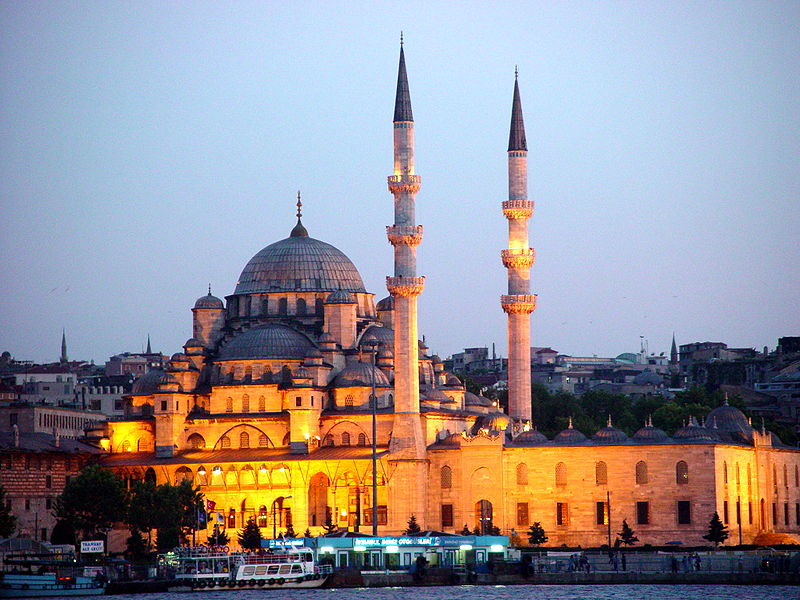
The Yeni Camii or New Mosque, Istanbul.  Photo by Nevit Dilmen/Wikipedia. 
Inside the Yeni Camii.

This was the age of strong and capable royal women - Mary Tudor, Elizabeth Tudor, Mary Queen of Scots, and Catherine de Médicis, to name a few Europeans. They were grudgingly admired and very powerful.  Kudos to these Ottoman women who literally made the most of their lots in life and contributed to the greater good.

***************
Unless otherwise noted, all images courtesy of Wikipedia.
*******************************

Tuesday, May 17, 2011

The Eye of God

Quernado Mountain in San Luis Potosi, Mexico.
Image courtesy Anaroza/Wikipedia.

The Huichol peoples of western Mexico are well-known for their folk art.  When the Spanish conquistadores came across them they adopted one of their crafts, which the Huichol called Sikuli.  Sikuli stands for the concept of viewing and comprehending that which is unknown and unknowable.  What we might call the mystery of the divine.

This one made of Caron yarn.

In Spanish, these art pieces are known as Ojo de Dios, or the eye of God.  They are ritual tools of a culture with deep spiritual beliefs.  The Huichol use peyote to enhance their spiritual experiences but not in a light way.  One has to be instructed and qualified not only to use it, but to even collect it.  They consider peyote a gift from the Gods, and it is revered.

The Ojo de Dios is woven, generally square in shape, made of yarn woven onto a cross of wooden sticks.  The yarn is handspun and dyed with various types of berries, flowers, and other natural materials.  Original ones are very rare, but many are made for the tourist market.  These, of course, do not carry the same spiritual significance.

These were made by schoolchildren.

The originals are focal points which are used to concentrate energy.  They are also one of the objects known as a nierika, which comes from the root word nieriya, to see.  Thus it is a picture or appearance, a sacred representation.  A nierika is a metaphysical vision, an aspect of a god or an ancestor.  Natives who received guidance from a god or ancestor who appeared before them saw visions so intense and overwhelming that only the eye could be seen.  It is a representation of that eye that is created on an Ojo de Dios.

Image courtesy of craftypod, which has instructions for making them.

They also functioned as metaphoric shields, protecting against distractions or temptations along the spiritual path.  They additionally are portals that facilitate the entry into other states of consciousness or the spiritual world.  Portals that allow humans and gods or ancestors to perceive each other.

A specific type of Ojo de Dios is crafted to protect children.  When a child is born, the central eye is woven by the father.  Each year, for five years, it is added to.  This object is well-guarded throughout the person's life and functions as a talisman of spiritual protection and well-being.  It may be used by the person his/herself or by a shaman for healing or other rituals.

The four points represent the elements:  earth, fire, air, and water.  There is a significance to the color of yarns used in traditional ones.  Red is for life; yellow for the heavens; blue is both sky and water; brown signifies the soil of the earth; green stands for vegetation; and black means death.

Image courtesy of the Kansas City, Kansas Public Library.

Today they are meant as talismans of good luck and protection, and their use has spread all over the world.  Since modern ones are inexpensively and easily made, they are a favorite classroom project.  An ancient art, modernized by interaction with the outside world, what Ojo de Dios has lost in intrinsic meaning it has gained in popularity.

***************

Monday, May 16, 2011

The Writers' Workshop

Dey House, home of the University of Iowa's Writers' Workshop.
Photo courtesy of tjilafave, 2008.

What do Flannery O'Connor, John Irving, Jane Smiley, and W.P. Kinsella have in common?  They are all graduates of the University of Iowa Writers' Workshop, the first creative writing degree program in the United States, and the gold standard for writing programs.  Alumni have won seventeen Pulitzer Prizes, numerous National Book Awards, and other literary honors.  Three graduates from the Graduate Poetry Workshops have become U.S. Poet Laureates.  In 2003, the Workshop received a National Humanities Medal from the National Endowment for the Humanities - the first awarded to a university and the second awarded to an institution (as opposed to an individual).

National Humanities Medal signed by George W. Bush.

The two-year residency program has no textbooks, no grades, and admission is not based on GPAs.  One just has to show more promise than the other hundreds of applicants to be accepted in either the Graduate Fiction or Graduate Poetry Workshops.  When the program has been successfully completed, which entails the submission of a creative thesis (novel, story collection, or poetry collection), one will graduate with an MFA in English.  This degree will allow the graduate to teach creative writing at the college level, as well as serve as a proud affirmation of hard work well done.

Frank Conroy and Marilynne Robinson with students.
Photo courtesy of Tom Jorgensen, 2003.

The Program requires students to take a small number of classes each semester, including the Graduate Fiction or Graduate Poetry Workshop, and one or two additional literature seminars.  The Graduate Workshops meet once a week for three hours.  Some students submit their work for their peers to read prior to the meeting.  The class is a round-table discussion, and the students and instructor offer their thoughts and observations about each piece.  This allows the writers to get feedback on their strong points and shortcomings, and in turn the other students are able to observe each others' processes and learn about developing as a writer.

The Program agrees that writing cannot be taught per se but believes that talent can be developed, therefore they see the Program role as one of encouragement.  To this end, they provide access to established poets and writers.  Obviously, their program works, and works well.

Writers' Workshop staff Dave Pryce Jones, R. V. Cassill, Robert Williams, Richard Yates,
Paul Engle, Mark Strand, Eugene K. Garber, George Starbuck, Frederic Will in the mid-1960s.

The first creative writing class was offered in the spring semester of 1897. Twenty-five years later, in 1922, the dean of the Graduate College announced that UI would accept creative work as theses for advanced degrees.  The School of Letters offered regular writing courses with selected students who were tutored by writers in residence as well as visiting writers.   Officially founded in 1936, this year the Program celebrates their 75th anniversary.  Among the many special events to celebrate this anniversary will be a reunion June 9 - 12.


This has been a few exceptional years for Iowa as far as reading, writing, and literature go.  In 2008, Iowa was selected by UNESCO as a City of Literature.  The Creative Cities Network was established at the end of 2004 to promote social, economic, and cultural growth of cities around the world by recognizing their contributions in the fields of literature, film, music, design, folk art and crafts, media arts, and gastronomy.  The cities that are chosen promote creativity locally and with wider audiences, and offer new opportunities to develop creative productions.  The Writers' Workshop and its impressive history is arguably the core of the city.

Additionally, another coup has taken place.  Dr. Alphabet (writer Dave Morice) recently completed a 100 volume work of 10,119 pages in 100 days, the Poetry City Marathon.  (Full text here.)  This was in recognition of the City of Literature honor.  The final text was printed out by Bu Wilson and bound by Bill Voss of the UI Library Preservation Department.  The binding measures 8-1/2 x 11 x 24 inches.  Nancy Kraft, head of the Preservation Department, said it took 24 hours to bind, spread out over four days with half a day spent in making a small press to put the pages together.

The creators are considering submitting this to the Guinness
Book of World Records as the world's thickest book.

The book had to be assembled into small units then bound using the special press.  Making and attaching the cover was challenging, as the binding and cover must be both strong and flexible.  Obviously the book needs support while being read, and this is done by placing blocks under the "shorter" side, which are adjusted as the reading continues.

Check out this site for a slide show and explanation of the binding process.

The Hawkeye state has a lot going on, and literature is definitely one of their "prize" offerings.  Here's to another 75 years of excellence for the Writers' Workshop!
****************
Images courtesy the University of Iowa website.
For a very good article from 2007 assessing the top graduate writing programs
click here.
********************************

Saturday, May 14, 2011

The Ups and Downs of Alma-Tadema

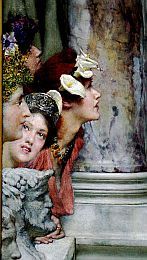
Spring, 1894, depicts the servants of the Temple of Flora
celebrating the Roman festival of Cerealia.  This
painting took four years to complete, and features
 members of his family, friends, and fellow artists.
Image courtesy of the Getty.

Contrary to most artists, the story of Sir Lawrence Alma-Tadema is not an angst-filled drama of unappreciative hard work, poverty, and obscurity.  During his lifetime he was arguably the most successful artist of the Victorian era.  His paintings of elegant people - "Victorians in togas", as one critic suggested - languidly posed in gorgeous classical settings appealed to the zeitgeist of Victorian times.  He was a Dutch ex-pat in Britain painting ancient Greece and Rome.

Detail from Spring.

Lourens Alma Tadema was born in the Netherlands.  His family intended for him to be a lawyer, but at age fifteen he suffered a physical and mental breakdown.  He was given a short time to live, and so was allowed to spend this time at leisure, drawing and painting.  He weaned himself back to health and decided to become an artist.  (Note:  he later anglicized his first name to Lawrence, and hyphenated his middle and last names so he would appear early in any alphabetized lists.  His last name rhymed with "had'em a", which was part of a verse tribute to him.)  In 1852 he entered the Royal Academy of Antwerp in Belgium and studied early Dutch and Flemish art.  In his four years there as a student he won several awards. He later became a studio assistant to one of his instructors who encouraged him to display historical accuracy in his paintings, for which he became famous.  He shared lodging in the home of an archaeologist, which fostered his interest in that subject, and was friends with an Egyptologist which furthered his interest.

Sir Lawrence Alma-Tadema, 19th Century, photographer and date unknown.
Image courtesy of PreteristArchive.com.

He then started working with another highly regarded artist in Belgium, and painted his first major work in 1861.  The Education of the Children of Clovis started his fame and reputation as it was a hit with artists and critics alike.  In fact, it was so highly regarded that it was bought and given to King Leopold of Belgium.  His main interest was in the Merovingians (rulers of Gaul from the 6th to 8th centuries).  But after a trip to London he was inspired by the so-called "Elgin Marbles" (forgive me but I am half-Greek and wish to see them returned - they never belonged to Elgin) and the Egyptian artifacts in the British Museum.

The Education of the Children of Clovis, 1861.
Image courtesy of Wikipedia.

He married in 1863 and honeymooned in Italy.  This piqued his interest in ancient Greece and Rome,  especially after visiting Pompeii.  He returned in 1876 and rented a studio in Rome, and returned again in 1883.  From all his trips he amassed a huge collection of photos and archival material for use in future paintings.  He even went to the quarry where Cararra marble is from (one of his early teachers told him his marble looked like cheese) to learn to convey its distinctive look and texture.  He studied classical architecture, studied and painted marble to depict it perfectly (he was called in Punch magazine  "the marbelous painter").  Later he even designed furniture, mostly Pompeiian or Egyptian in style, which he used in his paintings.  He even designed women's clothing.

The Triumph of Titus, 1885.  Image courtesy of PreteristArchive.com.

In 1864 he met Ernest Gambart who was the most influential art dealer and print publisher of the time.  Alma-Tadema moved to London, where he spent the rest of his life.  He met and friended many of the Pre-Raphaelite painters, and they influenced his work.  He was an excellent businessman, and one of the wealthiest artists of the 19th century.  He received many awards in his lifetime, and was knighted in 1899.  He was the eighth artist from "the continent" to be knighted.

Silver Favourites, 1903.  Image courtesy of Wikipedia.

There is little action in his paintings, although one can see the fine execution of the old Dutch masters in his work.  He was a perfectionist, and repeatedly reworked his paintings until he was satisfied (hence the four years it took to paint Spring.) The rose petals and flowers are from live ones - he would hurry to paint them before they withered.  His archaeological research paid off.  If one studies the architecture of the buildings in his paintings, one can see the meticulous design - any one of them could be built by ancient Romans using Roman tools, methods, and materials.  As a matter of fact, his paintings were (and are) used as source material for Hollywood productions, such as Ben Hur, Cleopatra, and the Ten Commandments.  They are still used by set designers - as recently as 2005 they were used for the Chronicles of Narnia:  The Lion, the Witch, and the Wardrobe.


Egyptian Chess Players, 1879.  Image courtesy of Wikipedia.

He is distinctive for portraying "everyday" life from classical times, and not mythology, legends, and seldom famous figures.  Every detail in his paintings is exact and correct, from marble to metals, however his people lack "soul".  They are not differentiated in his paintings, and function as if they were objects.  While his contemporaries produced genre paintings with historical dress and allegorical themes, Alma-Tadema held that art should elevate and not teach, so he never intended any social or moral lessons.

The Roses of Heliogabalus, 1888.  Image courtesy of PreteristArchive.com.

Although in his heyday he was financially successful, in the early 1920s Victorian art in general saw a huge collapse in prices.  This devaluation lasted some forty years.  Alma-Tadema's paintings were denounced, he was declared "the worst painter of the 19th century" by John Ruskin, the curmudgeon, who never liked Alma-Tadema's work (early on, Ruskin commented on one painting, "the general effect was exactly like a microscopic view of a small detachment of black-beetles, in search of a dead rat").

A Favourite Custom, 1909.  Image courtesy of the Tate Gallery, London.

After being relegated to virtual obscurity, his paintings caught the eye of one man. Allan Funt, famous for his Candid Camera television show, had a B.A. from Cornell in fine arts from 1934.  He starting buying Alma-Tadema when the artist's reputation was at its lowest.  Within a few years, he had bought some 35 works. However, he was forced to sell them due to financial difficulties.  He sold them just before the prices shot up, and shoot up they did.  The painting called The Finding of Moses in 1960 was put on sale by the Newman Gallery, and didn't even meet the reserve when it sold for £252.  The initial purchase had been £5,250 after completion.  It sold for £861 in 1935, and £265 in 1942.  After Funt sold his collection at Sotheby's in London in 1973, interest in Alma-Tadema renewed.  That same painting was auctioned at Christies in New York for £1.75 million in 1995. Last November it sold for $35,922,500 to an anonymous bidder at Sotheby's in New York.  This is the highest price paid for Alma-Tadema and for a Victorian painting.

The Finding of Moses, 1904.
Image courtesy of Wikipedia.

Although he had intended to be buried with his second wife who pre-deceased him, he is buried in a crypt in St. Paul's cathedral in London, as befits a highly-honored individual.  The recipient of numerous awards and honors, he enjoyed a life of wealth, popularity, and the pursuit of his interests.  A life like that is uncommon, especially for an artist.  I salute the successful life of art, history, archaeology, and wealth!

Friday, May 13, 2011

The Tree Cathedral


Giuliano Mauri was a unique artist.  An advocate of natural architecture, he constructed large-scale outdoor works of environmental art.  Because he used organic materials, these structures were temporary.  He loved outdoor spaces, where he came up with the concept of living cathedrals, using trees for the walls and roofs.


Although he planned and developed many sites, the Tree Cathedral near the northern Italian city of Bergamo is a posthumus memorial to him.  The work was completed by a skilled team led by Mauri's son, Robert, under the artistic direction of Paola Tognon.  It was built in a quiet glade surrounded by tall trees.  


It consists of 42 columns that form a basilica with five aisles.  Poles of fir and 600 branches from chestnut trees and 66,000 meters of hazel branches were woven together with string and nails, forming a support structure for 42 beech trees that were planted.  As the beech trees grow, they will form natural columns.  As the support structure deteriorates, the trees will have grown to replace it.
  

The Cathedral covers 650 square meters, and is more than 90 feet long, 80 feet wide, and ranges in height from 16 to 70 feet.  Once the beeches overtake the structure, it will be open and passable in many directions.  The Cathedral was inaugurated on September 6, 2010.  It is a tribute to Bergamo's observance to the International Year of Biodiversity, as well as a tribute to Mauri.
  

Mauri was born in 1938 in Lodi Vecchio.  By the end of the 60s he became involved with avant garde art movements in Italy.  By the 70s he was doing performance art, showing his video and photographic performances in various galleries.  In 1976 he participated in the Venice Biennale, in 1992 the Milan Triennale, and in 1994 the Biennale di Penne.  He died in 2009 at the age of 71.
  

There are plans to use the Cathedral as a natural backdrop for various events, as well as a resting place for local educational and training sessions.  Now this is my idea of a cathedral!

***************
Images courtesy of Arte Sella. 
*******************************

Wednesday, May 11, 2011

Mary and Mary, Quite Contrary

Mary Wollstonecraft, circa 1797 by John Opie.
Oil on canvas, image courtesy the National Portrait Gallery, London.

Mary Wollstonecraft (1759-1797) is one of those women whose personal life vastly overshadowed, in fact practically buried, her work, although her personal life would have been ignored had she been male.  This British woman was a writer, philosopher, and early advocate for women's rights.  Her writings included novels, treatises, a travel book, a history of the French revolution, a conduct book, and a children's book.  When she died she left behind several unfinished manuscripts.

She grew up in a household with an abusive father who squandered money; she always attempted to protect her mother and sisters.  She tended to fixate on other people, and in her youth that was a friend whose family she found solace in, with an intellectual environment she thrived in.  She left her home to be a lady's companion to a widow in Bath, but it did not work out well.  When she was called home to tend to her dying mother, she did not return to that position.  In order to earn a living, she set up a school with her sisters and a friend in Newington Green, which was a dissenting community (where Christians who advocated separating from the Church of England lived).  Her friend married and moved to Europe because of her poor health.  Mary followed to tend her, but her friend died.  Mary's abandonment of the school caused it to fail, as well.

Frontispiece to the 1791 edition of
Original Stores From Real Life, engraved
by William Blake, courtesy of Wikipedia.

Her friends helped arrange a position as a governess to the daughters of a family in Ireland, and though she did not get along well with the mother, she did with the girls.  From these experiences came her first book and only children's one, Original Stories from Real Life (1788).  Frustrated by the limited career choices for women, she decided to write, telling her sister that she wanted to be "the first of a new genus" of women who supported themselves through their writing.  She learned French and German and translated texts.  She also wrote reviews of novels for the Analytical Review.  She met many famous people, Thomas Paine for one, including William Godwin.  Godwin was a British journalist, novelist and political philosopher, and one of the forefathers of anarchism.

Wollstonecraft fell in love with a married artist, and even suggested that she live with him and his wife platonically, but his wife was appalled.  Humiliated, she went to France where she found the intellectual atmosphere of the French revolution stimulating.  She had become well-known for having written A Vindication of the Rights of Men (1790) and A Vindication of the Rights of Woman (1792).  In France she met and fell in love with Gilbert Imlay, an American who was diplomatic representative of the U.S. government in France. She became pregnant and delivered a daughter, Fanny.  When Britain declared war on France, Imlay registered her as his wife to protect her, even though they never married.  Upon leaving France she continued to use the name "Mrs. Imlay" for her daughter's sake.  Imlay left her, and she attempted to commit suicide with laudanum, but he saved her.  She tried suicide once more by jumping into the Thames but was saved again, this time by a passerby.


Title page from the 2nd American edition, 1792.
Image courtesy of the LOC.

Eventually she returned to her prior circle of friends, including William Godwin. This time they fell madly in love, and she became pregnant again.  They decided to marry so their daughter would be legitimate, but in doing so it was revealed she was never married to Imlay, and both suffered for this breach of social mores. Godwin suffered further criticism because he'd written favorably toward the abolition of marriage.  In 1797, after the birth of a second daughter, Mary died of septicemia. Godwin was devastated, and in an attempt to honor the woman he loved, he wrote Memoirs of the Author of A Vindication of the Rights of Woman.  Although his intentions were sincere, his honest portrayal of the intimacies of her life - love affairs, suicide attempts, illegitimate children - shocked their friends and his readers.

William Godwin, 1802, oil on canvas by James Northcote.
Image courtesy of the National Portrait Gallery, London.

The Memoirs had a devastating effect on Wollstonecraft's reputation, and the consensus was that no dignified woman would stoop so low as to read her work. Women writers turned her into a cautionary tale, and while people read about her, they did not read her.  Among the few who did read her work were Elizabeth Barrett Browning, Lucretia Mott, George Elliot, and Margaret Fuller.  She was reincarnated when women's voting rights became an issue, and adopted by the Suffragists.  But most of her work was still ignored, due to her "scandalous" lifestyle.  It wasn't until the feminist criticism of the 1960s and 1970s that her work was widely read.  She is now considered a pioneering feminist thinker.

1798 second revised edition of the Memoirs.
Image courtesy of Wikipedia.

While her work was being suppressed, her second daughter, also named Mary (1797-1851), was being raised by Godwin to admire her mother's work and to think liberally. One of her father's friends was a married poet and philosopher, Percy Bysshe Shelley.  When she was 17 she became involved with him romantically.  She went to Europe with him and when they came back she was pregnant.  They were ostracized.  They also were in debt, and grieving over the death of their premature daughter.  Shelley's wife committed suicide, and they married shortly after.  Mary was pregnant again, and they were trying to get custody of Shelley's children from his first marriage.

Mary Shelley, nee Mary Wollstonecraft Godwin, by Richard Rothwell,
1840.  Image courtesy of the National Portrait Gallery, London.

In 1816, after their marriage, they spent the summer with Lord Byron, Mary's half-sister, and some friends at a lake in Switzerland.  They were confined indoors because of the rain, and spent time discussing the experiments of Erasmus Darwin (grandfather of Charles), who was said to have reanimated dead matter.  This lead to conversations about returning body parts or a corpse back to life.  They also read each other German ghost stories.  Byron came up with the idea that they each write a supernatural tale.  Mary wrote what she intended to be a short story, but Shelley encouraged her to develop it into a novel.  Frankenstein was published in 1818. She claimed that summer was the moment "when I first stepped out from childhood into life."

Draft of Frankenstein, 1816.
Image courtesy of Oxford.

To escape creditors and in fear of legally losing their children, they moved to Italy that year.  Their second and third children also died, but a fourth was born.  In 1822, Shelley died when his sailboat sank in a storm.  A year later Mary returned to Britain to raise their son and write.  She died of a brain tumor at the age of 53.

Frontispiece to the 1831 Frankenstein illustrated by Theodor von Holst.
Image courtesy of the Tate, London.

Although she had a prolific career as a writer she is mostly thought of as a one-novel writer.  Like her mother, her works were ignored and out of print until the 1970s.  Studies show that she remained a political radical all her life, arguing that cooperation and sympathy, especially the sympathy of women within their families, were the ways to reform society.  Her education may not have been what her mother would have wanted for her, but it was unusual and advanced for a woman of that time.  Literary scholars now consider her to be a major Romantic figure, both for her writings and her liberal politics.

Percy Bysshe Shelley, 1819, by Alfred Clint.
Image courtesy the National Portrait Gallery, London.

Both women were remarkable thinkers and writers.  They were ahead of their time. Instead of being judged for their intellect and capabilities, they were known for their personal lifestyle choices, which, frankly, was no one's business then or now. We know of the work of male writers and philosophers, and if we know of their personal lives and sexual habits it is titillating at worst.  But women?  Women have been constantly assessed through their sexual activities, rather than their mental ones.  And so it goes.

***************