WELCOME TO CEREBRAL BOINKFEST!

WELCOME TO CEREBRAL BOINKFEST!

A blog about the arts, books, flora and fauna, vittles, and whatever comes to mind!

Note: Comments are moderated. If you include a link, your comment will not be published. As you will note, I do not accept ads on my website and that includes in comments.


Showing posts with label Japan. Show all posts

Monday, September 5, 2011

Japan and the Oldest Companies in the World

Money!  Image courtesy of Wikipedia.

The Tokyo Shoko Research, a Japanese survey firm, searched their database of 1,975,620 companies to see which ones have lasted for a century.  They found 21,666 companies that have.  To be on the list, a company's name or brand must remain, at least in part, since its beginning.  Any changes to their name must be verifiable.

"Onigawara" a depiction of evil by potter Seishichio Sumikawa, circa 1775.
It serves as a guardian protecting guests in the Hoshi Ryokan - one of the oldest.

A similar survey conducted by the Bank of Korea found 3,146 companies that are over 200 years old in Japan, 837 in Germany, 222 in the Netherlands, and 196 in France.  The oldest companies go back almost 1,300 years, and 89.4% of all the companies older than a century employ 300 people or less.  There's a lesson here on sustainability for big businesses.  Only one in five businesses started today will last five years.

Traditional breakfast at a ryokan.  Three of the oldest companies in the
world are ryokans.  Image courtesy of Wikipedia.

Kongō Gumi Company Limited, a Japanese firm specializing in building temples, was the world's oldest continually operating family business until it was purchased by Takamatsu Corporation in 2006.  At the time of the takeover, it had over 100 employees, but due to heavy investments in real estate, the subsequent bubble economy bursting, and the fact that fewer temples are being built, its debt was insurmountable.

Kongō Gumi in 1930.  Image courtesy of Wikipedia.

Still, it had an amazingly long run, starting in 578 CE, when an engineer hired by Prince Shōtoku to build a Buddhist temple decided to start his own business.  The firm had a hand in building many famous buildings, including Osaka Castle. There is a ten-foot 17th century scroll that traces 40 generations from the company's beginnings.  Its last president was Masakazu Kongo, the 40th member of the family to lead the firm.  One of the things contributing to its long success, according to him, was not strictly following the principle of primogeniture.  Rather than the oldest son inheriting the business, the best person was selected.  In at least one case, the 38th president, the best person was a woman, Masakazu's grandmother.

Osaka Castle.  Image courtesy of Wikipedia.

Out of the current top ten oldest companies in the world, six are in Japan.  Three of those are hotels.  In particular they are ryokan - traditional inns that served travelers on the nation's highways.  They are seldom found in cities, and became popular in the Edo period (1603-1868).  They are usually found in scenic areas and tend to be a bit pricey.  The Kyoto-based Ikenobo Kadokai is sometimes listed as the second oldest company, but it is an association promoting ikebana, Japanese flower arranging, with chapters all over the world, rather than a company.  It did begin in 587 CE, however with classes.

Exhibition of ikebana in a Kyoto subway station.  Image courtesy of Wikipedia.

Of the three ryokans, one began in the year 705 CE, and the other two in 717 CE. Nissiyama Onsen Keiunkan, founded in 705, is in the Guinness Book of World Records as the oldest hotel in the world.  Located in Hayakawa, Yamanashi Prefecture, after the Guinness achievement was awarded in February it was expected that Keiunkan would have a huge increase in guests.  Unfortunately, the great Japanese earthquake of March 11th resulted in cancellations.

Nishiyama Onsen Keiunkan - the world's oldest hotel and company.

Keiunkan is said to have been founded by Fujiwara Mahito, son of Fujiwara Kamatari, an aide to Emperor Tenji in the late 600s.  Some parts of the complex remain unchanged since the hotel was first built.  There is a hot spring there that was dug in 2005, almost a mile underground. It provides 430.5 gallons of 125.6 degrees F water every minute.  Keiunkan executives hope to pick up another Guinness world record for the hot spring with the largest volume of water.

Keiunkan's hot spring.

Hoshi Ryokan, in the Awazu Onsen area of Komatsu, Ishikawa Prefecture, was founded in 717 CE.  It was the previous record holder in Guinness for oldest hotel. Founded by a Buddhist disciple whose master dreamed of the spring's location, it has been run by the same family for 46 generations.  The legend is that Taicho Daishi, the great Buddhist teacher, hiked up to the top of sacred Mount Hakusan. While he was asleep the mountain deity appeared to him and told him of an underground hot spring with restorative powers.  The deity urged him to unearth the hot springs for the people of the nearby village.

Hoshi at night, courtesy of their website.

He went to the village of Awazu, uncovered the hot spring, and some of the locals who were unwell were immediately cured when they used it.  He instructed his disciple, Garyo Hōshi, to build a spa business there.  Some 1300 years later, and Hōshi's family is still running it.  As people with illnesses visited the spa, they made donations.  These funds were used for expansion, which grew as the number of visitors increased.  The ryokan now has 100 guest rooms, two indoor hot springs, and two outdoor ones.

One of the spas at Hoshi, also courtesy of their website.

Sennen-no Yu Koman is another ryokan that began in 717 CE.  It is in Toyooka, Hongo Prefecture.  It is in the center of a well-known onsen (hot springs) area. There are two types of hot springs.  There is also a private one, and one of the guest rooms has an open-air hot spring.

Sennen-no Yu Koman.  Image courtesy of www.japanhotel.net.

One of the lessons from these ongoing, very long-term businesses is first of all to pick a stable industry.  Construction is always a needed enterprise.  Inns and hotels have been necessary for travelers and therefore an indispensable business endeavor as well.  Japanese companies also tend to put their employees and their well-being first, ahead of concern for any shareholders.  Team spirit is legendary, and companies function as a social organization, similar to a family.  Of course, if it was easy, there would be many more businesses with such long histories.

***************

Thursday, August 4, 2011

Legislating Paternity in Japan

Painting of the haibutsu kishaku from 1907 showing temple bells being
smelted for the bronze.

The feudal era of Japan ended abruptly when the Tokugawa shogunate was usurped by the Meiji Restoration around 1867.  Thus began a haibutsu kishaku, which literally means "abolish Buddhism and destroy Shākyamuni", an anti-Buddhist movement where Buddhist temples, images, and texts were destroyed, and monks were defrocked and forced to return to a secular life.  This occurred with the rise of industrialization and westernization, and any valuable objects that evaded destruction were exported.

Detail of an eleven-faced Buddha (ekadaza mukha) image from the Heian period (9th century)
made of wood from a temple in Fujidera, Osaka, Japan, now a National Treasure.

In 1871, a decree was issued to protect Japanese antiquities, called the Plan for the Preservation of Ancient Artifacts, instigated by the universities.  Prefectures, and the temples and shrines left, were ordered to make lists of important buildings and arts.  This had little effect, but nine years later the government allotted funds for the preservation of ancient shrines and temples.  Fortunately, Japan was a quick learner, and in the wake of westernization perceived the idea of paternity.  Soon the first Japanese books on architecture and art were published.

Himiji Castle, Himeji, Hyogo Prefecture, Japan.  Made a National Treasure in 1931.

The Ancient Temples and Shrines Preservation Law was passed in June of 1897, calling for the preservation of historic art and architecture.  A second law was passed in December of 1897 designating works of art as "National Treasures", and religious architecture to be designated as "Specially Protected Buildings".  The categories at first included paintings, sculptures, calligraphy, books, and handicrafts, but later swords were added.  This law only protected items held in religious institutions; those in private hands were unprotected.  Private collections were required to be registered with the newly created museums, who had first option in future sales.

Circa 1330 document with Priest Mongaku's 45 article rules and regulations.

This was the foundation for the preservations laws of today.  When first enacted only England, France, Greece, and a few other European nations had done something similar.  Prominent men lobbied for conservation efforts, which resulted in the Historical Sites, Places of Scenic Beauty, and Natural Monuments Preservation Law of 1919, offering these properties the same protection as architecture and artifacts.

Akasaka Palace, the former imperial residence, is today the "State Guesthouse" for
visiting dignitaries.  It is the first 20th century building made a National Treasure.

In 1929 the National Treasures Preservation Law was passed, replacing the 1897 laws, and extending protection to items owned by private hands and public institutions, and widening the scope to secular buildings.  The designation of "National Treasure" was to be applied to these historical buildings and art, and permission was required for any alterations.  By 1933, facing the Great Depression and in an effort to protect objects not designated  National Treasures, a new law was passed - the Law Regarding the Preservation of Important Works of Fine Arts. This offered temporary protection, but more importantly prevented objects from exportation.

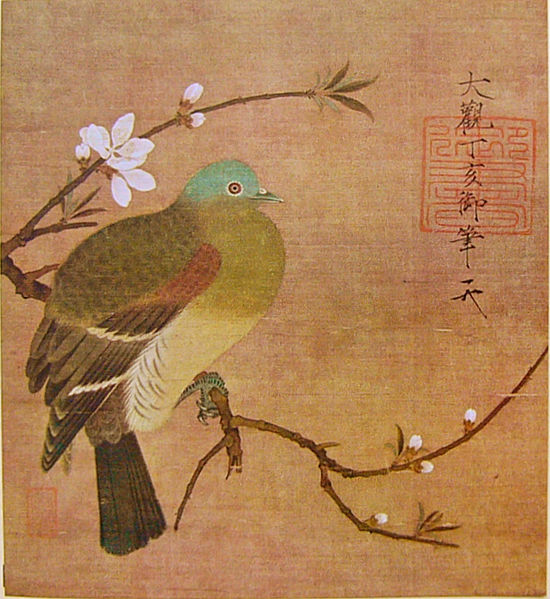
Pigeon on a peach branch, color on silk mounted on a hanging scroll,
by Emperor Huizong of Song Northern Dynasty, circa 1108. 

During WWII, 206 designated buildings were destroyed.  When the kon-dō of Hōroyū-ji, one of the oldest wood structures, dated circa 700, caught fire 7th century wall paintings were damaged.  This resulted in the Law for the Protection of Cultural Properties of 1950.  This combined all the previous laws and expanded coverage to "intangible cultural properties" such as performing arts, as well as folk arts, widely broadening what properties were covered.

Kon-dō and the five-storied pagoda at Hōryū-ji are two of the world's oldest
wooden structures, circa 700.  Located in Ikaruga, Nara prefecture.

Two standards were established:  Important Cultural Property and National Treasure.  Something becomes a National Treasure only if it is outstanding or has a high value in world culture.  Previous National Treasures were demoted to Important Cultural Property, although some were returned to National Treasure status.  Any property nominated as a World Heritage Site by UNESCO is required to be protected.

The Yomikaki Power Station in Nagano Prefecture is an Important Cultural Property.

While the Law for the Protection of Cultural Properties is still in force, there have been supplements.  The Law for the Preservation of Ancient Capitals was added in 1966, restricted to areas where there are a large number of National Treasures.  In 1975 the law was amended to include groups of historic buildings not in capitals. This law also protected conservation techniques, necessary due to the lack of skilled craftsmen in traditional techniques.

Buddhist ritual gong stand with bronze gilt from Nara.
Placed in 734 CE in the Western Golden Hall.  Lost and
reproduced in the late 12th/early 13th century.

An additional standard was added in 1996 for items in need of preservation called Registered Cultural Property.  This is sort of a waiting list for Important Cultural Properties.  This gives owners less responsibilities.  Owners are typically provided with advice on restoration and on public display.

Pair of two folded screens made of paper covered with gold leaves, drawings of
colors and ink of the Wind God and the Thunder God, 17th c. in Kyoto National Museum.

Although it is not mentioned by law, there is an informal reference to individuals who are certified as Preservers of Important Intangible Cultural Properties, or Living National Treasure.  These are people who have certain artistic skills and have attained a high level of mastery in those skills.  The Japanese government provides an annual grant (roughly $26,000 at this time).  In the case of groups with this designation, the government helps with the costs of public exhibitions and activities.  There are two basic categories:  performing arts - Gagku, Noh, Bunraku, Kabuki, Kumi Odori, Music, Dance, and Drama; and crafts - ceramics, textiles, lacquerware, metalworking, dollmaking, woodworking, papermaking, and miscellaneous crafts.

"A Fat Young Sparrow" woodcarving with kirikane decoration by Living
National Treasure Nichide Daizo, 1988.  Image courtesy of this site.

Other countries have a Living National Treasure designation for people or groups, following Japan including Australia, France, the Phillipines, Romania, South Korea, and Thailand.  UNESCO set forth some guidelines for supporting these programs.

Feminist writer Germaine Greer is one of Australia's Living Treasures.

Notice that the U.S. is not one of them.  The protection of cultural property should be attended to by all nations.  People who have a mastery of traditional skills should be honored and treasured.  History belongs to us all, and extant artifacts and buildings should be valued and made available to all interested parties, regardless of nationality.  Kudos to Japan for such a comprehensive program!

***************
Unless otherwise noted, images courtesy of Wikipedia.
*******************************