|
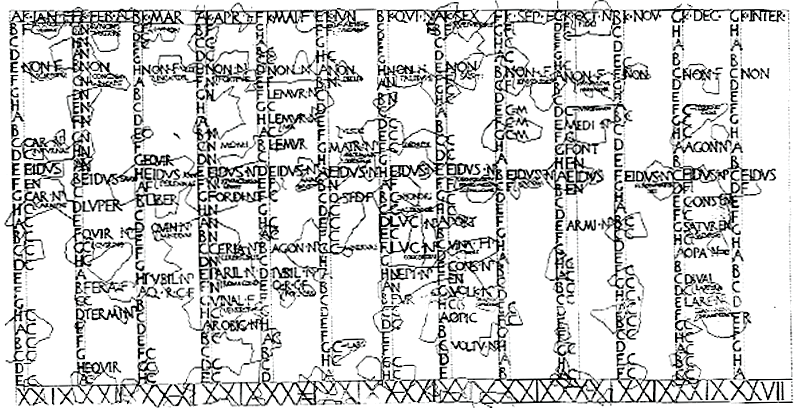
| Fasti Antiates Maiores, part of a fresco found at Nero's villa at Antium, shows a pre-Julian calendar with the months Quintilis (QVI) and Sextilius (SEX). |
Before the Julian calendar was introduced in 46 BCE, the Roman calendar was in use. One of the versions of the Roman calendar was supposedly invented by Romulus, legendary founder of Rome, and had ten months with 30 or 31 days in each month, for a total of 304 days: Martius, Aprilis, Maius, Iunius, Quintilis, Sextilis, September, October, November, December. This was "fixed" by Numa Pomilius, the king of Rome who succeeded Romulus. He added Ianuarius and Februarius for a total of 12 months and another 57 days, which totaled 355 days. This was a lunar calendar, but to align the calendar with the solar year a leap month - Mercedonius - was added from time to time in the middle of February, resulting in a year that was 377 or 378 days long.
 |
| Fasti were chronological or calendar-based lists of sanctioned events. Derived from the word fas, meaning what is allowed. The word came to denote lists organized by time. This example is a fragment of a Roman calendar in the Museo Epigrafico, Rome. |
Intercalation is the insertion of a leap year, month, or day into a calendar to adjust its length so that it follows a solar year or the moon phases. In the traditional leap year for some countries in the West which follow the Gregorian calendar, a day is added every four years. This is because this calendar is a solar calendar which has 365.24 days. Thus the extra day every four years helps us "catch up". This extra day is added to the end of February and is an intercalary day. Mercedonius was an intercalary month in the Roman calendar, but was not added on a scheduled basis.
 |
| Image courtesy of Facebook's The Loyal Society of the Most Noble Order of Mercedonius. |
Mercedonius comes from the Latin word merx, for which one meaning is wages (where "mercenary" also derives from), since it occurred at the time of year when workers were paid. The decision to add the month to a year was made by the Pontifex Maximus, the high priest of the Collegium of Pontiffs in ancient Rome. This group and office were also founded by Numa Pompilius, and were thought to originally act as advisors to the king on religious matters. They had control over religious rites, funds, institutions, and the instruction of religion. But their real power came when the monarchy of Rome was abolished, and those sacral duties of the former king were given to the Pontifex Maximus. His greatest power was administering divine law - divine law as interpreted by the Collegium.
 |
| Augustus as Pontifex Maximus, circa last decade of 1st century CE. |
So the Pontifices became politicians, and the office was often held by statesmen. Since one of their duties was to regulate the calendar, and since a magistrate's term of office corresponded with a calendar year, this became a convenient political tool. When one of his allies was in power the Pontifex could lengthen the year; when his opponents were in power he could refrain from lengthening it and effectively force them out of office. It also affected contracts and other legal arrangements. Since it was often decided late to add Mercedonius, this caused the people, especially those outside of Rome, to not know the date. Eventually the years became very much out of sync with the seasons. For example, Julius Caesar's crossing of the Rubicon on January 10 in 49 BCE, was actually in mid-autumn. This abuse of power over the calendar led to the calendar being so out of alignment with the solar year that the vernal equinox occurred three months later, in June instead of March.
 |
| The Tusculum Portrait of Julius Caesar, possibly the only surviving bust made during his lifetime. |
The last years of the pre-Julian calendar are known as the "years of confusion" because the calendar was so out of alignment and there seemed to be no rhyme or reason to it. Mercedonius was eliminated by Julius Casesar when he introduced the Julian calendar, which remained aligned to the sun without mediation. Finally dates could be assigned to the seasons, which was impossible prior to this time. The Julian calendar gave alternate months beginning, with January, 31 days; the other months 30 days, except for February which had 29 (but every fourth year, 30). He also renamed Quintilis, in honor of himself, Iulius. Augustus followed suit by changing Sextilis to Augustus, but since this day had only 30 days he added an extra one so he would have the same amount of days in his month as Iulius. This required other months to be changed. Later emperors also renamed some of the months after themselves, but these didn't stick.
 |
| Pope Gregory XIII, circa 1570-1585, by Lavinia Fontana. |
Still, the year was not in line with the vernal equinox, as Julius Caesar's astronomer, Sosigenes, calculated the astronomical year to be 11 minutes and 14 seconds longer than it is. Pope Gregory XIII in 1582 made changes so that the real astronomical equinox, which was important as it was used to calculate the date of Easter (determined by the First Council of Nicaea in 325 CE to be the first Sunday after the full moon following the northern hemisphere's vernal equinox), would fall on the right date. One change was in determining leap years. Years that are divisible by four are leap years; century years are leap years only if they are divisible by 400. Pope Gregory XIII was himself motivated to change the calendar not in the interests of making it correct, but to restore the edict for the date of Easter by the Council of Nicaea.
 |
| Illumination of the earth by the sun at the vernal equinox. Illustration made by DNA-webmaster (Wikipedia) with NASA image. |
The Julian and Gregorian calendars are still imperfect, but both are still followed in the West. Politics reigned from the imposition of Mercedonius to assuring the calendar supported the Council of Nicaea's edict. Thankfully, modern politics are more civilized and would never resort to these kind of machinations. ;-)
***************
Unless otherwise noted, images courtesy of Wikipedia.
*******************************