WELCOME TO CEREBRAL BOINKFEST!

WELCOME TO CEREBRAL BOINKFEST!

A blog about the arts, books, flora and fauna, vittles, and whatever comes to mind!

Note: Comments are moderated. If you include a link, your comment will not be published. As you will note, I do not accept ads on my website and that includes in comments.


Showing posts with label Gothic architecture. Show all posts

Friday, October 28, 2011

The Flying Buttress

The flying buttresses of the apse at the Cathedral of Our Lady of Chartres.

A buttress is an architectural element which is built against or projects from a wall which serves to protect or reinforce said wall.  They are common on buildings of certain styles or eras where they counteract the lateral forces from roofs that lack necessary bracing.  In other words, they stop the roof from squashing the walls.

The odd-shaped "walls" that extend from the sides of this church in the
Philippines (building to right) are examples of regular buttresses.

The Durham Cathedral, properly the Cathedral Church of Christ, Blessed Mary the Virgin and St. Cuthbert of Durham, is in northeast England and is the seat of the Anglican Bishop of Durham.  The cathedral was built in 1093, and is considered one of the finest examples of Norman architecture.  It has been designated a UNESCO World Heritage Site.  The cathedral is notable for the flying buttresses over the aisles, which are precursors of the Gothic style of architecture even though the building is considered to be of Romanesque design.  Buttressing made it possible to build taller buildings and open up space.

The quadrant arches in Durham Cathedral carried the
lateral thrust of the stone vault over the aisles, where they
were supported by buttresses.  These were precursors
of the fully-fledged flying buttresses.

The main advantage, which spurred the development of flying buttresses, was that outer walls didn't need to be as massive since the buttresses would relieve them of the burden of the weight of the vault.  This allowed for the wall space to be reduced so windows could be larger and designed with stained glass.  The buttress thus was a vertical masonry block on the outside of the building with an arch that stood in the gap between the buttress and the wall (the "flying" part).  One of the earliest uses of flying buttresses, which still survives, is the Basilica of St. Remi in Reims, dated to circa 1170.

The buttresses at the apse of the Basilica of St. Remi.

These first flying buttresses were unnecessarily heavy, but that much buffering wasn't needed for the loads they were to bear.  Later architects designed them to be slimmer and more refined.


These flying buttresses at the Cathedral of Our Lady
of Amiens, built between 1220 - 1270, are much more
graceful and elegant.

As the Gothic style of architecture continued, the flying buttresses were often embellished with "crockets", as were furniture and metalwork made in the Gothic style.  These were hook-shaped decorative elements that were stylized leaves, flowers, or buds. Aedicules were also a common decorative element.  They were framing devices used to highlight the importance of its contents, and were set into the buttresses.

Crockets on the finials at Sint-Petrus-en-Pauluskerk
in Ostend, Belgium.

Another use for flying buttresses was as an emergency measure to shore up walls in danger of collapsing.  This would often be more practical than rebuilding a wall, especially if it was the only weak part of a building.  Later architects abandoned the use of flying buttresses in favor of thicker walls.

The south wall of Chaddesley Corbett Church, begun in
the 12th century, has an added flying buttress to support
a weaking wall of the south aisle, built in the 14th century.

Flying buttresses are a hallmark of Gothic architecture.  They allowed the construction of taller buildings with soaring interior space.  Since they allowed for bigger windows in the walls, more light could enter the building, making it less gloomy.  It was an innovation that led to the great cathedrals, and some of the most spectacular architecture extant today.

***************
Images courtesy of Wikipedia.
**************************

Friday, January 7, 2011

Gothic Church Is Book Lovers' Paradise

Selexyz Dominicans
Photo courtesy of Etienne Sloun

The people in the photo above are going to church.  Sort of.  They are, in fact, going to MY kind of church - a bookstore in an old Dominican church.  This world-famous bookstore is in Maastricht in the Netherlands.  It has made "best" and "most beautiful" bookstore lists worldwide, and likewise the pictures of it have been well-circulated.  But what is the story behind this old building?

You are about to enter booklovers' heaven.
Photo courtesy of Etienne Sloun

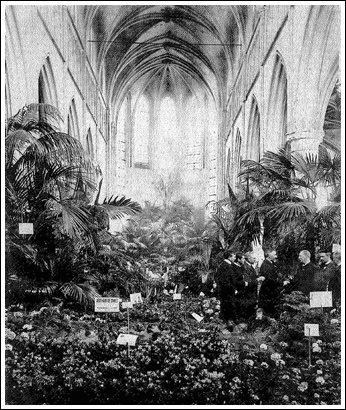
In 1261 the Dominicans were given permission to found a monastery in Maastricht.  They built this church, one of the oldest Gothic churches in the Netherlands, which was consecrated in 1294.  It existed for five centuries until 1794, when the French conquered and annexed the city to the French Republic. This ended the monastery, and the site was used by the French as a parish until 1805.  Then most of the art was removed, and the French used it as a stable for their cavalry.  In the ensuing centuries the building served many purposes, including housing the town's guillotine, as a snake house, a boxing arena, and finally as a parking area for  bicycles.

What the church looked like at one time.
A plant and flower showroom.
As a boxing arena.
As a car showroom.
As a second-hand bookstore.
For bicycle storage.

Enter Selexyz, a large Dutch bookstore chain, who collaborated with the city council to open a new bookstore here.  Designed by Dutch architects Merkx & Girod, a self-standing, two-story structure in black steel was erected for the books, thus keeping the church intact.  This clever arrangement earned the firm the Lensvelt de Architect Interior Prize in 2007 for preserving the landmark.  The juxtaposition between the modern and the old is intriguing.  The book structure is assymetrical, leaving visitors to experience the full height of the church building.

Photo courtesy of Roos Aldershoff
Photo courtesy of Roos Alderhoff
Photo courtesy of Amrit Dhir


This was not a quick nor easy project.  The initial proposal was made in 2002.  In the process of cleaning out the church, bones were found.  This lead to an archaeological investigation as everything had to be photographed and a careful study had to be made.  Once everything was correctly recorded and cataloged, work on the bookstore structure could begin.  The Boekhandel Selexyz Dominicanen was opened in 2006.


Photo courtesy of this site

In the vaults of the church were ancient and severely damaged frescoes, which have been restored.  They are considered exceptional quality for this area of Europe.  Most of these paintings have been dated to around 1619, and are considered the work of Jan Vassens (aka Joannes Vasoens), a 17th century Dominican monk.

Photo courtesy of Amrit Dhir
Photo courtesy of Emile Ramakers
Photo courtesy of this site
Photo courtesy of Arnold den Teuling

The church also has a mural depicting St. Thomas Aquinas (1224-1274), dated to 1337.  It is the oldest image of the saint in Europe.  The mural was covered in white limestone, but in the 19th century Victor Stuers carefully removed the limestone.  Stuers was a Dutch lawyer, politician and civil servant, whose concerns were bent toward preserving Dutch heritage.  Since then the restoration has been painstaking.

Photo courtesy of Amrit Dhir
Photo courtesy of Emile Ramakers

The bookstore also hosts a variety of events, from a poetry reading with a cellist playing, to local performers.  Readings, signings, book launchings, lectures, musical recitals, the church is now alive with creativity.  The walls of the choir exhibit local artists' work.  There are about 120 events per year, which are advertised on their website.  The Coffeelovers cafe is where the high altar once stood, and features a six meter long table in the shape of a cross.


Selexyz Dominicans has an inventory of approximately 50,000 books, many of them in English.  More than 700,000 customers and tourists visit the store per year. A high number of these visitors are Japanese, which is not surprising since their culture seems to value both tradition and innovation.

Great architecture, great art, books, and coffee.  This must be paradise.

***************
All black and white photos displayed here from a book by Emile Ramakers, 
library historian at the Centre Ceramique:
Dominicanen: Geschiedenis van Kerk en Klooster in Maastricht 
(The Dominican:  History of the Church and Monastery in Maastricht)
*******************************