WELCOME TO CEREBRAL BOINKFEST!

WELCOME TO CEREBRAL BOINKFEST!

A blog about the arts, books, flora and fauna, vittles, and whatever comes to mind!

Note: Comments are moderated. If you include a link, your comment will not be published. As you will note, I do not accept ads on my website and that includes in comments.


Showing posts with label Daughter of Time. Show all posts

Friday, March 16, 2012

Mystery Writer Solves Centuries-Old Mystery


Elizabeth Mackintosh, aka Gordon Daviot,
aka Josephine Tey.

Few people have heard of Elizabeth Mackintosh, even those familiar with her work.  She’s a mystery; she’s a writer of mysteries; she’s a mystery writer read by people who don’t like mysteries.  Significantly, she solved a five-hundred-year-old mystery.  Playwright and author, she died in 1952 at the age of fifty-five.  Born and raised in Iverness, Scotland, Mackintosh was trained as a physical training instructress, and taught for eight years at various schools in Scotland and England.  When her mother died she quit to stay and take care of her invalid father.  She started to write while tending him and sold some stories.  She also began to seriously study playwriting and theater.


Her most successful play was Richard of Bordeaux, which she wrote using the pen name Gordon Daviot.  It was first performed in 1932, and was so successful that it established her name as a dramatist, and made a name for the young leading actor and director, John Gielgud.


Richard of Bordeaux, aka King Richard II of England,
artist unknown, circa 1390s.

Her interests informed her writing.  An amateur psychologist, she studied people and tried to ferret out their personal mysteries – who they really were and what they kept hidden from the world. She prided herself on reading faces and facial expressions and even studied their penmanship.  All of these skills she aptly applied to her most famous mystery, Daughter of Time, which she wrote under the nom de plume Josephine Tey.

Richard III
Artist unknown, Late 15th Century
National Portrait Gallery, London.

The protagonist of five of her mysteries (and a minor character in another) is Inspector Alan Grant of Scotland Yard.  In Daughter of Time, Inspector Grant is laid up in a hospital.  Like Tey herself, Grant studies faces.  Given a portrait of Richard III, he finds him to be quite honorable, but ill at ease.  He is horrified to find out the man’s villainous reputation - Richard is accused of killing his nephews, princes Edward V and Richard of Shrewbury,  and Grant sets out to prove that his initial instincts concerning Richard III are correct. From his hospital bed, with the help of friends and a young researcher, he comes to the conclusion that Richard was not the heinous murderer he was thought to be, and offers another answer as to who really killed the princes in the Tower of London.


Earliest known portrait of Richard III, 1520s,
Society of Antiquaries.

Without revealing the entire book, some of the salient facts presented by Tey are compelling.  For one thing, Richard was never formally accused of either kidnapping nor murdering his nephews.  One would think this would be an issue, since at that time his reign was being challenged.  Secondly, their mother, Elizabeth Woodville, remained on good terms with Richard, which makes her the bigger monster if she had thought him guilty of the murders of her sons. Finally, there wasn’t any political advantage to get rid of them.  They were more in the way of Henry Tudor (Henry II).

Frontispage of 1st Quarto
Shakespeare's Richard III.

That history is written by the victors has never been more true than in the case of Richard III.  Sir Thomas More was the author of the unfinished History of King Richard the Third (1513), and he served Henry VIII, son of Henry Tudor who vanquished Richard.  It is an understatement to say that More toed the party line.  Also, More was eight years old when Richard died, so what he wrote was hearsay with a Tudor bent.  Shakespeare has been known to tweak historical facts for the sake of his art, and unfortunately his play, Richard III, has been taken all these centuries to be a history rather than a tragedy. However, his play may be the reason that Richard III has remained in popular memory, whereas other British monarchs have been virtually forgotten.   One also has to consider that at the time of these writings history was not even a genre of its own, but rather was considered a subset of literature.  Therefore historical accuracy was not necessarily a focus or consideration.

Sir Thomas More, 1527, by Hans Holbein the Younger
National Portrait Gallery, London.

A recurring theme in Tey’s work is injustice, and in Daughter of Time she successfully demonstrates that once an idea becomes a part of culture it is hard to correct even with contrary evidence.  Her keen detection, centuries after the fact, has been so impressive that the various Richard III societies that have sprung up internationally supporting his acquittal of this crime have made her their poster child.  This book was called by American crime writer and literary critic Dorothy B. Hughes “not only one of the most important mysteries of the year, but of all years of mystery.”

True First Edition.  London:  Peter Davies, 1951.

And Elizabeth Mackintosh remained a mystery until the day she died.  John Gielgud wrote, "Her sudden death...was a great surprise and shock to all her friends in London.  I learned afterward that she had known herself to be mortally ill for nearly a year, and had resolutely avoided seeing anyone she knew.  This gallant behaviour was typical of her and curiously touching, if a little inhuman, too.”  


"The Princes in the Tower" by John Everett Millais, 1878.

If you are interested in the mystery of history, then Daughter of Time is the mystery for you. Think CSI without the gadgets; only a sharp mind as a tool. A bit inhuman, perhaps, but remaining aloof from humanity while investigating it is the fictional detective’s stock in trade.  Recall Sherlock Holmes and Hercule Poirot.  And then remember that Josephine Tey, née Elizabeth Mackintosh, the mysterious mystery writer, was not a detective in a novel. She was the real deal.

***************
Unless otherwise noted, images courtesy of Wikipedia.
An earlier version of this post appeared on Booktryst.
******************************

Tuesday, December 28, 2010

Salieri, Richard III, and artistic license...

True First Edition
Not long ago I wrote a post for Booktryst on the author of one of my favorite books, Josephine Tey.  Her book, Daughter of Time, is all about dispelling the myths about Richard III, the English king accused of kidnapping and murdering his nephews - the two princes held in the Tower of London, sons of Henry II and Elizabeth Woodville. Tey made such a convincing argument for Richard III's innocence, that he has been vindicated to pretty much all who are aware of the facts she presented in the book.

Richard III's vilification began with a history of him by Thomas More, a Tudor toady who was only eight years old when Richard III died.  The story was furthered by William Shakespeare, who was known to put his art before historical fact, and thus a heinous villain was born.

The same occurred more recently with a play from 1979 and film from 1984 called Amadeus by Peter Shaffer.  Repeating a century-old rumor, it featured the rivalry between Wolfgang Amadeus Mozart and Antonio Salieri, both important musicians of the 18th century.  Mozart profoundly influenced western music, composing over 600 works, many of them considered the acme of their forms.  He is the most popular and well-known of classical composers.

Playbill, 1981

Antonio Salieri, a Venetian-born composer, conductor, and teacher, was an established musician holding posts with the Hapsburg monarchy.  Director of the Italian opera by a Habsburg Court appointment for almost twenty years, he also wrote works for opera houses in Paris, Rome, and Venice.  During his lifetime his works were widely performed throughout Europe.  His students included Ludwig van Beethoven, Franz Liszt, and Franz Schubert.

Theatrical Release poster

It is unclear if there was anything sour between Mozart and Salieri, although I have read that there are letters that the young Mozart wrote to his father complaining of Salieri (in fact all Italians in the biz) and apparently blaming him/them for his inability to establish himself successfully in Vienna.  However, it would be interesting to know if Mozart wrote letters complaining about any others; he could have been dumping on Dad or justifying himself to him.  There was a rivalry between the German and Italian factions of the music world that resulted in some rancor between the two groups.  Since good paid positions were rare and highly sought, competition was fierce, just like in any other time and in any other discipline.

Portrait of Mozart by Johann Nepomuk della Croce, 1780
Image courtesy of Wikipedia

Actually, Salieri was a protege of two Germans - Gassmann and Gluck.  Even though he was born in Legnago in the Republic of Venice, he spent almost sixty years in Vienna, and was considered by many at the time to be a German composer.

Portrait of Antonio Salieri by Joseph Willibroad Mahler, 1825
Image courtesy of Wikipedia

Salieri also promoted some of Mozart's work - he revived Figaro in 1788, and took three of Mozart's masses to the coronation festivities for Leopold II in 1790.  They even wrote a cantata for voice and piano together, but unfortunately this work has been lost.  Mozart's son, Franz Xavier Wolfgang Mozart, was a student of Salieri at one time.

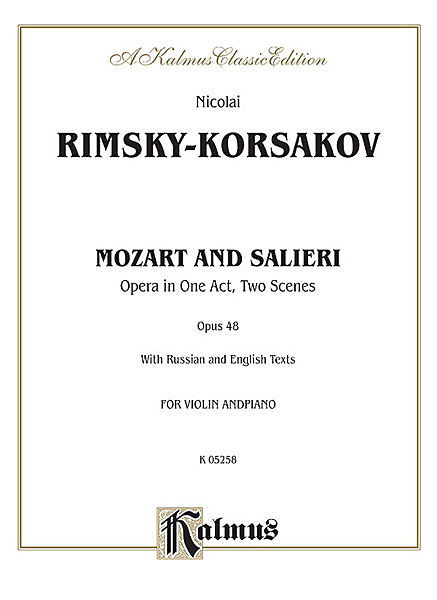
The rivalry rumor began after Salieri's death in 1825.  Alexander Pushkin wrote a "little tragedy" entitled Mozart and Salieri, published in 1831.  This was a dramatic study of the sin of envy - Salieri's envy of Mozart.  This story was later adapted by Nikolai Rimsky-Korsakov into an opera of the same name in 1898.

The rumor was further perpetuated by the Shaffer play and film.  In his version Salieri is so in awe of Mozart and so resentful that he renounces God for giving such gifts to a boorish and puerile man such as Mozart as depicted in Amadeus.

However, talented as Mozart was, there was no cause for Salieri to be envious of him.  Salieri was well-respected throughout Europe, and held important, well-paying positions, things that Mozart did not attain.  While Salieri enjoyed recognition during his lifetime, was a much sought-after teacher, and influenced contemporary Viennese music, Mozart's fame and acclaim came well after his death.


The play and movie also took liberties with Mozart's death.  The city of Vienna has kept weather records for centuries, and  those records show that on the day of his death - December 5, 1791 - the weather was calm and mild, not the horrible snowstorm shown in Amadeus.  Mozart's cause of death is now accepted to have been from rheumatic inflammatory fever.  Salieri did attend his funeral, according to an 1856 report.  Mozart was buried in a common grave which was the Viennese custom at the time   (Apparently the Great Plague necessitated some changes in burial customs due to the huge number of deaths and infectious bodies.)
Salieri

The good thing that Amadeus, the latest of the attempts to vilify Salieri, did was to revive his music and his fame.  The Salieri Opera Festival, sponsored by the Fondazione Culturale Antonio Salieri, is an annual event in his native town of Legnago each autumn.  It is dedicated to not only honoring and rediscovering his work but also his contemporaries and their work.  In 1999 Il Teatro Salieri was inaugurated, a theater in Legnago re-named in his honor.

It took about 150 years for Salieri to come into his own again and his reputation restored, much less time than for Richard III, but it gives us pause to consider that all that is written is not true, not even if most people think so, and have thought so for a long time.

*******************************