WELCOME TO CEREBRAL BOINKFEST!

WELCOME TO CEREBRAL BOINKFEST!

A blog about the arts, books, flora and fauna, vittles, and whatever comes to mind!

Note: Comments are moderated. If you include a link, your comment will not be published. As you will note, I do not accept ads on my website and that includes in comments.


Showing posts with label classical architecture. Show all posts

Friday, October 28, 2011

The Flying Buttress

The flying buttresses of the apse at the Cathedral of Our Lady of Chartres.

A buttress is an architectural element which is built against or projects from a wall which serves to protect or reinforce said wall.  They are common on buildings of certain styles or eras where they counteract the lateral forces from roofs that lack necessary bracing.  In other words, they stop the roof from squashing the walls.

The odd-shaped "walls" that extend from the sides of this church in the
Philippines (building to right) are examples of regular buttresses.

The Durham Cathedral, properly the Cathedral Church of Christ, Blessed Mary the Virgin and St. Cuthbert of Durham, is in northeast England and is the seat of the Anglican Bishop of Durham.  The cathedral was built in 1093, and is considered one of the finest examples of Norman architecture.  It has been designated a UNESCO World Heritage Site.  The cathedral is notable for the flying buttresses over the aisles, which are precursors of the Gothic style of architecture even though the building is considered to be of Romanesque design.  Buttressing made it possible to build taller buildings and open up space.

The quadrant arches in Durham Cathedral carried the
lateral thrust of the stone vault over the aisles, where they
were supported by buttresses.  These were precursors
of the fully-fledged flying buttresses.

The main advantage, which spurred the development of flying buttresses, was that outer walls didn't need to be as massive since the buttresses would relieve them of the burden of the weight of the vault.  This allowed for the wall space to be reduced so windows could be larger and designed with stained glass.  The buttress thus was a vertical masonry block on the outside of the building with an arch that stood in the gap between the buttress and the wall (the "flying" part).  One of the earliest uses of flying buttresses, which still survives, is the Basilica of St. Remi in Reims, dated to circa 1170.

The buttresses at the apse of the Basilica of St. Remi.

These first flying buttresses were unnecessarily heavy, but that much buffering wasn't needed for the loads they were to bear.  Later architects designed them to be slimmer and more refined.


These flying buttresses at the Cathedral of Our Lady
of Amiens, built between 1220 - 1270, are much more
graceful and elegant.

As the Gothic style of architecture continued, the flying buttresses were often embellished with "crockets", as were furniture and metalwork made in the Gothic style.  These were hook-shaped decorative elements that were stylized leaves, flowers, or buds. Aedicules were also a common decorative element.  They were framing devices used to highlight the importance of its contents, and were set into the buttresses.

Crockets on the finials at Sint-Petrus-en-Pauluskerk
in Ostend, Belgium.

Another use for flying buttresses was as an emergency measure to shore up walls in danger of collapsing.  This would often be more practical than rebuilding a wall, especially if it was the only weak part of a building.  Later architects abandoned the use of flying buttresses in favor of thicker walls.

The south wall of Chaddesley Corbett Church, begun in
the 12th century, has an added flying buttress to support
a weaking wall of the south aisle, built in the 14th century.

Flying buttresses are a hallmark of Gothic architecture.  They allowed the construction of taller buildings with soaring interior space.  Since they allowed for bigger windows in the walls, more light could enter the building, making it less gloomy.  It was an innovation that led to the great cathedrals, and some of the most spectacular architecture extant today.

***************
Images courtesy of Wikipedia.
**************************

Monday, October 17, 2011

Watts Up

Sabato "Simon" Rodia.  Image courtesy of Lucien den Arend (see link below).

He wanted to build something really big.  So Sabato "Simon" Rodia did.  The former construction worker used scraps and a few tools to build the structures that are known as the Watts Towers, one of the most famous landmarks in Los Angeles.


His background is sketchy, but he was born in Serino, Italy in 1875.  He came to the U.S. with his brother when he was 15.  His brother was killed in a mining accident, and Rodia moved to Seattle, then Oakland, Long Beach, and finally Watts in 1920, where he purchased an odd-shaped property.  He began his work on the towers in 1921, and finished in 1954.  The Watts Towers are a collection of 17 inter-connected structures and were built in his spare time; he worked construction jobs during the day.


All three images above courtesy of Lucien den Arend.

Rodia called it "Nuestro Pueblo" (Our Town), and built it without scaffolding, bolts, rivets, welds, or by a planned and written design.  His tools were a pipefitter's pliers and a window-washer's belt and buckle.  The structures are made of steel pipes and rods, wrapped with wire mesh and coated with mortar.  The main supports have pieces of glass, tile, and porcelain embedded in them, as well as found objects such as bottles and shells.  Some of the identifiable soda bottles still bear the logos.  The property is near some railroad tracks, which he used as a vise.

This is known as the "ship's wheel", and you can see the soda bottle labels.
Image courtesy of Victoriansecrets (see link below).

He worked without drawings, and designed the structures as he built them.  Some liken them to an ark, saying the tall towers form masts.  Certainly there are ship elements throughout.  Within there is also a gazebo with bird baths and a circular bench.

This resembles a prow.  Image courtesy of Victoriansecrets.
The "gazebo".  Image courtesy of Victoriansecrets.

Unfortunately, these were paranoid times, and Rodio did not get along well with his neighbors, so his place was frequently vandalized.  Rumors spread that he was building antennae for transmitting secrets to the commies or the Japanese (you pick 'em), and he finally gave up and moved.

Image courtesy of Lucien den Arend.

He gave the property to a neighbor.  It was then bought by a man who hoped to put a Mexican fast food restaurant on the lot.  It changed hands again, and the bungalow was torched, most likely by vandals.  The City of L.A. condemned it and ordered it razed.  An actor and an editor visited the site in 1959, saw how neglected it was, and purchased it for $3,000 with the goal of preserving it.  When the City found out, they planned to raze it before the property was transferred, but the Towers were already world-renowned and there was international opposition to their destruction.

Image courtesy of Lucien den Arend.

The Committee for Simon Rodia's Towers in Watts was formed, consisting of the two owners, the curator of the Los Angeles County Museum of Art (LACMA), and local architects and community activists.  The Committee negotiated to have the Towers tested for safety.  The crane used to attempt to topple or shift the Towers was unable to make them budge.

Image courtesy of Lucien den Arend.

The Towers were deeded to the City in 1975, and then deeded to the State in 1978.  It was designated as the Watts Towers of Simon Rodia State Historic Park, and is operated by the City of Los Angeles Cultural Affairs Department in a partnership with LACMA.

Image courtesy of Lucien den Arend.

The Towers suffered structural damage in 1994 from the Northridge earthquake. After repairs were made, it was reopened in 2001.  It was further damaged in a windstorm, and was reopened this year.  A lot of vandalism still occurs.  Earlier this year LACMA announced that a $500,000 grant was received from the James Irvine Foundation for preservation and to promote the site.

Image courtesy of Lucien den Arend.

The Watts Towers have been hailed as a prime example of American Naïve art. There are annual festivals held there which include the Simon Rodia Watts Towers Jazz Festival, and the Day of the Drum Festival.  For more information on events and visiting the site, check here.


He may have been deterred by fear and hate and chased away, but he will be immortalized always by the Beatles - and how many can claim that?  He is on the cover of the Sgt. Pepper's album, top row and second from the right (behind Bob Dylan), peering over the heads of Karl Marx and H.G. Wells.  Not bad for someone just following his artistic impulses.


***************
Unless otherwise noted, images courtesy of Wikipedia.
Website maintained by Lucien den Arend is here.
Website for Victoriansecrets is here.
******************************

Saturday, May 14, 2011

The Ups and Downs of Alma-Tadema

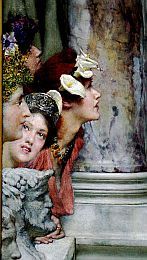
Spring, 1894, depicts the servants of the Temple of Flora
celebrating the Roman festival of Cerealia.  This
painting took four years to complete, and features
 members of his family, friends, and fellow artists.
Image courtesy of the Getty.

Contrary to most artists, the story of Sir Lawrence Alma-Tadema is not an angst-filled drama of unappreciative hard work, poverty, and obscurity.  During his lifetime he was arguably the most successful artist of the Victorian era.  His paintings of elegant people - "Victorians in togas", as one critic suggested - languidly posed in gorgeous classical settings appealed to the zeitgeist of Victorian times.  He was a Dutch ex-pat in Britain painting ancient Greece and Rome.

Detail from Spring.

Lourens Alma Tadema was born in the Netherlands.  His family intended for him to be a lawyer, but at age fifteen he suffered a physical and mental breakdown.  He was given a short time to live, and so was allowed to spend this time at leisure, drawing and painting.  He weaned himself back to health and decided to become an artist.  (Note:  he later anglicized his first name to Lawrence, and hyphenated his middle and last names so he would appear early in any alphabetized lists.  His last name rhymed with "had'em a", which was part of a verse tribute to him.)  In 1852 he entered the Royal Academy of Antwerp in Belgium and studied early Dutch and Flemish art.  In his four years there as a student he won several awards. He later became a studio assistant to one of his instructors who encouraged him to display historical accuracy in his paintings, for which he became famous.  He shared lodging in the home of an archaeologist, which fostered his interest in that subject, and was friends with an Egyptologist which furthered his interest.

Sir Lawrence Alma-Tadema, 19th Century, photographer and date unknown.
Image courtesy of PreteristArchive.com.

He then started working with another highly regarded artist in Belgium, and painted his first major work in 1861.  The Education of the Children of Clovis started his fame and reputation as it was a hit with artists and critics alike.  In fact, it was so highly regarded that it was bought and given to King Leopold of Belgium.  His main interest was in the Merovingians (rulers of Gaul from the 6th to 8th centuries).  But after a trip to London he was inspired by the so-called "Elgin Marbles" (forgive me but I am half-Greek and wish to see them returned - they never belonged to Elgin) and the Egyptian artifacts in the British Museum.

The Education of the Children of Clovis, 1861.
Image courtesy of Wikipedia.

He married in 1863 and honeymooned in Italy.  This piqued his interest in ancient Greece and Rome,  especially after visiting Pompeii.  He returned in 1876 and rented a studio in Rome, and returned again in 1883.  From all his trips he amassed a huge collection of photos and archival material for use in future paintings.  He even went to the quarry where Cararra marble is from (one of his early teachers told him his marble looked like cheese) to learn to convey its distinctive look and texture.  He studied classical architecture, studied and painted marble to depict it perfectly (he was called in Punch magazine  "the marbelous painter").  Later he even designed furniture, mostly Pompeiian or Egyptian in style, which he used in his paintings.  He even designed women's clothing.

The Triumph of Titus, 1885.  Image courtesy of PreteristArchive.com.

In 1864 he met Ernest Gambart who was the most influential art dealer and print publisher of the time.  Alma-Tadema moved to London, where he spent the rest of his life.  He met and friended many of the Pre-Raphaelite painters, and they influenced his work.  He was an excellent businessman, and one of the wealthiest artists of the 19th century.  He received many awards in his lifetime, and was knighted in 1899.  He was the eighth artist from "the continent" to be knighted.

Silver Favourites, 1903.  Image courtesy of Wikipedia.

There is little action in his paintings, although one can see the fine execution of the old Dutch masters in his work.  He was a perfectionist, and repeatedly reworked his paintings until he was satisfied (hence the four years it took to paint Spring.) The rose petals and flowers are from live ones - he would hurry to paint them before they withered.  His archaeological research paid off.  If one studies the architecture of the buildings in his paintings, one can see the meticulous design - any one of them could be built by ancient Romans using Roman tools, methods, and materials.  As a matter of fact, his paintings were (and are) used as source material for Hollywood productions, such as Ben Hur, Cleopatra, and the Ten Commandments.  They are still used by set designers - as recently as 2005 they were used for the Chronicles of Narnia:  The Lion, the Witch, and the Wardrobe.


Egyptian Chess Players, 1879.  Image courtesy of Wikipedia.

He is distinctive for portraying "everyday" life from classical times, and not mythology, legends, and seldom famous figures.  Every detail in his paintings is exact and correct, from marble to metals, however his people lack "soul".  They are not differentiated in his paintings, and function as if they were objects.  While his contemporaries produced genre paintings with historical dress and allegorical themes, Alma-Tadema held that art should elevate and not teach, so he never intended any social or moral lessons.

The Roses of Heliogabalus, 1888.  Image courtesy of PreteristArchive.com.

Although in his heyday he was financially successful, in the early 1920s Victorian art in general saw a huge collapse in prices.  This devaluation lasted some forty years.  Alma-Tadema's paintings were denounced, he was declared "the worst painter of the 19th century" by John Ruskin, the curmudgeon, who never liked Alma-Tadema's work (early on, Ruskin commented on one painting, "the general effect was exactly like a microscopic view of a small detachment of black-beetles, in search of a dead rat").

A Favourite Custom, 1909.  Image courtesy of the Tate Gallery, London.

After being relegated to virtual obscurity, his paintings caught the eye of one man. Allan Funt, famous for his Candid Camera television show, had a B.A. from Cornell in fine arts from 1934.  He starting buying Alma-Tadema when the artist's reputation was at its lowest.  Within a few years, he had bought some 35 works. However, he was forced to sell them due to financial difficulties.  He sold them just before the prices shot up, and shoot up they did.  The painting called The Finding of Moses in 1960 was put on sale by the Newman Gallery, and didn't even meet the reserve when it sold for £252.  The initial purchase had been £5,250 after completion.  It sold for £861 in 1935, and £265 in 1942.  After Funt sold his collection at Sotheby's in London in 1973, interest in Alma-Tadema renewed.  That same painting was auctioned at Christies in New York for £1.75 million in 1995. Last November it sold for $35,922,500 to an anonymous bidder at Sotheby's in New York.  This is the highest price paid for Alma-Tadema and for a Victorian painting.

The Finding of Moses, 1904.
Image courtesy of Wikipedia.

Although he had intended to be buried with his second wife who pre-deceased him, he is buried in a crypt in St. Paul's cathedral in London, as befits a highly-honored individual.  The recipient of numerous awards and honors, he enjoyed a life of wealth, popularity, and the pursuit of his interests.  A life like that is uncommon, especially for an artist.  I salute the successful life of art, history, archaeology, and wealth!