WELCOME TO CEREBRAL BOINKFEST!

WELCOME TO CEREBRAL BOINKFEST!

A blog about the arts, books, flora and fauna, vittles, and whatever comes to mind!

Note: Comments are moderated. If you include a link, your comment will not be published. As you will note, I do not accept ads on my website and that includes in comments.


Wednesday, March 7, 2012

The "Miracle of the Age" - a Forerunner of Audubon

Los Borrachos or The Drunks, 1629, by Diego Velázquez.
Velázquez served as court painter for Philip IV of Spain.

Court painters were artists who were employed by members of a royal or noble family.  Sometimes they were given a fixed salary; sometimes they were employed on an exclusive basis.  In some eras and locations, this freed them from the restrictions of their local guilds.  Hans Dürer, Jan van Eyck, Francisco Goya, Hans Holbein the Younger, Peter Paul Rubens, Titian, and Diego Velázquez are some of the European artists who spent time as court painters.  Some, such as Velázquez, also served other capacities in court, such as diplomats or administrators.

The Mughal ruler Jahangir, 1617, attributed to Abu al-Hasan.
Measuring six feet tall, this is a life-size painting and sold
At Bonhams in April of  2011 for approx. $2,239,482.

In Islamic cultures, notably between the 14th and 17th centuries, rulers maintained ateliers or court workshops for artists, in particular for miniaturists, calligraphers, and other artists and craftsmen.  These became the princely courts' focus of patronage, whether Muslim or Hindu.  The Mughal emperors were keenly interested in recording their reflections on art, science, and the world around them. Jahangir, son of Akbar and father of Shah Jahan of Taj Mahal fame, was especially known for his love of nature and his writing.  He recorded detailed descriptions of wildlife in his memoirs, the Jahangirnama.

A Nilgai Ibue cow by Mansur, courtesy of Wikigallery.
A turkey cock by Mansur, 1612.

Jahangir was a keen birdwatcher and observer of animals.  Even zoologists had not discovered the gestation period of elephants until the mid-nineteenth century, but Jahangir had estimated that it was approximately eighteen months in the early seventeenth century.  He was a connoisseur of art, and his court painters, of whom he was justly very proud, have provided scholars today with accurate records of his time and reign.  One of his court painters was Ustad Mansur.

Portrait of a falcon from north India, 1619.
Image courtesy of Wikigallery.
Indian lapwing, 1600.  Image courtesy of Wikigallery.

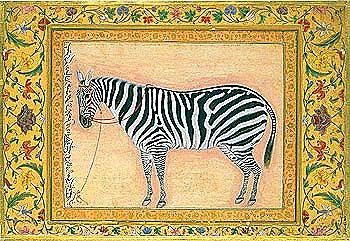
Ustad Mansur began his career as a minor painter in the court of Akbar.  When he was painting in the court of Jahangir, he became noted for his depictions of plants and animals.  His attained such skills that Jahangir dubbed him Nadir-ul-Asar, or "Miracle of the Age".  ("Ustad" means "master.)

A chameleon, which may have acquired from traders at Goa.
Image courtesy Royal Library, Windsor.

Because of his interest in nature, and it was customary for Mughal rulers to keep zoos and gardens of exotic plants, Jahangir bought rare creatures from the Portuguese colony of Goa on the western coast of India.  One of these creatures was the dodo.  Mansur was the first artist to paint the dodo (that we have extant proof) and it is thanks to his painting that we know what it looked like.  Others have produced images of the dodo, but from skeletal remains and eyewitness account; Mansur painted his from life.

Mansur's depiction of a dodo, center, c. 1610.
The others are (clockwise from upper left):
Loriculus galgulus, Tragopan melanocephalus,
Anser indicus, and Pterocles indicus.

Mansur also was the first to paint a Siberian Crane (also known as a Snow Crane), and painted the rare Bengal Florican, or Bengal Bustard.  Both the Siberian Crane and the Bengal Florican are signed works, and can be viewed in the Kolkata Indian Museum.

A Himilayan cheer pheasant.
One of several zebras Mansur painted.

Most of Mansur's work is unsigned, which is a hallmark of Mughal painting - the genre did not celebrate the individual fame of the artist.  In the Jahangirnama it states that on a trip to the Kashmir Valley, Mansur painted over a hundred flowers.

This tulip painting is the only signed flower painting.
It states:  "Jahangirshahi, the work of the slave of the
Presence-Chamber, Mansur Naqqash, c. 1610."
Image courtesy of this site. 
This painting, Squirrels in a Plane Tree, has been
attributed to Abu al-Hasan, a student of Mansur, but
since its title reads "Nadir al-Asr" it may likely be a
collaboration between the two.  Since the subjects
are European squirrels, the artist either accompanied
Jahangir to Europe, or these squirrels were brought to
India.  Image courtesy of the British Library.

Mansur's talents were well-adapted for scientific documentation, and his works are valuable for their accuracy.  Although unsigned, some have been attributable because of Jahangir's written praise for his work.  His studies of nature are unsurpassed today, and his reputation as a stellar artist has grown.  He remains today Nadir-ul-Asar.

***************
Unless otherwise noted, images courtesy of Wikipedia.
******************************

Tuesday, March 6, 2012

A Marriage of Painting, Writing, and Music: Illuminated Choir Manuscripts


Initial C:  Monks Singing.  MS. 24, Leaf 3V.
Unknown artist, Italian, circa 1420.
Tempera colors, gold leaf, and ink on parchment.
18-5/16" x 13-5/8"


Picture a dimly lit church.  The scent of incense is in the air, and you hear the sound of chanting. Choristers are clustered in a corner, performing a call and response with one of the monks.  In front of them is a lectern, and on top of it is a huge book.  It is big enough that they all can read it at the same time.  Now swing around behind them and look at the book.  It has large notes, and shows the words to be sung.  It most likely has illuminated drawings on it, and if it is an especially fine specimen, it will have a large illuminated initial.

Close-up of monks from above image.

Choirs were an integral part of medieval worship.  Since books were very expensive then it wasn’t possible for each member of the choir to have their own.  So very large books were made, some beautifully embellished with initials, drawings, borders, and other decorations.  The entire choir was able to read and sing from the one book.

Initial R:  The Resurrection.  MS. LUDWIG VI, FOL. 16
Antonio da Monza, Italian, late 1400s or early 1500s
Tempera colors and gold leaf on parchment.
25-1/4" x 17-1/8"

The books were made by hand, written by a scribe or calligrapher on parchment or vellum.  Their production usually required a team of craftsmen working under a master.  Some were made in scriptoriums, others in artisan workshops.  An illuminator was an artist who decorated the book.  A binder then sewed the sheets together into a book and placed them within a cover.  The production of a book was commissioned and financed by a patron, sometimes the head of a monastery or cathedral.

Initial C:  The Creation of the World.  MS. 24, LEAF 5
Artist unknown, Italian, circa 1420, tempera colors,
gold leaf, and ink on parchment.  18-5/16" x 13-5/8"

Musical chants were an important part of ritual ceremonies.  One of these was the Mass, a public ceremony that included the blessing of wine and bread to be consumed.  Missals, which contained the spoken prayers and chants that priests performed during Mass, were small and portable.  Graduals, containing music and text sung during the year for Mass, became larger as choirs grew in size.


Initial A:  A man singing.  MS. LUDWIG VI 2, FOL. 128V
Artist unknown, Italian, circa 1460-1480.
Tempera colors and gold leaf on parchment.
23-3/4" x 17-5/16"

The Divine Office is a cycle of prayers that are recited each day at prescribed hours.  One of the books used for these is an antiphon.  An antiphon is usually in Gregorian chant, and is a response by a choir or congregation to a text, most often a psalm.  Antiphons are still integral in Greek Orthodox and Eastern Catholic churches.

Initial A:  Christ in Majesty.  MS. LUDWIG VI, FOL. 2
Master of Gerona, Italian, 1275-1299.  22-15/16" x 15-13/16"
From an antiphonal; sung on the first Sunday in Advent.

Depending on the age of the book, the musical notation may be in neumes or in square notation.  Neumes are a series of ascending and descending dots and lines.  A neume was a symbol that could signify two to four notes.  Readers could get a sense of the melody and how long each word should be sung with this notation.

From a page of the Stammheim Missal, German, circa 1170s.

The word neumes comes from the Greek word for gestures.  They were placed without staffs.   Since most singers knew the songs by heart, the neumes served as a reminder of the rises and falls of the melody being sung.  So in essence they were a type of shorthand or mnemonic for the melody of a chant.

From a page of a gradual, Italian, circa late 1400s or early 1500s.

Square notation used a four-line staff with clef notes.  Groups of ascending notes were squares, stacked, and read from bottom to top.  Descending notes (sometimes diamonds) were read from left to right.  Square notation became the standard, and is the precursor to the modern notation used today.

Initial E:  The Prophet Isaiah.  MS. 97, leaf 3V;
Bohemian, circa 1405.  Tempera colors, gold leaf,
and gold paint on parchment.  22-3/8" x 15-13/16"

Many of these religious volumes are difficult to read today, due to the lettering style and the abbreviations.  Although printed books were introduced in the mid-fifteenth century, the production of handmade books continued for approximately another century.

Illuminator known as the Master of Gerona.  MS. LUDWIG VI 6.
Italian, late 1200s.  Tempera colors, gold leaf, and
ink on parchment.  22-15/16" x 15-13/16"

The illuminated initial usually came at the beginning of a passage or a paragraph.  These letters were both a source of beauty and served to help the choir to find their place.  (Remember those churches were  dimly lit.)  It was common for a “V” to be written as a “U”, and vice versa.

Close-up from a page from a gradual illuminated by Antonio da Monza.
Italian, late 1400s or early 1500s.  MS. LUDWIG VI 3.
Tempura colors, gold leaf and ink on parchment.  25-5/16" x 17-1/8".

These beautiful volumes were made and used in Europe beginning around 500 C.E., and in some areas their use continued into the early part of the 20th century.  They serve as historical documents revealing to us the songs that were sung, the production methods of books, and many of the illustrations provide a glimpse into the life of their respective eras.  We cannot hear their voices, but we can imagine...

***************
All images courtesy of the Getty:  © 2010 The J. Paul Getty Trust. 
All rights reserved.
 An earlier version of this post was published on Booktryst.
******************************

Thursday, February 23, 2012

Art and the World's First Novel

A portrait of Murakasi Shikibu by Tosa Mitsuoki, painted
in Yamato-e, the classical Japanese style, 12th century.

What is generally acknowledged as the world's first novel was written by a Japanese woman a thousand years ago.  The Tale of Genji, by Murakasi Shikibu (known as Lady Murakasi in the West), is regarded to be an accurate description of life in the imperial court in the Heian era (794 - 1185 CE).  The daughter of a scholar and an officer of the court, she was given a male's education.  Being a lady-in-waiting herself, she was privy to life at court.

The Murakasi Shikibu Diary, attributed to Fujiwara Nobuzane
(illustrations) and Kujo Yoshitsune (calligraphy),
Gotoh Museum, 13th Century.

There are three works that are attributed to her - The Murakasi Shikibu Diary, The Murasaki Shikibu Collection (128 of her poems), and The Tale of Genji. Genji was written in 54 installments, chapter by chapter, and distributed to the women of the court.  Since it was deemed inappropriate to use real names in the Heian court, none of the characters have names but are referred to by their roles, functions, relationships to others, or by an honorific.  There is one central character and a large number of major and minor characters.

Genji Monogatari Emaki, Chapter 50, "Eastern Cottage",
Tokugawa Art Museum, 12th Century.

The novel contains no central plot, but the evolving story of the characters in time has amazing consistency.  As it was erudite and conventional to write and send poems, especially after a lovers' tryst, the novel contains some.  The original manuscript no longer exists, but there is an extraordinary piece that is a blend of literature and art - the Genji Monogatari Emaki - believed to have been created between 1120 and 1130 CE.

Genji Monogatari Emaki, Chapter 38, "The Bell Cricket",
Gotoh Museum, 12th Century.

Monogatari is a literary form of Japanese literature that is comparable to an epic. Closely related to oral tradition, it is usually about a fictional story, such as The Tale of Genji.  While the form peaked during the 10th and 11th centuries, the word is often used for modern tales.  The Lord of the Rings is known in Japan as The Yubiwa Monogatari.

Genji Monogatari Emaki, Chapter 37, "Flute",
Tokugawa Art Museum, 12th Century.

The Genji Monogatari Emaki (an emaki is a scroll) is both the oldest surviving scroll depicting The Tale of Genji, and the oldest surviving non-Buddhist scroll in Japan.  Commissioned by rulers and members of the aristocracy, they were created by the best artists of their time, and were never intended for public view.  There are other versions of the Genji Monogatari Emaki, but the one pictured here is the most famous, and the term without other explanation refers to this version.

Genji Monogatari Emaki, Chapter 45, "Lady at the Bridge",
Tokugawa Art Museum, 12th Century.

The original scroll consisted of ten to twenty rolls, with over 100 paintings and 300 sheets of calligraphy, making it approximately 450 feet long.  What survives are only 19 paintings, 65 sheets of calligraphy, and 9 pages of fragments, which is roughly 15 percent of the original scroll.  There are two painting conventions from this era that were used in the Genji Monogatari Emaki.  The first technique is funkinuki yatai, which means "blown away roof".  It is a compositional technique used to depict an architectural interior.  A building is rendered without a roof so the gazer has a bird's eye view of the interior.

Genji Monogatari Emaki, Chapter 44, "Bamboo River",
Tokugawa Art Museum, 12th Century.

The second technique is hikime kagibana, literally "slit eyes, hooked nose".  This was used to illustrate people.  Faces done in this style were always drawn at an angle, eyes as straight lines, noses as hooked lines, and small mouths like circles. The faces in the Genji Monogatari Emaki do have some variations; later paintings done in this style were less expressive.

Genji Monogatari Emaki, Chapter 39, "Evening Mist",
Tokugawa Art Museum, 12th Century.

The calligraphers of the Genji Monogatari Emaki did not use just one style of calligraphy.  The different styles were picked for aesthetic purposes rather than for facile reading of the text.  Because of this it is hard for even experts to decipher.  It is assumed that one reason this was done was so the focus would be on the paintings, and not the reading of the script.

Genji Monogatari Emaki, pages of calligraphy,
Gotoh Art Museum, 12th Century.

Japan has a National Treasure program whereby the most precious cultural properties are designated as such.  The Genji Monogatari Emaki is certainly one of these treasures.  These scrolls are so fragile that they are only shown in public on rare occasions, but reproductions and ephemera associated with them are readily available.  The Tokugawa Art Museum in Nagoya has some of the scrolls, as does the Gotoh Museum in Tokyo.  An oversized photo-reproduction, translated into English, was published in a limited edition in 1971 by Kodansha International.  It is available from rare booksellers for around $400 - $450.

Genji Monogatari Emaki, Chapter 36, "Oak Tree",
Tokugawa Art Museum, 12th Century.

The Tale of Genji has become a timeless classic, its popularity increasing with passing time.  It has been a key component of the Japanese education curricula for a millenium.  Although it was not the only literature written during the Heian era, nor was Murasaki Shikibu the only writer, both were captivating enough to live on in the hearts and minds of people throughout the centuries.  The Genji Monogatari Emaki is a beautiful collaboration of literature and art.

***************
Images courtesy of the Tokugawa Art Museum and the Gotoh Museum.
An earlier version of this post appeared on Booktryst.
*******************************

Tuesday, February 7, 2012

The Golden Age of Illustration - Maxfield Parrish

Dinky Bird, 1904, from Eugene Field's Poems of Childhood.

When I was 19, a friend gave me a poster of the above work by Maxfield Parrish. She said it reminded her of me.  I was very pleased, as I fell in love with it upon first sight.  She was about a decade older than me and had been a real hippie, so I was especially flattered.  It hung in every bedroom I had until it finally got damaged in a move.  But the dreamy print always made me feel peaceful, and was my first piece of art as an adult.

Princess Parizade Bringing Home the Singing Tree,
1906, from Arabian Nights.

Frederick Parrish was born in Philadelphia in 1870.  He later adopted his maternal grandmother's maiden name as his middle one, Maxfield, eventually using it professionally.  His father, Stephen, was an engraver and landscape artist, and his parents encouraged him.  He was doodling even as a child.  He once studied architecture, which is evident in many of his later paintings, but it was in drawing and painting that he concentrated his efforts.

One of his drawings as a teenager.  Image from Young Maxfield Parrish
by John Goodspeed Stuart, T.H. Pickens Technical Center, 1992.

His first commissions were to illustrate L. Frank Baum's Mother Goose in Prose, and Kenneth Grahame's The Walls Were as of Jasper for Scribners Magazine, in 1897.  All of his 19th century illustrations were in black & white.  It was in a subsequent period that he began painting in the colors he became and remains famous for - particularly "Parrish blue".  When he was thirty, he came down with tuberculosis.  He went to Arizona to recuperate, and that's when his career took off.

The Walls Were as of Jasper, 1897, Scribners Magazine.
The Golden Age, from a 1904 photogravure edition.
This and the image above courtesy of the book
The Black & White Parrish, Thumb Tack Books, 1982.


He illustrated Eugene Field's Poems of Childhood in 1905, and The Arabian Nights in 1909; in 1910 he illustrated A Wonder Book and Tanglewood Tales.  He had many magazine commissions in the 1910s and 1920, including Hearst's, Collier's, and Life.  He was also a favorite of advertisers, including Edison-Mazda Lamps, Colgate, and Oneida Cutlery.

A 1918 ad for Djer-Kiss.

In 1905, a 16-year-old woman, Susan Lewin, came to work for his family as his son's nanny.  She became his assistant and a favorite model (mostly in the 1920s); then eventually they became lovers.  His wife left him in 1911; however Susan remained with him for over 50 years.

Collier's, November 1929.

His androgynous nudes in fantasy settings were a recurring theme, but in the 1920s he turned from illustration and concentrated on painting for pleasure.  He lived off the royalties from his posters and calendars, then in 1931 he declared he was through with "girls on rocks".  He directed his attention to landscapes, and often built models and lit them as preparation for his paintings.

White Birches, 1952.

Photographs do not do his paintings justice.  He worked in oils on stretched paper. He would apply numerous layers of thin, transparent oil, alternating with varnish, which lead to high luminosity, a process called glazing.  He also photographed, enlarged, or traced figures and objects, then cut them out and placed them on his works and covered them with thick, clear layers of glaze, giving them a three dimensional appearance.

Cadmus Sowing the Dragon's Teeth, 1910,
 in A Wonder Book and Tanglewood Tales
by Nathaniel Hawthorne.

Although it was Air Castles (a 1904 Ladies' Home Journal cover) that gave him wide exposure, Daybreak is considered his masterpiece.  His work was widely reproduced in posters, calendars, and candy box lids, and is still in demand.  By the time of his death at age 95 in 1966, he was able to see a renaissance of interest and promotion of his work.  He was the most popular American artist from the turn of the century until the 1940s, when Norman Rockwell became his heir apparent.

Air Castles.
Daybreak.

Maxfield Parrish shaped the Golden Age of illustration, and influenced American visual arts for decades.  His work experiences new surges of interest as each new generation discovers it.  Daybreak is considered the most popular art print of the 20th century, judging from the number of prints that have been made.  It has outsold Warhol's Campbell's Soup Cans and even Da Vinci's Last Supper, and is still in print.  By all accounts he was affable and well-liked.  How fortunate to be so successful at doing what you love!

***************
Unless otherwise noted, all images courtesy of Wikipedia.
The National Museum of American Illustration has the largest body of his works.
This website has interesting information on Parrish.
*******************************

Thursday, February 2, 2012

Borobudur: The Architecture of Buddhist Cosmology

Image courtesy of UNESCO (see link below).

Borobudur is a temple located in central Java.  It is a shrine to the Buddha, and a pilgrimage place.  It was built between 750 and 842 CE.  Carved into the base of the temple are 160 carved reliefs, the most complete collection of Buddhist reliefs anywhere in the world.  Looking down on it, one can see a mandala - a microcosm of the universe - a pattern with spiritual and ritual significance for Buddhists and Hindus.

An aerial view of the temple from the Borobudur website (see link below).
The three zones of the universe are exemplified at Borobudur.
The foundation is approximately 387 feet on each side.
Image courtesy of the Borobudur website.


According to Buddhist cosmology, the universe has three zones, represented at Borobudur in rising layers.  The first is Kāmadhātu, the world of desire.  This world is inhabited by common people.  This is the base of the temple, which has been covered by a foundation and is hidden from view except for one corner that has been left uncovered for viewers.  These 160 reliefs carved into this base illustrate the law of cause and effect, and the collection is known as the Mahakarmawibhangga.  They illustrate the behavior of desire, including the invidious behavior of acts such as killing, rape, torture, and robbery.  There is a reckoning in the afterlife depicted for those committing these acts.  There are also reliefs showing meritorious behavior such as charity and working together.  When the base was dismantled and the reliefs discovered, they were photographed by Casijan Chepas in 1890.  These photographs are on view in the site museum.

The Buddha's mother, Queen Maya, retreats to Lumbini so that she may give
birth to Siddhartha Gautama, the future Buddha.  This is one of the reliefs from
the base, which do not depict a continuous story, nor are they all related to the
Buddha.  Beside the blameworthy and praiseworthy activities, they show other
aspects of everyday life.  This image and the one below courtesy of Wikipedia.
Here Siddhartha Gautama shaves his head in his preparations to become an ascetic.

Rupadhatu, or the world of forms, is the second layer.  It is a transitional zone, where humans are released from their desires for the physical world.  They continue living in the world and see forms but are not desirous of them.  This is comprised of four tiers, which have galleries of carved reliefs and niches with 432 statues of the Buddha, as well as depictions of Sanskrit manuscripts.  The top layer is Arupadhatu, the world of formlessness.  This is the abode of those who have become Buddhas.  These terraces have stupas containing Buddha sculptures that face outward.  The central stupa is empty; it is unknown if whatever was inside was removed, or whether it was always empty.

This image and the one below courtesy of Wikipedia.


There are no written documents that reveal who built Borobudur, but it is generally held that it was a ruler in the Sailendra dynasty, as the temple was built in the peak of their reign.  There is a lot of confusion as to the religious preferences of rulers at that time, but because known Buddhist kings allowed Hindu monuments to be built, and vice versa, it suggests a climate of tolerance existed.  There is a Hindu complex nearby known as Prambanan, which likewise has three levels corresponding to the zones of Borobudur.

Prambanan - the Hindu temple compound that also has three levels or zones.
This has suffered much earthquake damage, but is used by local Hindus today.
Image courtesy of the Borobudur website.

There are two smaller temples that appear in a straight line leading to Borobudur, Mendut and Pawon.  Although the exact relationship between the three temples is unknown, today they are part of a procession in the Waisak day festival.  This is held each year on the day of the full moon in April or May, commemorating the birth, enlightenment, and death of the Buddha.  It is an important day in the Buddhist calendar, and pilgrims from all over the world come to take part in the procession from temple to temple, ending at Borobudur.

Image courtesy of the Borobudur website.

Although it is unknown why Borobudur was abandoned, and there may have been many reasons, volcanic activity surely had a part.  When discovered, the site was covered in volcanic ash.  The capital of the kingdom was moved to East Java; then in the 15th century, there was a conversion to Islam.  All of these contributed to the desertion of the site, and it continued only in memory through local tales for centuries.

Mount Merapi seen ominously smoking in 2009.  Image courtesy of Wikipedia.

When the British took over Java in 1811, Sir Thomas Raffles was appointed governor.  He had an interest in Javanese history, and listened to the rumors about a big monument in the jungle.  He had the site cleaned, and the reliefs documented and interpreted.  In 1885, the hidden reliefs were found, which also had Sanskrit instructions left for the carver, from which the construction was datable.  Over the pursuing years the site was restored, and water damage from inadequate drainage was corrected.  After a 1973 renovation funded by UNESCO, Borobudur was used once again for worship.

Image courtesy of Wikipedia.

As an interesting aside, in 1982 Philip Beale, previously of the British Royal Navy, was in Indonesia to study ships and marine traditions.  He found ten panels at Borobudur showing sea vessels - some powered by oars, others by sails.  He thought since the other panels showed everyday life, these ships may have been part of the Cinnamon Route - a shipping route linking Indonesia to Africa across the Indian Ocean, past the Seychelles, Madagascar, and the Cape of Good Hope to Ghana.  With the help of experienced Indonesian shipbuilders, he had a ship modeled on the stone carvings constructed.  It was then launched on an expedition to retrace the route to Ghana.  The expedition took six months, demonstrating that ancient trading routes were viable.  The ship - the Samudra Raksa, "defender of the seas", is housed in a museum in Borobudur Archaeological Park.

The stone relief of an Indonesian trade ship.
The full-scale reconstruction of the above ship, here stored at the Borobudur site.
Both images courtesy of Wikipedia.
UNESCO made Borobudur a world heritage site in 1991.  Today it is the most visited tourist site in Indonesia, attracting pilgrims and art and architecture lovers alike.  A marvel when it was built, it is still one today.

***************
The Borobudur Archaeological Park website is here.
The UNESCO website for Borobudur is here.
*******************************