WELCOME TO CEREBRAL BOINKFEST!

WELCOME TO CEREBRAL BOINKFEST!

A blog about the arts, books, flora and fauna, vittles, and whatever comes to mind!

Note: Comments are moderated. If you include a link, your comment will not be published. As you will note, I do not accept ads on my website and that includes in comments.


Friday, January 20, 2012

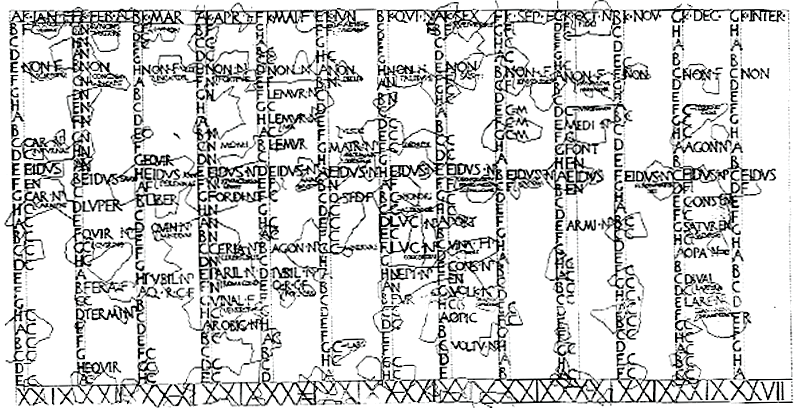
Mercedonius: Cheating with the Marking of Time

Fasti Antiates Maiores, part of a fresco found at Nero's villa at Antium, shows
a pre-Julian calendar with the months Quintilis (QVI) and Sextilius (SEX).

Before the Julian calendar was introduced in 46 BCE, the Roman calendar was in use.  One of the versions of the Roman calendar was supposedly invented by Romulus, legendary founder of Rome, and had ten months with 30 or 31 days in each month, for a total of 304 days:  Martius, Aprilis, Maius, Iunius, Quintilis, Sextilis, September, October, November, December.  This was "fixed" by Numa Pomilius, the king of Rome who succeeded Romulus.  He added Ianuarius and Februarius for a total of 12 months and another 57 days, which totaled 355 days. This was a lunar calendar, but to align the calendar with the solar year a leap month - Mercedonius - was added from time to time in the middle of February, resulting in a year that was 377 or 378 days long.

Fasti were chronological or calendar-based lists of sanctioned
events.  Derived from the word fas, meaning what is allowed.
The word came to denote lists organized by time.  This example
is a fragment of a Roman calendar in the Museo Epigrafico, Rome.

Intercalation is the insertion of a leap year, month, or day into a calendar to adjust its length so that it follows a solar year or the moon phases.  In the traditional leap year for some countries in the West which follow the Gregorian calendar, a day is added every four years.  This is because this calendar is a solar calendar which has 365.24 days.  Thus the extra day every four years helps us "catch up". This extra day is added to the end of February and is an intercalary day. Mercedonius was an intercalary month in the Roman calendar, but was not added on a scheduled basis.

Image courtesy of Facebook's The Loyal Society of
the Most Noble Order of Mercedonius.

Mercedonius comes from the Latin word merx, for which one meaning is wages (where "mercenary" also derives from), since it occurred at the time of year when workers were paid. The decision to add the month to a year was made by the Pontifex Maximus, the high priest of the Collegium of Pontiffs in ancient Rome. This group and office were also founded by Numa Pompilius, and were thought to originally act as advisors to the king on religious matters.  They had control over religious rites, funds, institutions, and the instruction of religion. But their real power came when the monarchy of Rome was abolished, and those sacral duties of the former king were given to the Pontifex Maximus.  His greatest power was administering divine law - divine law as interpreted by the Collegium.

Augustus as Pontifex Maximus,
circa last decade of 1st century CE.

So the Pontifices became politicians, and the office was often held by statesmen. Since one of their duties was to regulate the calendar, and since a magistrate's term of office corresponded with a calendar year, this became a convenient political tool.  When one of his allies was in power the Pontifex could lengthen the year; when his opponents were in power he could refrain from lengthening it and effectively force them out of office.  It also affected contracts and other legal arrangements.  Since it was often decided late to add Mercedonius, this caused the people, especially those outside of Rome, to not know the date.  Eventually the years became very much out of sync with the seasons.  For example, Julius Caesar's crossing of the Rubicon on January 10 in 49 BCE, was actually in mid-autumn.  This abuse of power over the calendar led to the calendar being so out of alignment with the solar year that the vernal equinox occurred three months later, in June instead of March.

The Tusculum Portrait of Julius Caesar, possibly the
only surviving bust made during his lifetime.

The last years of the pre-Julian calendar are known as the "years of confusion" because the calendar was so out of alignment and there seemed to be no rhyme or reason to it.  Mercedonius was eliminated by Julius Casesar when he introduced the Julian calendar, which remained aligned to the sun without mediation.  Finally dates could be assigned to the seasons, which was impossible prior to this time. The Julian calendar gave alternate months beginning, with January, 31 days; the other months 30 days, except for February which had 29 (but every fourth year, 30).  He also renamed Quintilis, in honor of himself, Iulius.  Augustus followed suit by changing Sextilis to Augustus, but since this day had only 30 days he added an extra one so he would have the same amount of days in his month as Iulius.  This required other months to be changed.  Later emperors also renamed some of the months after themselves, but these didn't stick.

Pope Gregory XIII, circa 1570-1585, by Lavinia Fontana.

Still, the year was not in line with the vernal equinox, as Julius Caesar's astronomer, Sosigenes, calculated the astronomical year to be 11 minutes and 14 seconds longer than it is.  Pope Gregory XIII in 1582 made changes so that the real astronomical equinox, which was important as it was used to calculate the date of Easter (determined by the First Council of Nicaea in 325 CE to be the first Sunday after the full moon following the northern hemisphere's vernal equinox), would fall on the right date.  One change was in determining leap years.  Years that are divisible by four are leap years; century years are leap years only if they are divisible by 400.  Pope Gregory XIII was himself motivated to change the calendar not in the interests of making it correct, but to restore the edict for the date of Easter by the Council of Nicaea.

Illumination of the earth by the sun at the vernal equinox.
Illustration made by DNA-webmaster (Wikipedia) with NASA image.

The Julian and Gregorian calendars are still imperfect, but both are still followed in the West.  Politics reigned from the imposition of Mercedonius to assuring the calendar supported the Council of Nicaea's edict.  Thankfully, modern politics are more civilized and would never resort to these kind of machinations.   ;-)

***************
Unless otherwise noted, images courtesy of Wikipedia.
*******************************

Tuesday, January 10, 2012

The Secret Drink of the Caucasus

This kefir is made with water.

Fermented foods - from kimchi to pickles to yogurt - have been proven to be healthy for the human body, and some advocates state that one should eat something fermented every day.  Kefir (pronounced ke-'feer) is a fermented milk drink made with special grains that are a combination of  beneficial bacteria and yeasts.  Similar to yogurt but more liquid, it has been made and drunk for centuries.  The word comes from the Turkish keif, meaning a state of feeling good.


It was first documented in the Caucasus mountain regions where shepherds discovered that innoculating milk with kefir grains would produce this potable drink.  Scientists and others have written about the longevity of people from this area, especially Soviet Georgia, and while it is often attributed to yogurt, most likely it is kefir.  Marco Polo mentioned kefir in the tales of his travels.  But as so often happens in history, the story of its origin has divine beginnings - it is said to have been given from Allah through his prophet Mohammed, and passed down through the generations by his followers, never shared with strangers.


Russian doctors got wind of kefir, and in the late nineteenth century published the first scientific studies that it was good for the treatment of tuberculosis and intestinal and stomach diseases.  However kefir grains were carefully guarded. The All Russian Physicians' Society were determined to try kefir and sought to get hold of some of the grains.  They contacted the Blandov brothers who owned the Moscow Dairy but also had businesses in the Caucasus Mountain area including a cheese-making plant.  As this would make them the only commercial producers, they concocted a plan.  They sent an employee, the beautiful Irina Sakharova, to the court of local prince Bek-Mirza Barchorov to charm him and get some of the grains.  The prince refused to part with any "Grains of the Prophet" for fear of religious reprisal.  Ms. Sakharova left empty-handed, but was kidnapped by local tribesmen and taken back to the prince.  Her employers mounted a daring rescue, and the prince was made to appear before the Tsar who ruled that Ms. Sakharova would receive ten pounds of grains in compensation.


The grains were taken to the Moscow Dairy and in September of 1908 the first bottles were sold in Moscow.  In the 1930s kefir was manufactured on a large scale for commercial consumption.  However, commercial kefir is not as good. Traditionally it was made in sacks made of animal hides, or wooden buckets or clay pots.  The contents were constantly prodded, and as the kefir was consumed more milk was added so the fermentation continued.  In the 1950s a new method for commercial production was introduced.  In 1973, the minister of the Food Industry in the Soviet Union sent a letter to Ms. Sakharova thanking her for bringing kefir to the Russian people.  She was by then 85 years old.  It is the most popular fermented milk product in Russia.  Today it is produced commercially in countries throughout Europe, parts of southeast Asia, and in the U.S. and Canada.


It can be made of any type of milk (cow, goat, sheep, coconut, rice, or soy) or even water.  Whatever type of fluid is chosen, it is fermented with special "grains", which are actually yeast and bacteria colonies that look like cauliflower.  These are gelatinous white or yellow particles which ferment the fluid and then are strained and reused or stored.  The drink is effervescent and tart when plain, but various fruits and flavorings can be added.  While available commercially, it is easy to make.

Image courtesy of www.bonappetit.com.

The grains are initially purchased or given by someone producing kefir.  The grains cannot be produced from scratch, but since they grow during fermentation additional grains are generated.  The traditional methods of making kefir are now artisanal efforts.  Grains and milk are added to an acid-proof, dark container which is left out at room temperature and agitated several times a day.  The container must be dark in order to prevent the degradation of vitamins.  The grains are sifted out and reused for the next batch.  The temperature is not critical as long as it does not get above 104 degrees F or under 39 degrees F.


If not drunk immediately the kefir will thicken in several days, and also will sour. It will be good for a few days, then should be refrigerated.  The grains can be stored in milk in the refrigerator for a couple of weeks, or frozen for a couple of months.  For even longer term storage, they can be dried and kept for a couple of years.  If the kefir is left out for a couple of days after the grains are removed, a thick cream will develop on the top.  This can be scooped out and used as sour cream.

Image courtesy of www.mercola.com.

The abundance of beneficial yeasts and bacteria in kefir produce lactase, the enzyme that consumes lactose, and thus any lactose that develops in the fermenting process is absorbed.  This makes it tolerable for those who are lactose-intolerant.  In European countries kefir is drunk much like a glass of milk, even served with sweets.  Because it has a sour taste, some people prefer mixing fruit with the kefir in a blender, and that is mainly how it is produced in the U.S.

Image courtesy of www.kefirstore.com.

When you drink, and especially when you make, kefir you are taking part in a process that was secret for centuries and is now celebrated for its benefits.  Za tva-jó zda-ró-vye!

***************
Unless otherwise noted, imaged courtesy of Wikipedia.
*******************************

Friday, December 30, 2011

Happy 2012!


Each new year opens with a sense of optimism.  "This year, everything will go right."  What this involves is different for everyone, but we all want happiness and security.  New year celebrations go back to Roman times when this day and month was dedicated to Janus, the god of doors and beginnings.  Janus had two faces on opposite sides of his head, looking forward and backward.  Thus another one of our celebrations has its beginnings in pagan traditions.

An as of Janus (Roman coin).

The January 1st date became New Year's Day when the Gregorian calendar was adopted.  Cultures that use other calendars still celebrate the new year, the most famous of which is probably Chinese New Year.  Hindu new year is in mid-April. Nowruz celebrates both the new year and the beginning of spring, and has been observed for over 3,000 years in Central Asia, South Asia, Northwestern China, Crimea, and other areas where ancestors were Zoroastrian.  The Islamic new year is moveable since their calendar is lunar.

Half Sīn, the traditional table setting of Nowruz.

A significant part of the Western new year celebration is the making of resolutions - a commitment to a goal, often the changing of a habit.  A resolution stands out from other goals made because of the new beginnings aspect of the new year, thus a resolution may mark a change in a new direction.


A recent study showed that while 52% of the participants expected success in keeping their resolutions, only 12% actually did.  It is suggested that goals be made in baby steps - say one pound a week instead of 20 pounds total if one is working on weight loss.  Getting support from family and friends help, although making your goals public can backfire if people, intentionally or not, try to undermine you.


However you celebrate, whether you make resolutions or not, may the new year bring you positive things, and all changes be for the best!
***************
Unless otherwise noted, images courtesy of Wikipedia.
*******************************

Wednesday, December 28, 2011

Waxing Artistically for History

The Beatles at Madame Tussauds, London.

Wax sculptures have been made since the Middle Ages, although there is some evidence that wax was used for making death masks in ancient Rome.  During the Middle Ages wax figures were made as votive offerings to churches, and wax masks were made of monarchs and important people.  This is when the superstition began of sticking pins in wax figures to cause harm to whoever was represented.

Pouring wax into molds is an ancient practice.  What developed was the modeling
of colored waxes into masks and figures.  Image courtesy of www.dipity.com.

During the Italian Renaissance, wax modeling was used to create medallions and other types of metalwork.  Antonio Abondio, a famous medalist, made wax relief portraits in miniature.  Only thirteen survive.  Moulage, the modeling of human anatomical parts, used wax as its medium (later replaced by latex and rubber), and was first practiced in Florence to teach anatomy at this time.

Kaiserin Anna von Tirol by Antonio Abondio, 1618.

By the end of the 1700s medallion portraits and relief groups became very popular in Europe.  Polychromatic works, of the kind made popular by Abondio, were more prevalent, and many of the artists were women.  John Flaxman did many portraits and figural reliefs that Josiah Wedgwood used in his famous pottery.

The Flaxman Gallery in the octagon building of the main library
at the University College London.

Works made of wax were and are often considered a lower form of art.  But they have become popular in the images of celebrities and other famous people.  This has evolved into wax museums which feature wax figures in lifelike poses.  The more horrific characters of a wax museum are usually in special rooms where they are exhibited in a "chamber of horrors".

Wax heads of Louis XVI, Marie Antoinette, Carrier,  Hébert, and
Robespierre are in the Chamber of Horrors at Madame Tussauds
London site.  Image courtesy of flickr.

One of the most famous of these museums is Madame Tussauds, originally in London but now with branches in Hong Kong, Shanghai, Bangkok, Dubai, Blackpool, Manchester, Hamburg, Berlin, Vienna, Moscow, Amsterdam, Niagara Falls, Las Vegas, Hollywood, New York City, San Antonio, and Washington, D.C. Madame Tussaud created her first permanent site on Baker Street in London in 1835.  Madame Tussaud was a wax sculptor herself who created her first work, a figure of Voltaire, in 1777.  She also did figures of Ben Franklin and Rousseau.

A figure of Madame Tussaud greets
entrants to the London site.

She learned her trade from a doctor for whom her mother was a housekeeper, and when he died she inherited his collection of wax models.  She made models during the French Revolution of many of the victims of Madame Guillotine, reportedly searching through the corpses to find decapitated heads.  She eventually took to the road, exhibiting her collection throughout Europe.  Once settled into a permanent place on Baker Street, she planned and coined the phrase "chamber of horrors".

Pope John Paul II and other religious leaders, as well as Lady Gaga, Queen
Elizabeth and Prince Phillip, and Johnny Depp as Jack Sparrow (below)
can be seen at the London Site.


There are a few of her sculptures left, but there was fire damage in 1925 and German bombs in 1941, destroying most of the older figures.  She died in 1850, but her grandson moved the museum to a new building he commissioned on Marylebone Road, which opened in 1884.  Although it was very successful, financial problems and family squabbles led to the sale of the enterprise to a group. Still a major tourist attraction in London the museums are now owned by Merlin Entertainments, and have grown to include royals, sports heroes, stars of all media, and famous murderers.

This figure is in Madame Tussauds London museum.
This statue, unveiled in 1933, has been frequently
vandalized and a 1936 replacement has been carefully
guarded.  In 2008, the Hitler statue in the Berlin
museum was decapitated by a man who later confessed
it was done on a bet.  It has since been repaired.

The premiere wax museum in the U.S. was the Movieland Wax Museum in Buena Park, California.  It opened in 1962 and featured models of famous show business personalities.  Stars would attend the unveilings of their wax figures, but attendance dwindled, and the museum closed in 2005.


The Hollywood Wax Museum opened in 1965, and claims to be the only wax museum dedicated to celebrities.  It has 180 wax figures of movie and television stars as well as other characters, such as Nintendo's Mario.  In 1985 another was built in Branson, Missouri.  (A 2007 museum built in Gatlinburg, Tennessee soon closed.)

The Hollywood Wax Museum on Hollywood Blvd., in Hollywood.

There are many wax museums all over the world, and more are being erected, especially in the last few years.  An interesting way to record and show the people who have made and are making history, even if it is sometimes gruesome.

***************
Unless otherwise noted, images courtesy of Wikipedia.
******************************

Tuesday, December 27, 2011

Art Deco's Most Famous Artist

A part of "Wisdom, with Light and Sound" that is over
the entrance of the GE Building in New York City.
(30 Rockefeller Center.)  Image courtesy of Wikipedia.

Art Deco was an art movement that began in Paris in the 1920s, and became internationally popular up until WWII.  It was a style that encompassed all areas of design, from fashion to graphic arts to architecture.  It was notably different from the curves and organic forms of Art Nouveau, the movement that preceded it.  A hallmark of Art Deco was symmetry and linear forms.  Drawing from ancient art and cubism and modernism, it was purely decorative without philosophical or political import.  There is one artist who embodied and defined the ornamental style of Art Deco.

L'arc en Ciel, 1929.  Harper's Bazaar cover design.

His name was Romain de Tirtoff, although he was called Roman Petrovich Tyrtov in his native Russia.  He was born in St. Petersburg in 1892 to an admiral of the Russian fleet.  He became famous as an artist with the pseudonym of Erté - the French pronunciation of his intials, R. T.  He used the pseudonym to avoid disgracing his family, which expected that he become a naval officer.

Costume design, 1923, for "The Marriage of Figaro"
for the Chicago Opera Company.
Costume design, 1923, "Woman with Wings"
for the Folies Bergère.

When he was a young boy he became intrigued with Persian miniatures he found in his father's library.  He created his first costume when he was five. The exotic and brightly-colored patterns and designs influenced his style.  He had a profound influence on the entire Art Deco movement.  He forged a new path when he was 75, working in bronze and serigraphy.  This brought about a rebirth in popularity of Art Deco in the 1960s, which was a boost for him as he had become relatively obscure in the 1940s and 1950s.  This was the time of WWII, and people sought more practical things.

"Cleopatre" produced in 1986.

"Samson and Delilah" produced in 1980.

He moved to Paris to begin a career as a designer in his twenties.  His career took off with his work for Harper's Bazaar magazine, where he designed over 200 covers between 1915 - 1937.  He also did illustrations for other magazines, including Vogue, Cosmopolitan, and Ladies Home Journal.


"Aquarium", 1923, cover for Harper's Bazaar.

"Seagulls", 1938, cover for Harper's Bazaar.


Soon he was doing fashion design and creating stage sets.  His costumes and program designs were featured in the Folies Bergère and the Ziegfield Follies.  This was the 1920s and the Art Deco movement was in full swing.  His work captures the giddy spirit of the "Roaring Twenties".

"Mermaids" from 1926.

Curtain design from "The Oriental Ballet", 1925, while at MGM.

In 1920 he designed the costumes and set for a Marion Davies movie financed by William Randolph Hearst.  He went to Hollywood in 1925, to design sets and costumes for a silent film by Louis B. Mayer.  This film - Paris - had many problems with the script, so while this was being sorted out Erté worked on other projects, one of which was the film Ben-Hur.


"Ebony" a 1982 graphic.

The letter "L" from his alphabet, 1976.


During his "second career" in the 1960s, he also did jewelry, furniture, fabrics, interior designs, sculpture and produced limited edition prints.  His flamboyant style and his talents assured him longevity as an artist.  He died in 1990 at the age of 97, being one of those artists who knew fame and acclaim during his lifetime.  His work can be seen in museums and galleries all over the world.

His famous signature, courtesy of Wikipedia.

***************
Unless otherwise noted, images courtesy of www.erte.com.
*******************************

Monday, December 26, 2011

The Ultimate Monument to Love


Mumtaz Mahal, the face that launched a thousand
artisans.  Painting circa 17th-18th century.

Prince Khurram, the fifth and favorite son of the Mughal emperor Jahangir, was smitten when he first saw her in a bazaar.  He was fourteen years old.  He went home and told his father that he wanted to marry her.  Fortunately she was a Persian princess, Arjuman Banu Begum.  A marriage was arranged, but they had to wait five years for the auspicious date the court astrologers had chosen.  By all accounts they had a very close and loving relationship.   She went everywhere with him, even to battles.  He called her "Mumtaz Mahal" - "the jewel of the palace".  He had been named "Shah Jahan" ("King of the World") by his father for his victorious military campaigns.

Shah Jahan, "King of the World", standing on a globe.
Mid-17th century, Mughal dynasty.

Mumtaz Mahal, the third, and evidently most dearest, wife of Shah Jahan, died in 1631 giving birth to their 14th child while accompanying him on a military campaign.  In his grief he began construction on a mausoleum that would take 22 years to complete.  This monument - the Taj Mahal - is an internationally recognized architectural masterpiece.

The Taj Mahal.  Image courtesy of pbs.org.  When the complex is open to
the public, the walks and grass areas are filled with people.

It became a UNESCO World Heritage Site in 1983.  It is the gold standard for Mughal architecture, a blend of Persian, Indian, and Turkish styles.  While the mausoleum is the most famous structure, it is actually part of a complex.  The 42-acre site borders on the Yamuna River in Agra, India, and is surrounded on the other three sides by crenellated red sandstone walls.  Red sandstone was the primary material that had been used in Mughal architecture, but Shah Jahan built the mausoleum of marbles from all over that part of the world and inlaid precious and semi-precious stones throughout.  His reign was quite peaceful and prosperous, and during a time when gems were being mined in great quantities.

An example of some of the art work made of inlaid stones.  When the
British were in India, parts were vandalized and the stones, especially
lapis lazuli, were taken.  The British government had repairs made.

The mausoleum is the central focus and is a symmetrical structure on a square plinth topped by a dome.  It has arch-shaped doorways and the corners are chamfered, creating an unequal octagon.  Each 180-foot  side has a vaulted archway, with two balconies on either side.  Each corner of the plinth has a minaret opposite the chamfered corners.  Inside the main chamber are the sarcophagi of Mumtaz Mahal and Shah Jahan, although they are buried at a lower level.  Since Shah Jahan's entombment was never planned, his cenotaph and casket in the mausoleum disrupts the symmetry found throughout.

These are the cenotaphs of Shah Jahan (left) and Mumtaz Mahal (right).

Part of the screen, or jali, which borders the cenotaphs, made of eight
marble panels with carved piecework.  Detail of the inlay shown below.

The real tombs are in a lower chamber with plain walls, in keeping with the
Islamic tradition prohibiting the elaborate decoration of graves.  Both bases
and caskets are inlaid with gems and have calligraphic inscriptions with verses
from the Qu'ran.  Mumtaz Mahal's casket is on the right, and the sides have the
ninety-nine beautiful names of Allah.  Shah Jahan's casket is larger and the lid of
his casket has a writing tablet and pen box,which are traditional funerary icons.

The marble dome is its most fabulous feature.  It is 115 feet high atop a 23-foot round pedestal.  The dome is called an onion dome, and typically their diameters are wider than the drum, or pedestal, that they stand on.  There are four smaller domes over the chamfered corners.  The finial on top was originally made of gold, but was replaced with one of gilded bronze in the early 1800s.  The finial is topped by a crescent moon with the horns pointed up.  This is a standard Islamic motif. The minarets are "working" minarets, used by the muezzin to call Muslims to prayer.  They are 130 feet tall, and each have two balconies dividing the minarets into equal parts.

The base, dome, and one of the four minarets.
The gilded brass finial.
One of the minarets.


Both interior and exterior decorations keep with the Islamic view that anthropomorphic forms are forbidden.  Instead floral or abstract forms are used and calligraphy is an important decorative element, especially passages from the Qur'an.  Much of the calligraphy is made of black marble or jasper, set into the white marble.  Geographic forms, such as herringbone and tesselations, are used throughout.

A column with herringbone.
Carved floral motif.

The inner decorations feature the precious and semi-precious gems.  Much of the art work within is in a smaller scale than the exterior.  The building is octagonal and planned to allow entry from all four sides, although the door leading to the garden is the only one used.

Inside the mosque's interior hall.

Outside of the tomb are two structures on the eastern and western walls that mirror each other.  On the western side is a mosque, featuring a long hall.  The opposite structure may have been a meeting room or guesthouse.  On the outside the two buildings are identical and balance each other symmetrically, but they are different inside.

The Complex:
1.  The Moonlight Garden (north of the Yamuna River).
2.  The Terrace area with mausoleum, mosque and guesthouse.
3.  The gardens with pavilions.
4.  The gateway, other tombs, and attendant accomodations.
5.  The bazaar area.

The gardens of the complex are meant to represent the Islamic idea of Paradise - a garden of abundance with four rivers flowing from the center (usually a spring or a mountain) separating the garden into quarter sections.  The garden south of the tomb (No. 3 in the above diagram) is 980 feet square.  Raised pathways divide each of the four quarters into 16 sunken beds.  A normal Muslim garden is rectangular with a tomb or pavilion in the center, but this garden has a raised marble water tank central instead, and a pool on the north-south axis which reflects the mausoleum beautifully.  Early accounts of the garden describe an abundance of flowers and fruit trees, but as the Mughal Empire declined so did the garden. When the British took over the management of the site during their occupation of India, they redid the garden in a British style with lawns instead.

An artist's rendering of the complex, circa 1790-1810.

On the other side of the Yamuna River is the "Moonlight Garden".  It is thought that the river was intended to be part of the design as one of the rivers of Paradise. It, too, was replanted with lawns.  There is a myth that Shah Jahan planned a black marble mausoleum for himself across the Yamuna River from the Taj Mahal, but that has never been proven.

A view of the Taj Mahal from across the Yamuna River.

Calligraphy is an important element in Islamic art, and throughout the complex passages of the Qu'ran are incorporated into the decorations.  The calligraphy was designed by Abd ul-Haq in 1609, and Shah Jahan gave him the title of "Amanat Khan" to show his esteem.  The calligrapher's modesty is revealed in an inscription inside at the base of the dome, "Written by the insignificant being, Amanat Khan Shirazi."

The Great Gate, the entrance to the complex.  It has calligraphy that says, "O Soul
thou art at rest.  Return to the Lord at peace with Him, and He at peace with you."

Outside the walls of the complex are more mausoleums, include those of Shah Jahan's other wives.  These are typical Muslim tombs, and are made of red sandstone.  There is a bazaar that used to sell trinkets and other small artifacts to support the upkeep of the complex until 1996.

A view from the Red Fort.

The construction of the complex was very involved and built in stages.  First was the mausoleum which took 12 years to complete.  Then the minarets, mosque, guesthouse, and gateway was built.  The ground was carefully prepared and fortified.  Instead of a bamboo scaffold, a brick one was built.  When the time came to dismantle it - a daunting project - Shah Jahan decided that anyone could keep the bricks of the scaffold, and the local population dismantled it overnight. Twenty thousand workers were employed - from sculptors and calligraphers, to stonecutters and specialists in all kinds of construction.  The total cost has been estimated to be 32 million rupees at that time.  This project supported many workers, artisans, and craftsmen.


Over a thousand elephants were used to haul the materials, which were from all over India and as far as Arabia and China.  Twenty-eight different types of precious and semi-precious stones were used for inlay.  After the complex was completed, Shah Jahan was deposed by his son, Aurangzeb, and put under house arrest at the Red Fort until his death.

The Taj Mahal as seen from the Red Fort.  Shah Jahan may have gazed
at it from this place when he was under house arrest.

Today the Taj Mahal is visited by between 2 and 4 million people yearly. Depending on the time of day, the Taj appears to be a different color every time you look at it. This is said to reflect the different moods of Woman.  The style of the architecture, the grounds, and the decorations feature many departures from traditional Mughal ones, and is still a topic of interest among art historians and scholars.  Almost four centuries later, it is an international symbol of undying love and devotion, and a simply beautiful reflection of one man's ideas, aesthetics, and emotions.

***************
Unless otherwise noted, images courtesy of Wikipedia.
*******************************