WELCOME TO CEREBRAL BOINKFEST!

WELCOME TO CEREBRAL BOINKFEST!

A blog about the arts, books, flora and fauna, vittles, and whatever comes to mind!

Note: Comments are moderated. If you include a link, your comment will not be published. As you will note, I do not accept ads on my website and that includes in comments.


Wednesday, January 25, 2012

Cars, Sex, and Movies

Movie poster image courtesy of John Story.

My parents never went to drive-in theaters; actually they hardly went to theaters at all.  But I remember fondly going to the drive-in with neighbors and the families of friends.  On a summer night in Southern California, not much could be finer.  I remember getting really comfortable, often among the cushions spread in the bed of a truck, and eating food that we brought in ourselves - everything from real dinners to  homemade goodies.  And if the movie sucked, well, people-watching was a lot of fun.  Especially the horny teenagers, of which there were lots.
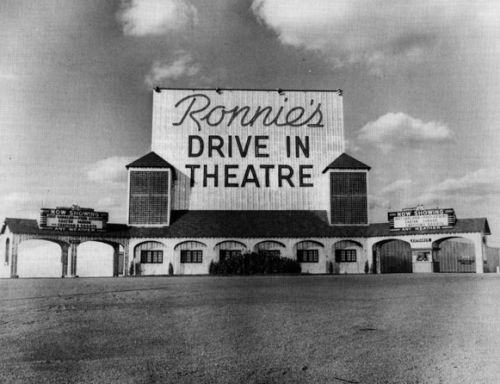
Sappington, Missouri.  Image courtesy of Stan Galczynski.

By the time I was a teenager, going to drive-ins was a thing of the past, and there were very few left.  Yes, the sound was always sucky and sometimes you had to move around to find a speaker that worked (before they began broadcasting the soundtrack over the radio), and if the lot wasn't slanted right you'd have to put up with people walking across your field of vision.  The screens themselves were often in need of repair.  I remember someone who lived in an apartment where you could see the screen if you hung out the window, and I thought that was pretty cool and where I would want to live someday (I didn't consider the fact that I'd have to hear the same movie night after night.)

Radio frequency sign at ticket booth.
Image courtesy of Dave Page.

The peak of popularity for drive-ins was 1958, when there were about 5,000 drive-ins operating in the United States.  Today there are less than 500.  There are many reasons for the decline:  rising land values; daylight savings; video rentals; the advent of color television; and getting decent (first-run was almost impossible) films are just some of them.  The rising cost of real estate due to urban sprawl may have been the single biggest deterrent.  And showtimes were limited to after dark, although there were experiments with daytime showings under tents which failed. Weather, too, played a significant role - movies were often not viewable in inclement weather, making the drive-in experience a seasonal activity in some climates.

A drive-in in Dickson City, Pennsylvania.  Image courtesy of Arnold Schuff.

There is actually a patent held for the "invention" of the drive-in theater.  U.S. Patent 1,909,537 was issued to Richard M. Hollingshead, Jr. on May 16, 1933.  He opened the first one in Camden, New Jersey on June 6th of that year.  It had a 40 x 50 foot screen with 400 slots.  It only existed for three years, but by that time the idea caught on and drive-ins opened in other states.  Hollingshead originally planned his "invention" at his home, nailing a screen to trees, and determining the space for vehicles in his driveway.

Hollingshead's drive-in.  Image courtesy of www.wired.com.

Because drive-ins were a popular dating venue they gained a reputation for being "dens of iniquity", and the media called them "passion pits."  They also tended to show "B" movies.  Soon they began to offer exploitation films, some made specifically for drive-ins.  In the 70s, some drive-ins began showing porno films in an attempt to generate more income.  This became problematic in crowded areas, and even at drive-ins in remote, rural areas.  It was difficult to be sure the viewers were of age.

Newspaper ad for the Evansville, Indiana Westside Drive-in.
Image courtesy of Bruce Lacoste.
Ad for the Rustic Drive-in in North Smithfield,
Rhode Island.  Image courtesy of Quahog.

Some drive-ins lent themselves to other activities, such as religious services on Sunday, swap meets, flea markets, and concerts.  To augment the money they made from sales at snack bars or concession stands, some drive-ins had playground areas for children, petting zoos, miniature golf, and sit-down restaurants.  Because cars often snuck people in without paying for them, drive-ins started to charge per car admission prices.

Image courtesy of Wikipedia.
Concession at the Fort Myers, Florida drive-in.  Image courtesy of Dave Page.

In the past decade, there has been a revival of sorts that has been called the "guerrilla drive-in movement."  Showings are advertised online, and films are projected on the walls of buildings, warehouses, or even giant bridge pillars.  Most of these showings are cult, independent, or experimental films.  Inflatable screens have been developed, and are often used for showing films outdoor, as well as for sporting and other social events.

An autokino event in Hückelhoven, Germany.  Image courtesy of Wikipedia.
An inflatable screen in Brussels, Belgium.  Image courtesy of Wikipedia.

Those of us of a certain age remember a classic comedy routine by Cheech & Chong - Pedro and Man at the Drive-In (on their album Los Cochinos.)  There are a limited number of drive-ins left in the U.S., which is sad because great childhood memories are meant to be shared.

***************
Unless otherwise noted, images courtesy of www.drive-ins.com
*******************************

Tuesday, January 24, 2012

The Big Sirs of Big Sur


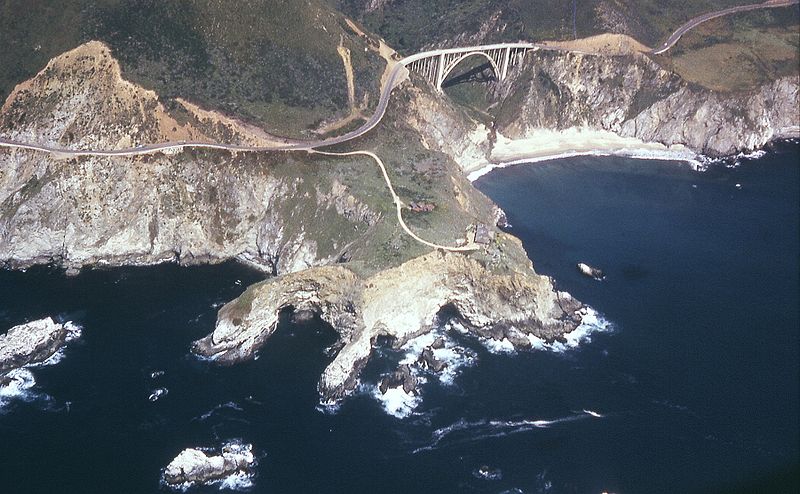
Big Sur is the short, anglicized name for el país grande del sur or "the big country of the south" because it was an impenetrable region south of Monterey, the capital of the Spanish colony of Alta California.  It is a unique spot in the U.S. for two reasons:  Cone Peak, the highest coastal mountain in the contiguous 48 states (5,155 feet above sea level); and arguably one of the most scenic driving routes in the world.

The famous "Dinosaur Rock" and Bixby Bridge.

The area basically runs along California State Route 1 between San Simeon and Carmel, covering 90 miles of coastline, and ranging from 3 to 20 miles inland. Since its discovery by non-natives, it has remained almost inaccessible.  Up until the 1920s only two of the few homes in the entire region had electricity from water wheels and windmills.  In the early 1950s connections were made to the California electric grid.  Highway 1, a two-lane road, was completed in 1937 as the Roosevelt Highway, but in 1939 it was incorporated into the state highways system and renamed.  It was designated as the first State Scenic Highway in 1965.

Image courtesy Stan Russell/www.bigsurcalifornia.org.

It remains sparsely populated today, with no urban areas but small clusters of businesses.  The area economy is based on tourism, although there is less than 300 rooms on the entire 90-mile stretch with 3 gas stations, according to the Chamber of Commerce.  There are no chain hotels, supermarkets, or fast-food outlets, and the area adheres to strict codes which do not allow billboards or commercial development, as well as prohibitions against any new construction within view of the highway.

Image courtesy of Lee W. Nelson.

This is unusual in a state where coastlines are studded with pricey enclaves of expensive homes.  Protected once by its remoteness, it is now also protected by law and the efforts of environmentalists.  Despite and because of its isolation, the area attracts nature lovers and artists of all media.  Specifically, this rustic, secluded landscape has attracted a number of famous writers.

Jeffers in 1937, photographed by Carl Van Vechten.

John Robinson Jeffers, the poet and environmentalist, was one of the first to succumb to Big Sur's beauty.  Jeffers was known as an outdoorsman, and his work speaks of the natural world in epic form, often compared to the ancient Greek poets.  Most of his poems were set in Big Sur and explored the relationship of humans to the beauty of nature.  He was at his peak in the 1920s and 1930s, but his popularity declined and his work questioned after his opposition to U.S. involvement in WWII.

Hawk Tower, named for a hawk that appeared when Jeffers was
working on the structure then disappeared when it was done.

Hawk Tower on left, Tor House on right.  Tor House was his home where he
wrote his major poetical works.  Image courtesy of www.torhouse.org.

Although his work has been marginalized, Jeffers has been translated and published all over the world, and influenced many authors.  He also has been admired by several photographers of the early 20th century, including Ansel Adams, Morley Baer, and Edward Weston.  Today he is an icon for environmentalists.

Henry Miller in 1940, photographed by Carl Van Vechten.

Henry Valentine Miller was a novelist and painter.  His work was initially banned in the U.S. as it was considered obscene with detailed accounts of sexual encounters.  He had moved to Paris in 1930, but returned to the U.S. ten years later and settled in Big Sur where he continued to write challenging works.  His banned books were smuggled into the country, giving him an underground, notorious reputation, and inspiring the Beat Generation of writers.

The Henry Miller Library in Big Sur, founded by his friend, Emil White.
This houses a collection of his works and serves as a public gallery with
performances and workshop spaces for artists, musicians, and writers.
Image courtesy of the Henry Miller Library.

His book Tropic of Cancer was finally published in the U.S. in 1961 which led to obscenity trials resulting in a Supreme Court ruling that declared the book a work of literature.  But he was not just a fiction writer; he wrote excellent travel books, especially about Greece.  After his death at the age of 88, his ashes were scattered in the waters off Big Sur.

Richard Brautigan

The troubled writer Richard Brautigan's first novel was A Confederate General From Big Sur.  It met with little success, but his other novel which followed was Trout Fishing in America, which brought him fame and labeled him a representative of the counterculture of the late 1960s.  Although he was averse to middle class values and conformity he is not considered a Beat writer.  There is not a great deal of information about his life, but at some point(s) he experienced and was inspired by Big Sur.

Jack Kerouac by Tom Palumbo, circa 1956.

Jean-Louis "Jack" Kerouac was one of the founders of the Beat Generation.  After he attained fame and acclaim, he needed to escape his life on Long Island:  "Drunken visitors puking in my study, stealing books and even pencils...Me drunk practically all the time to put on a jovial cap to keep up with all of this but finally realizing I was surrounded and outnumbered and had to get away to solitude again or die." (Quoted from his book Big Sur.)  He found it at Big Sur in a little cabin.  The cabin was owned by his friend, Beat poet Lawrence Ferlinghetti.


He wrote the novel in 1962.  It is another autobiographical fiction piece telling of the events of his alter-ego living at Big Sur.  Another quote from the book:  "So later when I heard people say 'Oh Big Sur must be beautiful?' I gulp to wonder why it has the reputation of being beautiful above and beyond its fearfulness, its Blakean groaning roughrock Creation thoes, those vistas when you drive the coast highway on a sunny day opening up the eye for miles of horrible washing sawing."  In 2012 the movie Big Sur is due out - based on the novel and filmed in Big Sur.

Hunter S. Thompson in 1988.

Hunter Stockton Thompson, the creator of Gonzo journalism, where reporters become the stars of their own stories, was also a brief resident of Big Sur.  For eight months he worked as a caretaker and security guard at the Big Sur hot springs in 1961 (now the Esalen Institute).  During this time he wrote two novels, Prince Jellyfish and The Rum Diary, as well as short stories but with no success. (The Rum Diary was eventually published in 1998.)  He did get a national publication (Rogue magazine) to publish his feature on the bohemian culture of Big Sur, but the publicity got him fired from the hot springs.


These writers have one thing in common, besides an appreciation of raw beauty: they are iconoclasts.  A rare and untamed wildness attracts the rare and untamed. There is a synchronism there.

***************
Unless otherwise noted, images courtesy of Wikipedia.
*******************************

Monday, January 23, 2012

The View From the Top

Ocean City Ferris Wheel on the boardwalk in New Jersey.

George Washington Gale Ferris, Jr. was an engineer from Pittsburgh whose firm specialized in testing and inspecting metal for use in bridges and railroads.  In 1891, the directors of the World's Columbian Exposition to be held in 1893 in Chicago, issued a challenge to American engineers.  They sought a monument for the expo that would surpass the structure built for the Paris International Exposition of 1889 - the Eiffel Tower.  They asked for something "original, daring, and unique."  Ferris was intrigued and designed a rotating wheel that would allow visitors to see the entire expo and would "out-Eiffel Eiffel."

The Ferris Wheel of the 1893 Chicago World's Columbian Exposition.

This idea was not greeted with enthusiasm, as it was thought it would be unsafe and topple over.  But Ferris obtained opinions from other established engineers, and then secured financing from local investors to cover the construction costs of $400,000.  It was built with 36 cars accommodating 2,160 people.  38,000 people rode it daily; before it was demolished in 1906 some 2.5 million people had ridden on it.  It was 264' tall and the main axle weighed 71 tons.  A ride cost 50 cents and took 20".  It closed in April of 1894 and was dismantled and stored.  The following year it was rebuilt in the Lincoln Park area where it was in use from October of 1895 to 1903, when it was again dismantled and moved to St. Louis for the 1905 World's Fair.  It was destroyed in 1906 with dynamite in a controlled explosion.

Another view of Ferris's wheel.  The 45' axle was the largest
single piece of forged steel ever made at that time.

Ferris died before settling a lawsuit he began against the 1893 Chicago Expo for his and his investors' share of the profits from the Ferris wheel.  Looks like karma may have had a hand in this, as Ferris got his idea from three wooden wheels built by William Somers in Asbury Park and Atlantic City, New Jersey, and Coney Island, New York.  Ferris had ridden the Atlantic City wheel a year before designing his. Somers had been granted a patent for a "roundabout", and sued Ferris for infringement.  But Ferris and his lawyers had prevailed by arguing that his technology was different and the case was dismissed.

A 1656 engraving of a pleasure wheel by Adam Olearius.

Drawing by En:User:Ridetheory (Wikipedia) after a 17th C. drawing.

Pleasure wheels are thought to have been invented in Bulgaria in the 17th century. The first ones had chairs suspended from large wooden rings which passengers rode as men turned the rings.  Antonio Manguino, a Frenchman, brought the idea to the U.S. in 1848, when he constructed a small wooden pleasure wheel at a fair he ran in Georgia.

The Wiener Riesenrad at Prater amusement
park in Leopoldstadt in Vienna.

In 1897, the Wierner Riesenrad (Viennese Giant Wheel) was built to honor Emperor Franz Josef I's Golden Jubilee.  From 1920 to 1984 it was the world's tallest - 212.4', and had 30 passenger cars.  It burnt down in 1944, but was reconstructed with 15 passenger cars.  It remains today one of the top tourist attractions in Vienna.

The Singapore Flyer.  Image courtesy of http://listverse.com.
Inside one of the capsules of the Singapore Flyer.

The current tallest in the world is the Singapore Flyer, which is 541'.  It has 28 air-conditioned cars that hold 28 passengers each, and have restrooms and bars within.  It opened on February 11, 2008.  The cost was based on a lucky number - 8,888 Singapore dollars (about $6,988 U.S. dollars today).  Ferris wheels are also known as observation wheels, and this one seems to nail the concept, drinks included.

The Cosmo Clock - still the world's largest clock. 
The Cosmo Clock at night.

A previous holder for title of tallest ferris wheel in the world is the Cosmo Clock, constructed in 1989 for the '89 Yokohama Expo in Yokohama, Japan.  It was the tallest from 1989, when it was constructed, until 1997.  It has 60 cars that hold 8 people, and a complete rotation takes 15".  It is still the world's largest clock.

The Tiajin Eye on the Yongle Bridge (formerly the Chihai Bridge).
The Tiajin Eye at night, reflecting on the Hai River.

One of the most unusual ferris wheels is the Tianjin Eye.  It is 390' and is built on the Yongle Bridge crossing the Hai River in Tianjin, China.  Built in 2007, it is the only ferris wheel in the world built on a bridge.  It can handle 770 riders an hour in its 48 cars, and takes 30" for a complete rotation.

The Pacific Wheel at the Santa Monica pier.  Image courtesy of listverse.com.

A famous ferris wheel that has appeared in numerous films, TV commercials, and music videos, is the Pacific Wheel.  Located at the Santa Monica Pier at the end of Route 66, it was built in 1996 and featured 5,392 light bulbs.  It stood for 12 years, then was sold on eBay for $132,400 of which half was donated to the Special Olympics.  Its replacement is almost identical, but has 160,000 energy-efficient light bulbs and is the world's only solar-powered wheel.  It is 90' tall, and stands just 130' from the Pacific Ocean.

The Big-O, with the Thunder Dolphin going through it.  Image courtesy of listverse.com.

The Big-O is in Tokyo, Japan, and has the distinction of having no center axle, no spokes, and no internal support structure.  Instead, the wheel is held up by two side supports.  To make things even more interesting, Japan's tallest and fastest roller coaster, the Thunder Dolphin, runs through the middle of its 200' rim.


The London Eye.
Inside an "Eye" pod.

Opened at the millennium on New Year's Eve, the London Eye is the world's third largest ferris wheel, and the largest in the western hemisphere.  Supported on only one of its two sides, it is a cantilever wheel which provides riders with a pretty much unobstructed view of London.  The cars are attached to the outside rim by rotating circular mounts so that a full 360-degree panoramic view can be seen from the top.  It is slow enough that it doesn't have to stop for passengers to embark and disembark, and a full rotations takes 30".  It carries 10,000 riders a day, or more than 3 million annually.  The cost is £14.50 (roughly $22.60 U.S.)


But perhaps the most famous and beloved in the U.S., or at least the east coast, is the Wonder Wheel.  This was built in 1920 in Coney Island, and along with Nathan's hot dogs is an icon.  It is 150' tall with 24 cars that hold 144 riders.  It was built by the Eccentric Ferris Wheel Company.  This type of wheel is known as an eccentric wheel, as some of the cars slide on rails between the hub and rim as the wheel turns, instead of being fixed to the rim.  Mickey's Fun Wheel at Disneyland was inspired by the Wonder Wheel.

Sky Whirl in Gurnee, Illinois, 2000.

Today taller and more technologically advanced ferris wheels are being designed and built.  It was announced last year that there will be a 550' one to be built in Las Vegas.  Moscow announced a proposal to build a 722' one, but the timeframe and site have yet to be determined.  There are also double and triple wheels, Sky Whirl being the first triple wheel, debuting at Marriott's Great America parks in California and Illinois simultaneously in 1976.  We are probably most familiar with transportable ferris wheels that can be mounted on trailers and moved intact or easily dismantled and rebuilt.  There are notable ones in this category, but most of us have seen the small ones that can be found in traveling fairs.

The Roue de Paris, one of the most famous transportable
ferris wheels, here pictured in the Netherlands in 2005.
It has operated in France, England, Belgium, and Thailand
as well as the Netherlands.  It can be erected in 72 hours
and dismantled in 60.  It uses a water ballast for a stable base.

Bigger and higher seem to be the goals in ferris wheel designs, but faster is left to that other amusement ride - roller coasters.  To have a commanding view of a location, ferris wheels are the way to go!

***************
Unless otherwise noted, images courtesy of Wikipedia.
*******************************

Friday, January 20, 2012

Mercedonius: Cheating with the Marking of Time

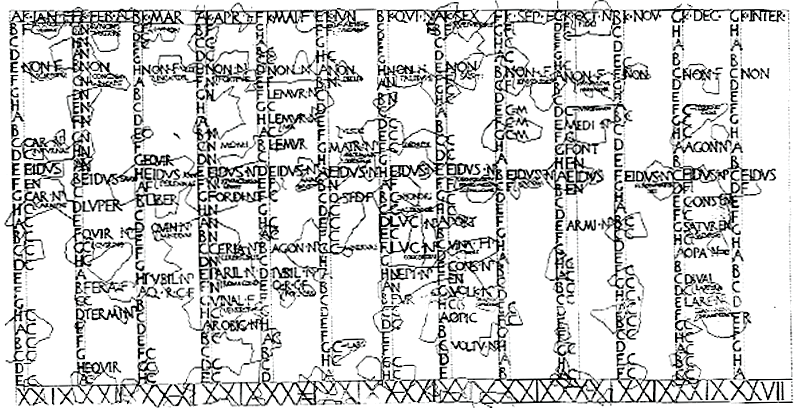
Fasti Antiates Maiores, part of a fresco found at Nero's villa at Antium, shows
a pre-Julian calendar with the months Quintilis (QVI) and Sextilius (SEX).

Before the Julian calendar was introduced in 46 BCE, the Roman calendar was in use.  One of the versions of the Roman calendar was supposedly invented by Romulus, legendary founder of Rome, and had ten months with 30 or 31 days in each month, for a total of 304 days:  Martius, Aprilis, Maius, Iunius, Quintilis, Sextilis, September, October, November, December.  This was "fixed" by Numa Pomilius, the king of Rome who succeeded Romulus.  He added Ianuarius and Februarius for a total of 12 months and another 57 days, which totaled 355 days. This was a lunar calendar, but to align the calendar with the solar year a leap month - Mercedonius - was added from time to time in the middle of February, resulting in a year that was 377 or 378 days long.

Fasti were chronological or calendar-based lists of sanctioned
events.  Derived from the word fas, meaning what is allowed.
The word came to denote lists organized by time.  This example
is a fragment of a Roman calendar in the Museo Epigrafico, Rome.

Intercalation is the insertion of a leap year, month, or day into a calendar to adjust its length so that it follows a solar year or the moon phases.  In the traditional leap year for some countries in the West which follow the Gregorian calendar, a day is added every four years.  This is because this calendar is a solar calendar which has 365.24 days.  Thus the extra day every four years helps us "catch up". This extra day is added to the end of February and is an intercalary day. Mercedonius was an intercalary month in the Roman calendar, but was not added on a scheduled basis.

Image courtesy of Facebook's The Loyal Society of
the Most Noble Order of Mercedonius.

Mercedonius comes from the Latin word merx, for which one meaning is wages (where "mercenary" also derives from), since it occurred at the time of year when workers were paid. The decision to add the month to a year was made by the Pontifex Maximus, the high priest of the Collegium of Pontiffs in ancient Rome. This group and office were also founded by Numa Pompilius, and were thought to originally act as advisors to the king on religious matters.  They had control over religious rites, funds, institutions, and the instruction of religion. But their real power came when the monarchy of Rome was abolished, and those sacral duties of the former king were given to the Pontifex Maximus.  His greatest power was administering divine law - divine law as interpreted by the Collegium.

Augustus as Pontifex Maximus,
circa last decade of 1st century CE.

So the Pontifices became politicians, and the office was often held by statesmen. Since one of their duties was to regulate the calendar, and since a magistrate's term of office corresponded with a calendar year, this became a convenient political tool.  When one of his allies was in power the Pontifex could lengthen the year; when his opponents were in power he could refrain from lengthening it and effectively force them out of office.  It also affected contracts and other legal arrangements.  Since it was often decided late to add Mercedonius, this caused the people, especially those outside of Rome, to not know the date.  Eventually the years became very much out of sync with the seasons.  For example, Julius Caesar's crossing of the Rubicon on January 10 in 49 BCE, was actually in mid-autumn.  This abuse of power over the calendar led to the calendar being so out of alignment with the solar year that the vernal equinox occurred three months later, in June instead of March.

The Tusculum Portrait of Julius Caesar, possibly the
only surviving bust made during his lifetime.

The last years of the pre-Julian calendar are known as the "years of confusion" because the calendar was so out of alignment and there seemed to be no rhyme or reason to it.  Mercedonius was eliminated by Julius Casesar when he introduced the Julian calendar, which remained aligned to the sun without mediation.  Finally dates could be assigned to the seasons, which was impossible prior to this time. The Julian calendar gave alternate months beginning, with January, 31 days; the other months 30 days, except for February which had 29 (but every fourth year, 30).  He also renamed Quintilis, in honor of himself, Iulius.  Augustus followed suit by changing Sextilis to Augustus, but since this day had only 30 days he added an extra one so he would have the same amount of days in his month as Iulius.  This required other months to be changed.  Later emperors also renamed some of the months after themselves, but these didn't stick.

Pope Gregory XIII, circa 1570-1585, by Lavinia Fontana.

Still, the year was not in line with the vernal equinox, as Julius Caesar's astronomer, Sosigenes, calculated the astronomical year to be 11 minutes and 14 seconds longer than it is.  Pope Gregory XIII in 1582 made changes so that the real astronomical equinox, which was important as it was used to calculate the date of Easter (determined by the First Council of Nicaea in 325 CE to be the first Sunday after the full moon following the northern hemisphere's vernal equinox), would fall on the right date.  One change was in determining leap years.  Years that are divisible by four are leap years; century years are leap years only if they are divisible by 400.  Pope Gregory XIII was himself motivated to change the calendar not in the interests of making it correct, but to restore the edict for the date of Easter by the Council of Nicaea.

Illumination of the earth by the sun at the vernal equinox.
Illustration made by DNA-webmaster (Wikipedia) with NASA image.

The Julian and Gregorian calendars are still imperfect, but both are still followed in the West.  Politics reigned from the imposition of Mercedonius to assuring the calendar supported the Council of Nicaea's edict.  Thankfully, modern politics are more civilized and would never resort to these kind of machinations.   ;-)

***************
Unless otherwise noted, images courtesy of Wikipedia.
*******************************