WELCOME TO CEREBRAL BOINKFEST!

WELCOME TO CEREBRAL BOINKFEST!

A blog about the arts, books, flora and fauna, vittles, and whatever comes to mind!

Note: Comments are moderated. If you include a link, your comment will not be published. As you will note, I do not accept ads on my website and that includes in comments.


Tuesday, March 22, 2011

"Mad as a March Hare"

The March Hare from Alice's Adventures in Wonderland by
Lewis Carroll.  Illustration by Sir John Tenniel.  The Hare
wears straw on its head, a sign of madness in Victorian times.

The saying "mad as a march hare" is an old one, and refers to the "madness" exhibited by hares as their breeding season commences, which in Europe is February or March.  Their season actually lasts until September or so, but apparently the first signs of their mating behavior struck an impression.  The saying has been expanded to refer to anyone who exhibits excitable or unpredictable behavior.

This "mad" behavior in hares includes "boxing", leaping over each other, jumping vertically (we call that "bunny bowling" at our house) and other rather frivolous behavior.  It was thought that the "boxing" with their forelegs was a sign of males competing for supremacy (the old testosterone flaring up), but scientists now know that it's the females repelling the males unwanted attentions.

A European hare.

The saying was a common one in Carroll's time.  An early poem referred to it that was written around 1500 - Blowbol's Test (author unknown) - which was first printed by W. C. Hazlitt in 1864 in his book Remains of Early Popular Poetry of England:

Thanne they begyn to swere and to stare, 
And be as braynles as a Marshe hare

(Then they begin to swerve and to stare,
And be as brainless as a March hare)

In 1528 John Skelton in his Replycacion wrote "Aiii, I saye, thou madde Marche Hare".  The book Magnyfycence in 1529 has "As mery as a marche hare".  The phrase also appears in John Heywood's collection of proverbs which was published in 1546.

The phrase has been in continuous use since the 16th century, but Carroll made it even more popular by naming one of his main characters the "March Hare".  This character is wacky, and always behaves as if it is tea time.  Subsequent interpretations of the Wonderland story always features a crazy rabbit - be it movies, cartoons, anime, or new books.

Thackery Earwicket, the March Hare from Tim Burton's film version of
Alice in Wonderland.

There is a similar tradition about the "myth of the moon gazing hare", which is the pagan belief that seeing a moon gazing hare will bring abundance, growth, and good fortune.  In pagan times the hare was sacred to the goddess Eostre and eventually evolved into the Easter bunny, yet another translation of pagan beliefs.

One can be "mad as a hatter" as well.  Mercury salts once were used in curing pelts from which hats were made.  Hatters and mill workers often inhaled the fumes and suffered from mercury poisoning, which resulted in neurological damage including vision and speech problems.  This phrase was also common in Carroll's time, occurring in print in 1937 in Thomas Chandler Haliburton's The Clockmaker.

The Mad Hatter by Sir John Tenniel.

There are several alternate theories as to the origin of the phrase, including pertaining to an "adder" - whose venom is poisonous.  "Atter" was the Anglo-Saxon word for adder.  Therefore "mad hatter" has been said to mean as angry as an adder.  It's unclear what Carroll believed, however in Through the Looking Glass, the March Hare and the Mad Hatter were friends.

This March has certainly been mad, from crazy weather to natural disasters.  If I see a hare with a hat on I'm running as far away as I possibly can!

***************
All images courtesy of Wikipedia.
*******************************

Monday, March 21, 2011

St. Norbert's Monastery

Saint Norbert. 

When I think of a monastery I picture a very austere place, bare, somewhat dank, with tiny little rooms with cots for the monks, a large church, and gardens, a brewery and a winery, and bees.  If I'm in a romantic mood and thinking back in time there is a scriptorium, where monks copy books.  Closer to the present time there is a library, but it is sparse, severely decorated, and without a copious amount of books.

Possibly my connotations come from growing up near the San Fernando Mission, where my little friends and I often went to beg for oranges and creep down into the cellars when the padres weren't looking.  Actually the padres were very kind, but insisted we stay in the public areas, and let us have all the oranges we could eat from the fields that then bordered the mission.  There was evidence of winemaking, although I really didn't know much about it, but no brewery.  I must have gotten that from movies.

Years ago I became curious about St. Norbert.  In learning about him I came across a beautiful monastery that quite exceeded my conceptions.  It is the Strahov monastery in Prague.  It is the second oldest monastery in the city, and quite extraordinary.

Present-day.

Saint Norbert of Xanten, born in 1080, was the son of a count and related to the imperial house of Germany and the House of Lorraine.  As was custom at the time (and I'm sure still is), the wealthy and connected controlled the Church and its politics.  Until he had a horseback riding accident, he had no interest in the Church but found his faith, and his place within the Church was bought and he moved up the ranks quickly.

St. Norbert of Xanten.

His ideas caused some ruckus, so he quit and became an itinerant preacher and travelled in northern France where he is said to have performed a number of miracles. Eventually Pope Calixtus II asked Norbert at the Council of Reims in 1119 to found a religious order, which he did in 1120 at Prémontré, France.  Later on several assassination attempts were made on him, and he was a player in the "Great Schism" which formally divided the Eastern Orthodox Church and the Roman Catholic Church.

When he died in 1134, his body was claimed by two parties.  For centuries the Monastery of Strahov tried to get his body, and finally on May 2, 1627, he was brought to Prague and interred in the monastery where he still lies today.  He was canonized by Pope Gregory XIII in the year 1582.

The order he founded was called the Premonstratensians, after Prémontré near Laon in northeastern France.  They are also known as the Norbertines, or in Britain and Ireland as the White Canons.  Canons differ from monks.  Monks are essentially lay people who live a contemplative and cloistered life.  Canons are clerics who engage in public ministry.  It is, of course, much more involved than that, but that's the basic gist.  Canons live according to precedents set by Saint Augustine.


St. Augustine (left) handing the Augustine Rule to
Norbert (right).  From the 12th century manuscript
Vita Sancti Norberti.  

Six years after St. Norbert died, King Vladislav II built a monastery on the road to Prague Castle.  It wasn't successful until 1143, three years later, when a group of Premonstratensians moved in.  The monastery began to prosper and became a center of spiritual and intellectual life.  The original wooden buildings were rebuilt with stone, but it was redone entirely in gothic style after a fire destroyed it in 1258.

It continued to prosper until it was sacked by Hussites in 1420.  It began to decline until the end of the 16th century and was plundered and sacked again during the 30 Years War (1618-1648).  Suffering one more time in 1742 from being bombarded by the French army, most of the gothic buildings were replaced with ones in baroque style.

In 1950, monastic orders were forbidden in Czechoslovakia.  Their members were interned, imprisoned and/or executed.  Their property, including the Strahov library, was made part of the new Museum of National Literature.  The archives, music collection, picture collection and other exhibits were dispersed to other state institutions.  With the collapse of communism in Czechoslovakia in 1989, the confiscated property, including its library was returned.  
It is now an active pilgrimage destination, a museum, and an incredible library.


Bible of Jan de Selmberk from 1440.


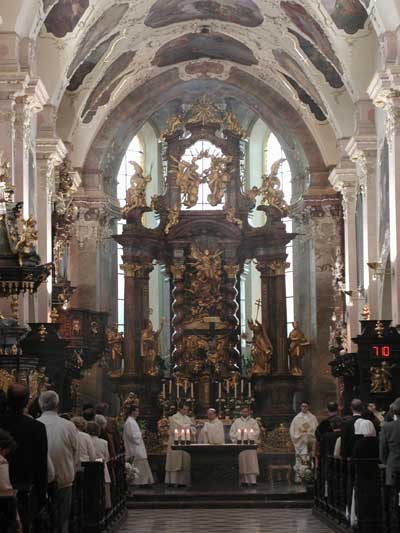
The Basilica of the Assumption of Our Lady is dedicated to St. Norbert.  It is decorated with frescoes painted in 1774 featuring motifs of the Virgin Mary and scenes from Norbert's life.  It also features an organ that Mozart played when he visited in 1787.  In a chapel once devoted to St. Ursula but now to St. Norbert lies buried an ebony coffin within a gilded brass sarcophagus.  This contains the remains of St. Norbert. 


The apse of the basilica.
The sarcophagus of St. Norbert.

But the Stahov's most astonishing feature is its library.  Divided into two halls, the Theological Hall contains religious texts and the Philosophical Hall contains philosophical texts.  There about 18,000 religious texts and 42,000 philosophical ones, many of them rare.  The library has been plundered repeatedly, but was rebuilt after the Peace of Westphalia in 1648.  The Theological Hall was constructed in 1679.  The acquisitions were so plentiful that by the end of the 18th century more room was required and the Philosophical Hall was built.

Above the texts in the Theological Hall are carved and gilded wooden decorations with cartouches.  The pictures in the cartouches and their titles tell what type of books are contained on the shelves below them.  The hall also contains a collection of 17th century globes.


The Theological Hall.

In the Theological Hall there is a compilation wheel which is a device used by 17th century scribes to compile texts.  The various texts that were to be copied were placed on a shelves.  The books were always displayed at the same angle, even when spun, thanks to a mechanism inside.


In addition to the two halls, some of the 200,000 books are in adjacent depositories.  Many are old works printed between 1501 and 1800.  There are over 1,500 incunabula and 3,000 manuscripts stored in a special treasury room.


The Philosophical Hall.
The ceiling fresco was done by Anton Maulbertsch, the
Viennese painter, over six months.  It depicts the "Intellectual
Progress of Mankind", showing the mutual impact of science
and religion on each other.


The monastery has cabinets of curiosities - those fabulous precursors to museums - taken from the estate of Karl Jan Erben in 1798.  The cabinets include parts of a dodo bird, specimens of insects, minerals, ocean specimens, and a large electrostatic device.


There is a dendrology library that consists of 68 volumes made around 1825, each one documenting a different wood.  Similar to the wooden books at the University of Padua, the panels are made from the wood of the featured tree.  The spines are titled in both Latin and German and made of bark with lichen.  Inside the books are the corresponding roots, leaves, flowers, fruits, pieces of branches, and pests.


One of the dendrology books.


The entire complex of the Strahov Monastery is still being reconstructed.  Today it bears little resemblance to the original cluster of wooden buildings.  A monument to a religious order and its perseverance through the travails of history, it once again strives for greatness.


***************
Images from the Stravosky Klaster website.
*******************************


Friday, March 18, 2011

Just One More!

Eric "Badlands" Booker

Sonya "The Black Widow" Thomas, Crazy Legs Conti, Eric "Badlands" Booker, Elizabeth "Rubber Gut" Canady, Ivan "The Invader" Hickman, Joey Chestnut, Gentleman Joe Menchetti - sound like a Mafia family to you?  Well, they are not. They are "gurgitators", competitive eating contestants.

Also known as speed eating, this is a fairly new "sport" that's becoming more and more popular where participants compete to consume massive quantities of food in a set amount of time, usually 15 minutes or less.  It is most celebrated in the U.S. and Japan, where prizes can be $10,000 or more.

Cookie Jarvis in action

The "sport" has its roots in county fairs (think pie or watermelon eating contests). Nathan's Hot Dog Eating Contest has been held every July 4th since 1916 at Coney Island.  With the advent of television this contest and others have made these competitions crowd-pleasing entertainment.

Takeru Kobayashi.  Image from his website.

There are two main camps for competitive eating:  The IFOCE (International Federation of Competitive Eating), founded in 1997 and now better known as Major League Eating; and All Pro Eating, formerly known as the Association of Competitive Eaters, which is a break-off group from IFOCE who left over contractual issues.  One major difference is that All Pro Eating advocates the picnic style rules, which means that contestants are not allowed to dip their food into liquids before consuming them.

Dipping foods in liquid, usually water but also soft drinks or other beverages, is one of the techniques used by participants.  This softens the food, making it easier and quicker to chew and swallow.  Food, which is usually one type but varied, can be eaten any way - in separate components (i.e., hot dogs first, then buns, as long as both are eaten in equal amounts), whole, or in pieces.  Japanese champion Teraku Kobayashi has his own style, which he calls the "Solomon Technique" (also called "Japanesing") which involves breaking a hot dog in half, then stuffing both halves into his mouth at once.

Joey Chestnut

There are universal rules:  no vomiting during or right after a contest.  This is called a "reversal" and disqualifies one immediately.  "Chipmunking" is the practice of stuffing as much food in your mouth as possible just before the time runs out.  This is usually allowed, but a contestant has a limited time to finish consuming the mouthful.

All foods must be consumed in a designated time period.  This can range from 7 to 15 minutes, or longer.  Any food left on serving pieces is counted against the total. Prize monies can make this "sport" a career, and some competitors earn their living this way.

Sonya Thomas.  The burger is almost bigger than her!

There is no standard body type that excels in competitive eating.  Participants range from the rather petite Sonya Thomas (weighing an average of 124 pounds) to Eric Booker (weighing about 420 pounds).  Kobayashi has a body worthy of a bodybuilder.  It has been posited that someone too fat or too muscular would not do well, as that fat or muscle would impede the stomach's expansion, but Booker and Kobayashi prove that false.

Sonya Thomas eats one large meal a day, usually from a buffet.
Eric Booker during a contest.  Photo by Ed Grabianowski.
Takeru Kobayashi.  Image from his website.

Some competitors train, although the IFOCE warns against it.  Since stomach elasticity is the key to success, many drink large amounts of water, or drink lots of water with low calorie meals like veggies and salads to stretch stomach capacity. Some also chew huge amounts of gum to build up jaw strength.  Those who do "train" will often do so for weeks or months before an event, often with the food from the impending contest.  

The dangers of this lifestyle, aside from the obvious ones of weight gain or obesity is high cholesterol and high blood pressure.  There can be stomach perforations, especially if there are ulcers.  Drinking large amounts of water can lead to water intoxication, a condition where the electrolytes in the blood become too diluted. Gastroparesis is a dangerous problem.  Also called stomach paralysis, the stomach loses its ability to contract and to empty itself.  Some of the side effects are chronic indigestion, nausea, and vomiting.

Consider the massive amounts of calories that are consumed at these events.  If each hot dog is 150 calories, and each bun is 100 calories, then eating 50 hot dogs will total 12,500 calories.  The USDA recommendation of daily calories for an adult male is 2,300.

Sixteen cups of mayonnaise in 8 minutes?  No thanks!
This is a record list from 2005 that gives an idea of the amounts consumed.  No more current chart found.


If you will be in the vicinity of Davenport, Iowa tomorrow (3/19/11), you may want to try your hand at the Rhythm City World Catfish Eating Championship. Last year's winner consumed 6.7 pounds in ten minutes.  You could win $2,500.  But then consider all the people in the world who are starving. This "sport" is not only gluttonous but rather shameful in light of world starvation.  As usual these events boil down to money.  Too bad the money isn't being spent easing world hunger.

***************
Unless otherwise stated, all images courtesy of the IFOCE.
*******************************

Thursday, March 17, 2011

Pope John Paul II, the Holocaust, and Star Trek

The Western Wall in Jerusalem.

In March 2000, eleven years ago, Pope John Paul II visited Yad Vashem, the national Holocaust memorial in Israel.  He also made history by going to the Western Wall in Jerusalem, where he left the following note:

"We are deeply saddened by the behavior of those who in the 
course of history have caused these children of yours to suffer, 
and asking your forgiveness we wish to commit ourselves to 
genuine brotherhood with the people of the Covenant."

As part of an address he gave he said, "I assure the Jewish people the Catholic Church...is deeply saddened by the hatred, acts of persecution and displays of anti-Semitism directed against the Jews by Christians at any time and in any place."  He added that there were "no words strong enough to deplore the terrible tragedy of the Holocaust."

Pope John Paul II in Denver in 1993.

Israeli cabinet minister Rabbi Michael Melchios commented on the Pope's gesture stating, "It was beyond history, beyond memory"

It is not surprising that the Pontiff had such strong feelings about the Holocaust. He had spent his formative years with close relationships within the Jewish community of his hometown.  As a young priest in his native Poland, he had to hide in his uncle's attic from the Nazis, and according to B'nai B'rith and others, he helped protect many Polish Jews from the Nazis.

In January 2005, John Paul II became the first pope in history to receive a priestly blessing from a rabbi.  Rabbis Benjamin Blech, Barry Dov Schwartz, and Jack Bemporad were visiting Pope John Paul II at Clementine Hall in the Apostolic Palace when they bestowed it.  The priestly blessing is a Jewish prayer based on scriptural verse (Numbers 6:24-27).  It can only be performed by a Kohen (plural Kohanim), a Jewish priest.  It is the oldest Biblical text that has been found, and is said to be connected to the three Patriarchs:  Abraham, Isaac, and Jacob.

During the course of the blessing the Kohen holds up his hands with the fingers separated to make five spaces between them, his head and hands covered so neither he nor the congregation can see his hands.  The position of each hand forms a Hebrew letter which is the first letter in the name of God that refers to him as a protector.


The hands are divided into twenty-eight sections, each with a Hebrew letter.
At the bottom of the hand are two letters, which combined are the name of God. 

In the mid-60s, Leonard Nimoy created a one-handed version of this gesture to accompany Spock's Vulcan greeting, "Live Long and Prosper".  He explained that as a child, raised in a traditional Jewish home, he peeked under the cloth and saw the gesture.  He and Gene Roddenberry thought it would be a good physical accompaniment for the greeting, and it went on to great fame.

Vulcan Salute.

Pope John Paul II will be remembered for his apologies.  Beside his apologies to the Jews, he also made public apologies for: the legal procedure on Galileo; the Catholics' involvement with the African Slave Trade; the Church's roles in the burnings at the stake and religious wars that followed the Protestant Reformation; and injustices committed against women, the violation of their rights, and their historical denigration.  (Although he upheld the traditional Catholic take on birth control and women in the priesthood.)

In a time when religious persecution is rearing its ugly head again, when people are dividing each other into biased groupings, we need to remember people like Pope John Paul II.  As an atheist even I can remember with gratitude his good works.  May the whole world live long and prosper...

***************
Images courtesy of Wikipedia.
*******************************

Wednesday, March 16, 2011

The Infamous Rock and Roll Hall of Fame...

Alice Cooper, Neil Diamond, Dr. John, Darlene Love, Tom Waits...
...and Leon Russell.

"This is supposed to be a hall of fame...if they renamed the place 'Rock and Roll 
Hall of Artists You Should Have Liked More Than the Ones You Actually Did',
I would not begrudge them these exclusions."    ~    Roger Wade

Each year I am surprised to learn of the Rock and Roll Hall of Fame's newest inductees.  Usually my reaction is "What - they aren't in already?", but often it is "WTF?"  The former was pretty much my reaction to this year's inductees - Alice Cooper, Neil Diamond, Dr. John, Darlene Love, and Tom Waits.  Leon Russell was inducted as the recipient of the first Musical Excellence Award, in the "Sidemen" category (he did play as a sideman with Joe Cocker, George Harrison, the Byrds, and others).  But there is a lot of contention with the Hall of Fame.

The Rock and Roll Hall of Fame in Cleveland by Lake Erie.

First of all, the board is made up of non-musicians.  Fans have no input.  Groups associated with certain companies or labels are said to have been nominated without discussion.  A past board member lamented that none of the choices were big enough names to sell tickets to the award dinner, so a doo-wop group was removed in favor of a big name artist.  Some artists have been inducted before or to the exclusion of the artists who so clearly influenced them.

The process and numbers are never revealed, so anything could go on.  In 2007 there was a rumor that the Dave Clark Five should have been selected, as they had more votes than two of the inductees.  The Hall of Fame denied fixing the vote, stating that some of the votes were not received in time.  The next year, however, the DC5 was inducted.

Some voters have not submitted ballots because they didn't feel any of the candidates were worthy.  What does this say about the process?  The Sex Pistols were inductees for 2006, however they refused the honor.  The following letter was sent by them to the Hall of Fame:

Sent by the surviving members of the group, 2/24/06.
Image courtesy of Wikipedia.

To be considered, an artist or group must wait twenty-five years after the release of their first record.  The nominees should have demonstrable influence on and be significant in the history of rock and roll.  There are four categories:  performers; non-performers, aka The Ahmet Ertegun Award (for music industry people such as producers, djs, concert promoters and journalists); early influence (early artists of genres which influenced rock and roll, i.e., Hank Williams, Howlin' Wolf, Louis Armstrong, Billie Holiday); and sidemen (session and concert players).

That the Hall of Fame is big business is reflected in the annual music competition for amateur company-sponsored bands in the U.S., Europe, and Australia.  Created in 2001, the Fortune Battle of the Corporate Bands is a contest whose proceeds benefit the Rock and Rock Hall of Fame Museum.  Sponsored by Fortune magazine, Gibson Guitar Corporation, Continental Airlines, among others, it has been called the "celebration of musicians with day jobs".  Entrants must be amateur and 50% of the group must work for the same corporation.


The winner of this competition is hailed as "the best corporate band in America", and receive an all-expense paid trip to the annual NAMM show where they are a featured performer.  Their name and photo is displayed at the Hall of Fame for a year as part of a permanent exhibit honoring the contest.  It is meant to boost the museum's profile in the business community, and increase exposure for the corporations through the media attention and recaps in Fortune magazine.

I should know better, but all of this is disappointing.  Rock and roll is supposed to be about being outside the box, being a rebel, an original, anything but a corporate tool.  If it wasn't controlled by business people, or at least included musicians and fans, it might have more credibility.  But it seems one can't escape politics.  I'm off to put my headphones on and listen to my own hall of fame......

***************
All images, unless otherwise stated, courtesy of the Hall of Fame.
*******************************

Tuesday, March 15, 2011

Anorexics and Bulimics Need Not Apply

Aysashōrū Akinori at the January 2008 tournament.
This Mongolian champion is 30 years old, weighs 330 lbs. and is 6' tall.
Photo by Eckhard Pecher via Wikipedia.

The guy above is a rock star.  Sort of.  In Japan, he was one of the top sumo wrestlers until he retired last year.  Sumo wrestlers in Japan are big celebrities. They also make big money.  There are six divisions within sumo wrestling, and they follow a strict hierarchy.  A second level wrestler will make about $11,000 a month; a top wrestler about $30,500 a month, according to 2006 figures.  This doesn't count extra money from bonuses earned at tournaments, prize monies, and bout prizes from sponsors.  First level wrestlers only earn an allowance until they prove themselves and move up in rank.

Aysashōrū wrestling Kotoshogiku at the January 2008 Tournament.
Photo by Eckhard Pecher via Wikipedia.

But this isn't easy money!  The payoff is a shorter lifespan - sumo wrestlers live to be 60-65 years of age compared to the average 75 years of an average Japanese man.  They live in communal training stables.  Those at the bottom (the ones who only get allowances) do most of the chores.  Those near the top live pretty well. Everyone trains every day.  They do not eat breakfast, but they eat a huge lunch, mostly a stew made with a variety of fish, meat, rice, and veggies, swallowed down with beer.  Subsequently they nap - this huge meal and then sleeping afterward is what puts the weight on.  But the weight can lead to diabetes, high blood pressure, and heart attacks, as well as liver problems from the alcohol and arthritis from the stress on joints.

The unranked working out at Tomozuma Stable in Tokyo, January 1998.
This is an end-of-the-workout ritual dance to help build teamwork.

There are no weight restrictions or standards, and smaller men can win against much larger ones.  The art of sumo is to push your opponent out of the ring, or make him place a body part other than the soles of his feet on the ground.  That's it!  Bouts usually last about a minute, but can end in seconds.  Part of the routine is to psych your opponent out.  Each bout starts by performing a number of Shinto rituals.  Then the opponents commence with staring.  Sometimes the wrestlers move back and resort to more mental preparation and/or staring.  If it goes on too long, the referee can order them to begin the bout.

Yokozuna Ashoryu performing a ritual of his rank blessing the ring.

The ring today is made of rice-straw bales on top of a layer of sand and clay.  They are just under 15' in diameter.  A new one is built for each tournament.  At the center are two white lines which position the wrestlers at the start.  Some have roofs resembling Shinto temples.  Around the ring is a layer of finely brushed sand that is used to determine if a wrestler touched anywhere outside of the ring.  This is checked and fixed if necessary before each bout.

The layout of the ring and placement of the participants.

There are six grand sumo tournaments each year, in all the odd months - January, March, May, July, September, and November.  This year, the March one has been cancelled when three of the wrestlers admitted to rigging bouts.  This is a strictly operated sport, and there have been few proven incidents of wrong-doing, however they do happen.

At the grand tournaments, the wrestlers are introduced to the audience one at a time in order of ascending rank.  They enact various rituals, including forming a circle facing outwards toward the audience.  Then they go to their respective dressing rooms and change into wrestling clothes.  They come back out two bouts before their first one, and sit at the side of the ring.

As part of the ring-entering ceremony, sumo wrestlers gather around the referee.

Although women are not allowed to participate in the sport, upper division wrestlers can marry.  They live with their families in apartments at the stables. There were female sumo wrestlers in the past, but they were mostly associated with brothels.  There are some amateur events for female wannabees.  Women, however, cannot enter or touch the professional ring.  There have been complaints about this, however it was decided that it would be dishonorable to the ancestors to allow women in the sport now.

Sumo has a history that began professionally in the Edo period, about 1600 CE.  It is associated with the Shinto religion, and is rumored to have begun as an entertainment for the Shinto gods.  In the Edo period it was both a test for strength in combat, and as a way of honoring Shinto rituals, strong ties that it still retains. The ring concept came into being with the Edo warlord Oda Nobunaga who organized tournaments.  The participants then were mostly Samurai and Ronin, who sought extra income.

Woodcut print of Somagabana Fichiemon, 1850,
by Toyokuni Utagawa aka Utagawa Kunisada.

Although there is a tradition of wrestling similar to sumo in the nations adjacent to Japan, Japan is the only country where sumo is practiced professionally.  Foreign-born wrestlers have been admitted to the sport, but when one stable recruited six Mongolians in 1992, an unofficial restriction was put on admitting foreigners, and none were recruited for the next six years.

A sumo wrestler throwing a foreigner at Yokohama in 1861.
This was a popular theme at the time.

The sumo wrestlers have a huge fan base, and there is a lot of memorabilia available.  If one buys either box or front row seats the tickets typically come with items.  These can be purchased separately as well.  While plates and cups are common, one of the most highly regarded is the tegata.  This literally means "hand shape" and is the sumo version of an autograph.  The hand print is in black or red ink with the wrestler's fighting name written in calligraphy by the wrestler himself. Originals can be pricey, but printed copies are affordable.  Only wrestlers in the top two divisions are allowed to make these.

Tegata by sumo wrestler Terao.

Sumo wrestlers are required to grow their hair long enough to wear in a topknot, and they are expected to wear the topknot and traditional Japanese clothes in public.  Each rank has different dress codes.  Women are very attracted to them, and they are big celebrities.

So eating a lot, napping, being kowtowed to, and honored sounds great.  But every great thing has its drawbacks, and the health problems, plus the loss of general mobility are big considerations.  Decisions, decisions!  In this, I am glad to be a woman.  ;-)

***************
All images courtesy of Wikipedia.
Go to the official sumo organization site for details on the current schedule and players.
*******************************

Monday, March 14, 2011

The Book Art of Robert The

Assortment of bookguns from the 90s by Robert The.

"Obsession with the semiotic erosion of meaning and reality led me to create 
objects that evangelize their own relevance by a direct fusion of word and form.  
Books (many culled from dumpsters and thrift shop store bins) are lovingly
vandalized back to life so they can assert themselves against the culture which
turned them into debris."          ~          Robert The, 1995

The California-born New Yorker has found a unique way to repurpose old books - he cuts them up.  Although he has made a number of different object, the most popular are his bookguns, which he began creating in 1991.

"Statement", 2003.

"Poetic Justice", 2003.
"The Medium", 2006.

The started out with interests in language and logic, so studied philosophy and mathematics at the University of Wisconsin, Madison.  Then he became interested in letters, first studying calligraphy, then hand-lettered sign painting.  He conceived of carving books and found many - too many - in the trash.  He took his first works into a gallery in SoHo, and was surprised to sell them.

"Desert Rose", 2004.
Created with 30 hollowed out KJV bibles.
One of his smaller works ala "Desert Rose".

A year later and his works are in major collection all over the U.S., including MOMA, the Norton Family collection, the L.A. Museum of Contemporary Art, Yale University, the Fine Art Museum of San Francisco, and the New York Public Library.

"Reader's Digest Cake" with wax frosting, 1998.

The doesn't consider himself part of "The Art World", but an outsider.  He is more a part of "The Design World".  He would rather sell at retail shops than galleries. He has sold virtual art on eBay.  He sold "this present moment" - what the winner actually got - for $13.21.

Bible grenade, 2001.

Author Jonathan Lethem was gifted with a bookgun made from his novel Gun, With Occasional Music. Far from being upset that his book was cut up, he instead saw it as a reward that he never imagined.  He uses it as an example in his excellent essay for Harper's Magazine discussing the appropriation of thoughts and ideas and arguing for more permissive copyright laws in the interests of creative expression.

"Britannica Vol. 14", 2008.

The's works are commentaries on language, but also are toys, so we can say he toys with language.  He was said to be inspired by ethnic crafts, which are often viewed as toys rather than art.  He realized that the people who make these have no presence in the art world.  He, too wanted to make objects that were not "high art", but that people could touch.

Simple, yet brilliant, The repurposes books and in a sense challenges viewers/handlers to make their own meanings.  These meanings are multivalent, and the objects are tactile, encouraging one to handle them with their hands and their minds.  Something a philosopher and designer could relish....

***************
All images courtesy of the artist.  See his website for more images.
*******************************