 |
| Image courtesy of www.ryanphotographic.com. |
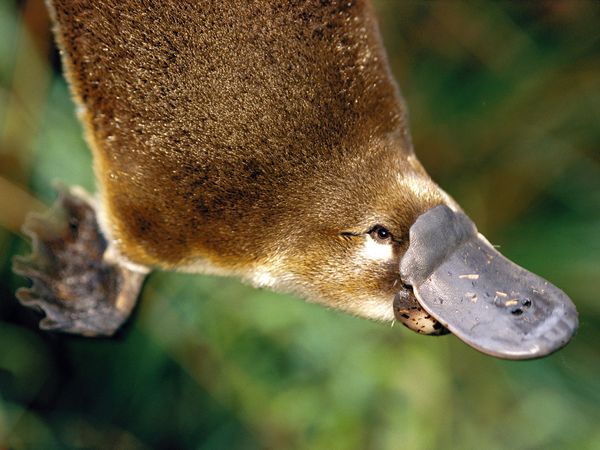
The first scientists to examine one thought it was a hoax. Comedian Robin Williams said he thought God was stoned and designed it to mess with people's minds. It's part duck, part beaver, part otter, and part reptilian and even walks with a reptilian gait since its legs are on its side and not under its body. Even its name is weird - platypus.
 |
| Magenta area to right of map shows where platypuses live. Map courtesy of Wikipedia. |
Found only in eastern Australia, the platypus was originally called a duckbill, watermole, or duckmole - all reflecting its strange architecture. Actually platypus is the common name, and a latinization of the Greek word "platupous", meaning flat foot. It was officially named the ornithorhynchus anatinus, meaning "bird-like snout, duck-like". Clearly, scientists were impressed with its physical appearance.
 |
| John Gould print of 1863 from Mammals of Australia. Image courtesy of Wikipedia. |
Platypuses (platypi is incorrect, considered pseudo-Latin) are of the order monotremata, named for the fact that the same body opening is used for reproduction and the elimination of water materials, same as reptiles. The only other monotreme is the echidna. They are considered mammals but are the exception to the rule that mammals give live birth.
 |
| Image courtesy of www.sciencedaily.com. |
Platypuses lay eggs, which they incubate by clutching them by their tails, holding them close to their abdomens for about two weeks. The "puggles" (another suggested name for the young is "platypups") hatch in roughly ten days but are the size of lima beans and are furless and completely helpless. Females have no teats, but produce milk in large glands beneath their abdominal skin. The milk accumulates on their fur where the puggles can lap it up. They nurse this way for about 3-4 months, until they can swim on their own. Normally females produce two eggs, but sometimes up to four. Platypuses do not mate every year, and not until they are about two years old.
 |
| Image courtesy www.cutepics.org. |
Excellent swimmers and divers, they have no external earlobes. Underwater they close both ears and eyes. Their eyesight is acute over distance, but because of their placement they are unable to see anything that is literally "under their nose". They have very sensitive bills which allows them to navigate and find food underwater. Electroreceptors are located in the skin of their bills, along with mechanoreceptors (which detect by touch), which locate prey by detecting electric fields generated by muscle contractions. They use signal strength to find the direction of their source.
 |
| Image courtesy of www.ryanphotographic.com. |
They dine on aquatic fare - shrimps, worms, insect larvae, small fish, roe, tadpoles, and frogs - which they collect by scrounging in the mud with their sensitive bills. They store their catch in their cheek pouches to be consumed later when they surface. Since they have no teeth, they need gravel to help them "chew".
 |
| Image courtesy of www.platypus.org.uk. |
They are so buoyant that they must continually swim downward to remain submerged. Their front feet have webs that extend past their claws forming large paddles for swimming. Their hind feet are also webbed, but are used to steer and brake. They can swim underwater for about two minutes, but can rest submerged for up to ten minutes. Their fur is dense and the first layer traps air next to the skin, providing insulation. A middle layer works like a wetsuit, and the outer layer can feel the closeness of objects.
 |
| Image courtesy of www.platypus.org.uk. |
Platypuses are 12-18" long and can weigh from 2.2 - 5.3 pounds, females being considerably smaller. They are known to live in captivity for twelve years. Their tails flatten to 4-6" long and are composed of fatty tissue that stores energy for use during a food shortage. Unlike a beaver's tail, it is not flat, is much narrower, and has no scales. While beavers use their to propel in water, platypuses use theirs for steering.
 |
| Image courtesy of this site. |
Males have a sharp hollow spur, like a horn, on the inside of both hind ankles. This is connected to a venom gland that produces a strong toxin. Females are born with them as well, but lose them within their first year. Because only males have them, it is thought they are meant to be used during mating season to fight off other males. Although not lethal to humans, the venom can cause excruciating pain, and will kill a dog or other animal.
 |
| Image courtesy of www. platypus.org.uk. |
They are mainly nocturnal animals, and are most active in the hours just before dawn and dusk. They sleep up to fourteen hours a day, and in burrows that are built on the edges of rivers and freshwater lakes, preferably where there is an overhang. Females dig special burrows to incubate their eggs in.
 |
| Image courtesy of www.sciencedaily.com. |
Their natural enemies are snakes, water rats, goannas, crocodiles, and foxes, but the biggest threat to their existence is the loss of habitat and pollution. They are currently being studied and measures are being taken for their protection. They are very important to science because their DNA can help piece together a more complete picture of the evolution of all mammals, especially since they possess features from reptiles and birds as well as mammals.
 |
| Image courtesy of Jean-Paul Ferrero/Nature Magazine. |
The platypus represents the earliest offshoot of mammals from an ancestor with features of both mammals and reptiles from 166,000,000 years ago. Somehow it retained an overlap of features, while later mammals lost their reptilian features. Comparing the platypus genome with the DNA of other mammals, including humans who came along much later, and the genomes of birds, who branched off about 315,000,000 years ago, helps define evolution.
 |
| Image courtesy of Nicole Duplaix/NatGeo. |
Researchers have compared the platypus genome with genomes of humans, mice, dogs, opossums, and chickens, and platypuses share 82% of their genes with them. The genetic sequence for venom production they found had evolved from ancestor reptiles, but curiously this developed independently in venomous reptiles. They also found genes for odor receptors such as the ones in dogs, which has led scientists to suspect that platypuses can detect odors while underwater, which may heighten their ability to find food sources. What a complex and unusual creature!
***************
For science geeks who want to see the platypus genome, click here.
*******************************


