|
| Charles Lutwidge Dodgson, aka Lewis Carroll, 1855. |
Charles Dodgson, as Lewis Carroll, is most famous for his book Alice's Adventures in Wonderland. His character, Alice, has become a female archetype of her own - the curious female who takes all things in stride and with aplomb. In fact, Alice is so popular in her own right that she continues to be a character in the writings of authors of books, stories, manga, and is even in video games.
 |
| Sir John Tenniel's illustration of Alice, 1865. |
Dodgson, however, has erroneously been assigned to a reputation undeserved.
Charles Dodgson was a precocious child, and later considered gifted in school, although he apparently did not always apply himself. He had a particular talent in math. He also suffered from stuttering, which his siblings also contended with. Despite this lifelong problem, he was an engaging storyteller, sang in public, and enjoyed charades. He was tall and thin, and reported to be a bit awkward and stiff, some say because of a knee injury. Thus his physical appearance and stammer may have made him appear a bit, well, weird. He was also deaf in one ear, no doubt adding to his oddness to some eyes.
 |
| The famous portrait of Alice Liddell as a beggar-maid from the story of Cophetua, a king who fell in love with a beggar. Image courtesy of Wikipedia. |
He began writing at an early age, mostly for his family's magazine, Mischmasch. His work was humorous and satirical. Some works were written under his chosen pen name of Lewis Carroll - a play on his real name, Lewis anglicized from Ludovicus (Latin for Lutwidge) and Carroll from the Latin Carolus (Charles). When he committed to writing his story of Alice, he chose his pen name to publish it under. He reserved Dodgson for his mathematical works.
 |
| Posthumous portrait of Dodgson by Hubert von Herkomer from a photograph, circa 1898. Perhaps the most honest thing done to him posthumously! |
 |
| Two of Dodgson's landscapes here and below, circa 1861. This is Magdalen Tower, Oxford. |
 |
| Whitby, a seaside resort in Yorkshire. |
A frustrated draughtsman (his friend John Ruskin discouraged him from drawing), he thought of photography as a replacement and signed his photos "from the Artist". He excelled at photography, and soon pushed the medium to its then limits. He quit photography in 1880, for various reasons. It was expensive (think of the expense of printing pictures before digital cameras took over), and he wanted to devote his time to writing.
 |
| "The Young Mathematician." Dodgson's brother, Edwin, with the family dog, Dido. |
Only 1,000 of the approximate 3,000 of his photographs have survived; many were destroyed deliberately. Roger Taylor and Edward Wakefield have researched his photographs. With only a third of his photos surviving, it is hard to make any assumptions, but they determined that about half of the surviving photos are of young girls. He did photograph many adults as well, and photography served to introduce him to a higher social circle. What photos are extant reflects more on who saved them and why than Dodgson, however.
 |
| Dante Gabriel Rossetti, albumen print, 1863. Image courtesy of the National Portrait Gallery, London. |
Much has been surmised and assumed about his interest in young girls, although there is no evidence of anything untoward going on. None of the girls, nor their families, have left any record of scandal. A number of his friendships with these young girls lasted from their childhoods into their adult years. There are some nudes, though very few, of young girls that he took, but their parents were at the scene and they were taken with the parents permission.
 |
| John Everett Millair and his wife Effie Gray Millair with their daughters Effie and Mary, 1865. |
This turns out to be the real problem. History, or looking back at past events, is a dangerous and often treacherous endeavor. Besides the lack of well-rounded data, it is important to see things through the eyes of the culture of that time. In the Victorian era, when Dodgson lived, nude young girls were seen as examples of the innocence of youth and of purity, not the lusty prurience that we look upon them today. Below are photos taken by two other artists of the time:
 |
| Study of a nude child by Julia Margaret Cameron, c. 1865. Image courtesy www.geh.org. |
 |
| Study of a nude child by Oscar Rejlander, c. 1880s. Image courtesy of zeno.org. |
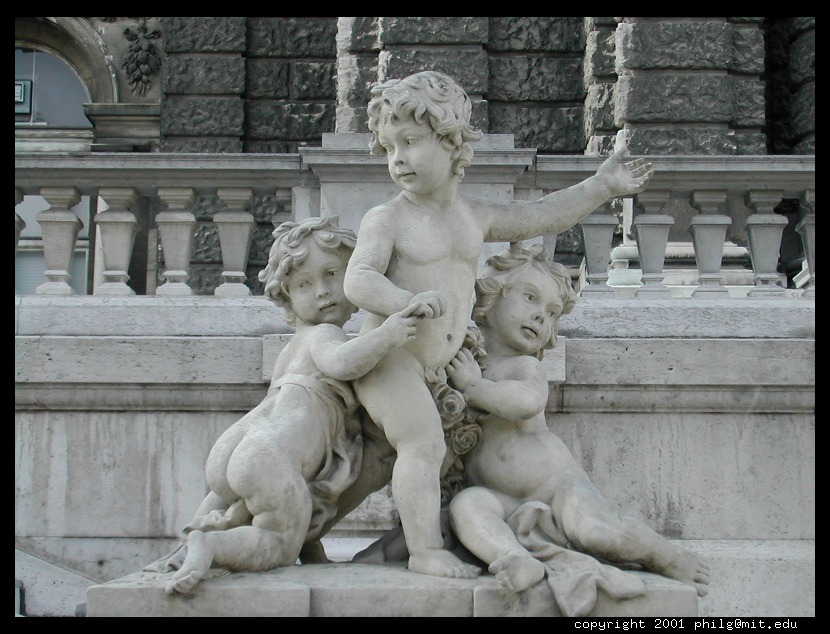
Clearly this art image comes from cherubs - those sweet, adorable, and nude little angels seen in paintings through the ages. Only later paintings show them swathed in clothing. During the Victorian era cards and photos of naked youths were common, some even used for Christmas cards.
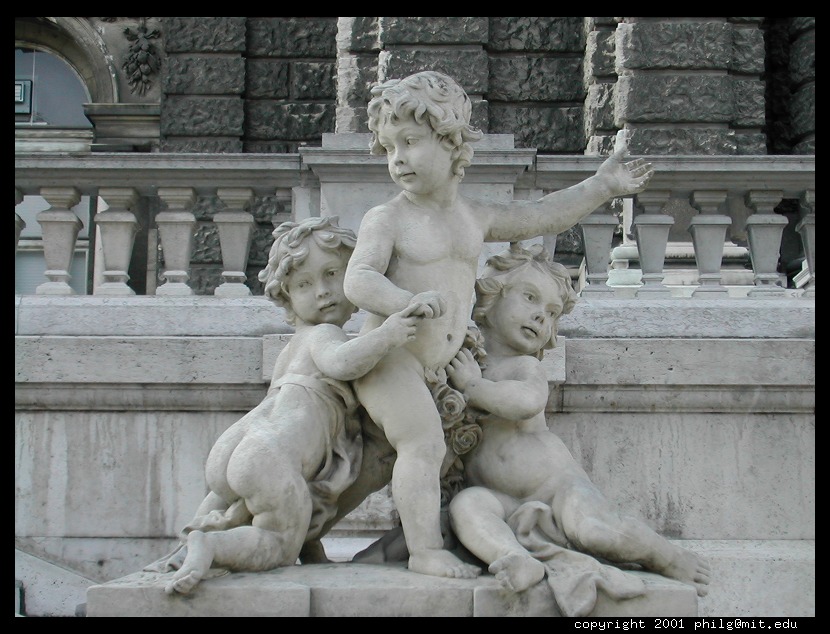 |
| Three Cherubs in the Shade, Vienna. Image courtesy Philip Greenspun. |
The problem arose from the short list of biographers that chose to document Dodgson's life. The first was by his nephew, Stuart Dodgson Collingwood, published less than year after his death. It paints a saintly view of not only Charles Dodgson, but the whole family. Since the nephew wasn't considering thoughts of pedophilia, he put too much emphasis on his uncle's saintly love of young girls, and suppressed evidence of relationships with adult women.
 |
| Alexandra "Xie" Rhoda Kitchin. "Xie" is pronounced "Ecksie". |
Although he couldn't secure the Dodgson's family help, and thus had no access to any private papers, Herbert Langford Reed wrote a biography anyway. What he lacked in fact, he made up. He diagnosed Dodgson with a split personality due to the fact that he occasionally wrote in different colored inks. He stated that Dodgson had no interest at all in adult women, and was the first to claim that Dodgson ended his friendships with girls when they reached puberty. He, of course, provided no evidence for any of it since there was none, but it biased many people's minds for generations.
 |
| Xie at age five in 1869. Dodgson once said that if you wanted excellence in photography, get Xie and put her in front of a lens. |
In 1945, Florence Becker Lennon wrote her book. Not being able to access any info from the Dodgson family, despite several attempts, and being part of the Freudian school, she used the first two books as references. She offered a Freudian explanation for Dodgson's interest, simply stating that he loved little girls. The pedophile was officially created.
 |
| George William Kitchin, 1859, image courtesy of National Portrait Gallery, London |
Alexander Taylor wrote a book about Dodgson's mathematics and religion, but was told by his publisher that he needed some salacious tidbits in it. Again, there was no cooperation with the Dodgson family, so he went on his own, stating that he had no doubts that Dodgson was in love with Alice Liddell, offering Dodgson's love poetry as proof, avowing it was inspired by Liddell. (In truth, no one knows who the poems were written for or about.)
 |
| "Saint George and the Dragon", 1875, featuring the Kitchin children - Brook, Hugh, Herbert, and Xie. |
At last a book came out based on a typescript by Dodgson's niece in 1953 - The Diaries of Lewis Carroll. Editor Roger Lancelyn Green claimed that nothing had been left out, but in truth only half of the diaries was presented. He had never seen the original material. Yet he never mentioned this, and gave editorial commentary suggesting that there was much factual data that Dodgson was "innocent". Since this publication was in the guise of real evidence, it was influential even though distorted.
 |
| Brook Kitchin as St. George, 1875. |
The next year The Life of Lewis Carroll by Derek Hudson came out. This was in response to Alexander Taylor's book criticizing him for knocking Dodgson off his pedestal. Known as the "Apologists", Hudson and Green among others thought that even if Dodgson was a pedophile, even if only in his desires, his actions were harmless, so let's forget about it. The general public took this as meaning that Dodgson was a pedophile.
 |
| The Twyford School Cricket Eleven, 1859. |
When the Dodgson family finally released his papers, including his full diaries, Anne Clark wrote a biography, Lewis Carroll. Even though she had more data then anyone before her, she pretty much went along with what had been written, adding that he did have some relationships with adult women. She also was free with her spurious ideas. She is still quoted today, as is her unsubstantial fact that Dodgson dedicated everything to Alice Liddell, extending the myth.
 |
| Wilfred Hatch at age 7 in a sailor's costume, 1872. |
Morton Cohen wrote what is in some respects a very scholarly and well-researched biography in 1995, Lewis Carroll, a Biography. This was marketed as the "definitive" biography, and some people still think so. But other than questioning the whole pedophile notion, he added to the number of women he had relationships with, and concludes that he had a predilection for young girls and supported the Alice story. He also was inventive with some facts.
 |
| Clement Male, 1859. |
More recently scholars have challenged what has become known as the "Carroll Myth" - this widely distorted perception of him. Generally scholars now claim that the biographies of Dodgson's life suffer from inaccuracies, and since key evidence was unavailable these specious works mushroomed without restraint. The "Carroll Myth" was so ingrained in the public mind by the time his papers were released that their release had little or no effect. If his papers are examined with an open mind, they will show that most of what has been written about him is false, or exaggerated, in particular his pedophila and "obsessiveness" with young girls.
 |
| Alice Liddell at 5 years old, 1857. |
In 1999, two authors set forth their own theories. Hugues Lebailly is a French scholar at the Sorbonne. His works stress the "Victorian Child Cult", and that biographers have erroneously viewed Dodgson's photography with modern eyes, rather than the aesthetic of the time. Karoline Leach published her book, In the Shadow of the Dreamchild, which created a seismic furor among Carrollians when it was first published, and it is still considered very controversial. She draws attention to his relationships with adult women, often scandalous, and that in order to suppress these affairs his family inadvertently gave the false impression that he only liked young girls.
 |
| Evelyn Hatch, age 8, 1879, hand-colored by Anne Lydia Bond per instructions. |
Sherry Ackerman is a recent player in the Carrollian games. Her 2008 book, Behind the Looking Glass, looks at the Neoplatonic Revival and its effects on Dodgson's writings. Others involved in the "Carroll Myth" include John Tufail, Sadi Ranson-Polizzotti, Pascale Renaud-Grosbras, and Christopher Hollingsworth.
 |
| A blue-fin tunny fish acquired by Dean Henry Liddell. This is currently displayed at the Oxford Museum of Natural History. |
Morton Cohen and Martin Gardner are opponents of the "Carroll Myth". Gardner was a leading math and science writer specializing in recreational mathematics. He was also a leading authority on Dodgson, and his annotated versions of Alice's Adventures in Wonderland and Through the Looking Glass examine the mathematical riddles and wordplay in the books. This is apropos, since Dodgson was not only a mathematician, producing almost a dozen works in his real name, but loved games of logic and words, and loved inventing gadgets. (One of his inventions was The Wonderland Postage-Stamp Case, basically a folder for stamps which included a copy of his lecture about letter-writing. This reflects his quirky sense of humor.)
 |
| The Wonderland Postage-Stamp Case, 1890, image courtesy of Charles Parkhurst Rare Books. |
There are many societies and groups devoted to him, and the search for the true Dodgson goes on. As stated in the mission statement of Contrariwise (see link below), Dodgson has been the victim, not the subject of his biographies. I suppose it's too much to ask that he be judged just for his work alone, but perhaps he would have enjoyed the controversy.
***************
Unless otherwise noted, images courtesy of this excellent site.
Contrariwise is the association for new Lewis Carroll studies.
*******************************