WELCOME TO CEREBRAL BOINKFEST!

WELCOME TO CEREBRAL BOINKFEST!

A blog about the arts, books, flora and fauna, vittles, and whatever comes to mind!

Note: Comments are moderated. If you include a link, your comment will not be published. As you will note, I do not accept ads on my website and that includes in comments.


Showing posts with label science fiction. Show all posts

Thursday, July 14, 2011

The House of Elsewhere

Maison d'Ailleurs in Yverdon-les-Bains, Switzerland.
Image courtesy of Wikipedia.

Pierre Versins was a French encyclopedist and scholar, and archivist.  He devoted his life to the study of "conjectures romanesques rationnelles" or "rational romanesque conjectures".


He amassed a collection of science fiction works and related memorabilia and wrote a major opus in the field, the Encyclopédie de l'utopie, des voyages extraordinaire et de la science-fiction.  In 1976 he donated his entire collection to the Swiss spa town of Yverdon-les-Bains with the provision that it be made available to the public.


The Maison d'Ailleurs (House of Elsewhere) is a place that humanoids and robots, among others, call home.  It holds two or three temporary exhibitions a year that explore themes such as space travel, alien life forms, futuristic cities, and lost and parallel worlds - the standard stuff of sci-fi.


It was originally located in a three-storytownhouse, but in 1991 it was moved to the middle of the city in a building that was once a prison built in 1806.  Further additions caused a new space to be built in an old casino, connected to the museum by a footbridge.  The new space houses workspaces for researchers, administrative offices, and an important collection.


In 2003 Jean-Michel Margot donated his extensive collection based on Jules Verne.  This contains some 20,000 documents, including rare items such as hand-written notes, posters from the end of the 19th century, and the complete collection of Les Voyages Extraordinaires.  This, "The Extraordinary Voyages", was the publishing title used for the novels and non-fictional work of Jules Verne.

Portrait of Jules Verne by Félix Nadar.

Verne was meticulous in his attention to detail, and part of the attraction of his work was the learning factor.  Readers learned something about a myriad of subjects - astronomy, biology, geology, oceanography, for example - and experienced the exotic locales and cultures of the world.  Because of this his works are often called "encyclopedic novels".


He is the most translated science fiction author in the world, and is the second most translated fiction author next to Agatha Christie.  Even though his works are outdated scientifically, he wrote with a sense of wonder that still enthralls readers. The collection of Les Voyages Extraordinaire was donated by the granddaughter of Verne's publisher, Pierre-Jules Hetzel.

A model of a "véhicule extraordinaire" built by JM Deschamps.

The Maison d'Ailleurs is the only museum of its kind.  It is public, non-profit, and a unique research center.  The museum is in collaboration with the European Space Agency, the University of Lausanne, the Cité de l'Espace in Toulouse, France, and several film festivals.  It has a large collection of pulp magazines, and the most important sci-fi image library in the world.


So, if you have some spare time, check out its archives - 70,000 documents, books, art, toys - some dating back to the 16th century.  Who knows what might inspire you there.  As the American computer scientist Alan Kay once said, the best way to predict the future is to invent it.

***************
Unless otherwise noted, all images courtesy of the website.
*******************************

Thursday, June 16, 2011

From Mummies to Mums

Photograph of Jane Webb Loudon taken before her
death in 1858.  Image courtesy of Wikipedia.

"In the year 2126, England enjoyed peace and tranquility
under the absolute dominion of a female sovereign."

Thus begins the novel The Mummy!:  Or a Tale of the Twenty-Second Century written in 1827 by Jane Webb.  One of the earliest works of science fiction it was published anonymously.  She was a teenager at the time.  She shifted her attention to gardening as an adult, becoming a successful horticultural writer, which may be science fiction's loss.


Although she was born to a wealthy family and raised in the lap of luxury, her father died penniless when she was 17.  To support herself she turned to writing. The Mummy! was most likely inspired by the French frenzy for anything Egyptian during Napoleon's invasion of Egypt.  No doubt it was also influenced by Mary Shelley's Frankenstein, and scholars are still trying to find links between the two women.

Kitwell House where Jane lived with her father.  Image courtesy of www.birmingham.gov.uk.

Unlike Frankenstein however, Webb's protagonist, the pharaoh Cheops, isn't running around horrifying people, but offering sage advice to those who choose to listen.  Her future Britain was not similar to her contemporary Britain with a few political changes.  She portrayed changes in society, technology, and even fashion (her ladies of the court wore pants and head bands of controlled flames).

The Ladies Companion to the Flower Garden.

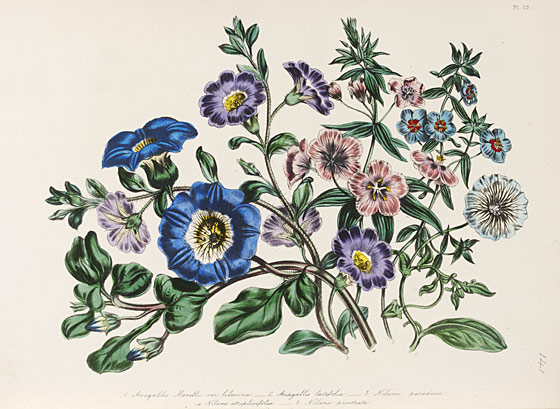
Illustration from The Ladies'Flower-Garden of Ornamental Greenhouse Plants.

One of her innovations in the book was a steam plough.  Her work intrigued John Claudius Loudon, a horticultural publisher and writer.  Because of the subject matter and the fact it was published anonymously, he thought she was male.  He arranged an introduction, they met, and within seven months they married.

Illustration from British Wildflowers.
Illustration from The Ladies Flower-Garden of Ornamental Greehouse Plants.

Although she claimed to know little about gardening, she was eager and after working with her husband she became knowledgeable enough to help him with her books.  His greatest work was an epic Encyclopaedia of Gardening, and Jane assisted him with research and note-taking.  She thought that the terms were a bit confusing and not geared toward beginners.  In fact, until recent times gardening was not thought suitable for a lady.  But with the advent of trains, people were able to move away from the city but still easily access it, and now had more room to spread out their houses.  Lawns and gardens were now possible, and she helped make gardening an acceptable activity, no longer limited to servants or the poor.

Illustration from British Wildflowers.

Jane wrote books encouraging women to take up gardening as a hobby.  Her books became the standard references for the hobby gardeners. She and John became the leading horticulturists of the era, and their social circle included Charles Dickens, and William Makepeace Thackery, among others.

A page from Plain Instructions in Gardening.

She was a self-taught artist and began to illustrate her own books.  Her illustrations became very popular to copy, and to use for decoupage on tables, trays, and lampshades.  To increase her output and make print production faster, she used chromolithography.


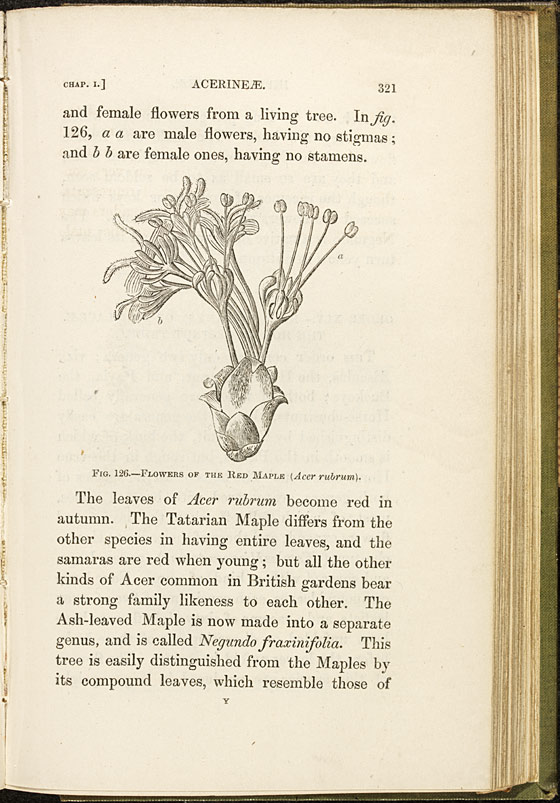
Both images above are pages from Botany For Ladies.

In 1843, John Loudon died.  He had always been in poor health, and in his declining years earned little money.  Jane worked as editor of The Ladies Home Companion at Home and Abroad, but wrote no more books.  According to their daughter, Agnes, she burned all her papers, so little is known about her. But assuming she never lost the feminist leanings exhibited in The Mummy, and with her promotion of the new lady-like hobby of gardening and her flower illustration, she is the feminine feminist.  Or perhaps one of the first earth mothers.

***************
Unless otherwise stated, images courtesy of the Victoria & Albert Museum.
*******************************