WELCOME TO CEREBRAL BOINKFEST!

WELCOME TO CEREBRAL BOINKFEST!

A blog about the arts, books, flora and fauna, vittles, and whatever comes to mind!

Note: Comments are moderated. If you include a link, your comment will not be published. As you will note, I do not accept ads on my website and that includes in comments.


Showing posts with label Easter eggs. Show all posts

Thursday, April 21, 2011

Easter Games

Pope Gregory I by Francisco de Zurbarán, 1626-1627.
Oil on canvas, courtesy of the Museo Provincial
de Bellas Artes, Seville, Spain.

Pope Gregory I (circa 540 - 604 CE) is famous for, among other things, sending out a mission - the Gregorian mission - to evangelize the pagan Anglo-Saxons.  He ordered his missionaries to take their religious rites and festivals and incorporate them into Church rituals.  The mission was successful, and from England missionaries went to Germany and the Netherlands to continue their work.  Of course, the pagan festival of Eostre fit in nicely with the Christian celebration of the Resurrection of Christ.

In England, Germany, and other European countries, it was a tradition for children to roll eggs down hillsides.  Whatever its original meaning was, it began to signify the rolling of the boulder from the tomb of Jesus.  In most countries, a prize is awarded to whoever's egg rolls the furthest.  In Egypt children bowl with them, rolling red and yellow eggs toward a row of eggs.  Whoever cracks one egg gets them all.

The White House Easter Egg Roll in 2007.  Image courtesy of Wikipedia.

In the U.S., children use a spoon to "egg" the eggs on.  The White House hosts an annual Easter Egg Roll on the lawn.  Dolly Madison is credited as starting the event in 1814, on the grounds of the Capitol building.  In 1877 a new lawn was planted and the event was cancelled.  Congress then passed a law forbidding the use of the grounds for children's play.  Then President Rutherford B. Hayes brought the event to the White House lawns.  It wasn't held during Franklin Roosevelt's presidency, but was brought back by Mamie Eisenhower who also opened the event to black children for the first time.  In 2009 President Barack Obama formally invited same-sex couples and their children to the Easter Egg Roll, although same-sex families had attended before.

"Beim Eierhärten" - German egg tapping.  Image courtesy of Wikipedia.

Egg tapping is another tradition, also known as dumping, shackling, or jarping. This involves attempting to tap the hard-boiled eggs of others with your own without cracking yours.  In Holland the game is called eiertikken.  In Bulgaria it is believed that the winner will have good health for the year, and the first painted red egg may be preserved until the next Easter as an icon of good health and good luck.  The Greeks call it tsougrisma, which means to clink together.  Even in the U.S., the state of Louisiana has a tradition of pocking eggs, which is a serious competition.  So serious that those involved know which breeds of chickens lay eggs with tougher shells and when.  Chickens are fed calcium-rich foods and are exercised and kept healthy.  Even how the egg is boiled is important - tips must be down in the pan so that the air pocket is in the wider end.

The red egg is the winner!  Image courtesy of Wikipedia.
An interesting custom is the egg dance.  Eggs are placed all over the floor, and the object is to dance among them without breaking any.  An 1895 issue of The American Magazine described an egg dance held in 1498.  Eggs were scattered over a level surface covered with sand and a young couple holding hands danced. If they finished the dance without breaking any eggs, they were betrothed, and no one could oppose the marriage.  (Klutz that I am, I am sure I'd still be single if this were still a requirement!)

The Egg Dance by Pieter Aertsen, 1552.
Image courtesy the Rijksmuseum in Amsterdam.

There was also a game/dance where one had to roll an egg out of a bowl keeping within a circle on the floor, using the feet without touching other objects on the floor.  Then the dancer had to flip the bowl over and cover the egg, again with feet only.  It is depicted in the image above.  In England the dancing was done by hopping and it was sometimes referred to as the hop-egg.  Perhaps because of its silliness, the word "hop" became a pejorative for a dance.

Dancing on one foot was a specialty of women dancers called hoppesteres according to Chaucer.  In the 18th century blindfolded egg dances were popular.  One of these dances was the hornpipe, a traditional Irish dance, one of which is the sailors' hornpipe, as seen below:

Sailors' Hornpipe in 1928, image courtesy of AP.

And last but not least is the egg hunt, where eggs are hidden for children to find.  This can be done indoors or outdoors, and real, plastic, or chocolate eggs can be used.  Prizes are often given for a number of different things - who found the most eggs, the largest, the smallest, etc.  In some parts of Europe the placement of the eggs is meant to be difficult for the hunters, and may be placed among thorns or some other hard-to-get place.  According to Guinness World Records, the largest Easter egg hunt was held in 2007 at the Cypress Gardens Adventure Park in Winter Haven, Florida.  9,753 children searched for 501,000 eggs.

Let's see...eating, artwork, dancing, games...sounds like a holiday to me, whatever religious twist you put on it.

****************

Wednesday, April 20, 2011

Easter Eggs

Decorated eggs from the U.S.

Colored eggs have been associated with Vernal festivals since ancient times. Ancient Greeks and Romans used eggs as symbols of fertility, rebirth, and abundance.  This pagan symbol of the rebirth of the earth in celebration of spring was adopted by early Christians as a symbol of the resurrection of Jesus.  The egg had previously figured in the festivals of numerous resurrected gods, since it is dormant but has new life sealed within it.

The ancient Zoroastrians painted eggs for Nowrooz, their New Year celebration which falls on the Vernal equinox, making it now a tradition of approximately 2,500 years.  For the Passover Seder, also held in spring, hard-boiled eggs called Betzah are dipped in salt water which symbolizes the peace offerings sacrificed at the temple in Jerusalem.

My Greek mother always insisted on red eggs, and we tapped each other's eggs together to see whose cracked (more on cracking eggs tomorrow).  The Orthodox and Eastern Catholic churches dyed their eggs red.  The red symbolizes the blood of Christ. One of the sacred traditions of Eastern Christianity is the story of Mary Magdalene bringing eggs to share with the other women keeping watch at the tomb of Jesus. When she saw the risen Christ, the eggs in her basket turned red. The egg also represents the boulder at the tomb, and the cracking of eggs symbolizes the resurrection.

Mary Magadalene holding a red Easter egg.

The Germans had a tradition of the Osterhas - the Easter bunny, which German settlers brought to the U.S.  Modern custom often uses chocolate eggs or plastic eggs filled with goodies, placed in baskets with artificial grass or straw to resemble a nest.  Tradition is to hide these eggs - real, chocolate, or plastic - for children to find on Easter morning.

Chocolate Eggs
REALLY good chocolate eggs - Cadbury.

Many countries have egg decorating traditions.  Russia, Ukraine, Bulgaria, Romania, Poland and other Slavic countries make them into works of art:

Belarusian eggs.
Embroidered eggs by a folk master from Ukraine - Inna Forostyuk.
Eggs from Serbia.
From the Czech Republic.

Eggs were forbidden food during traditional feast days in Western Christianity, and still are in Eastern Christian churches.  Both meat and dairy were forbidden, and eggs were considered dairy (a foodstuff from an animal gained without killing it). This included Lent.  Therefore, it was necessary to use up the egg supply before Lent.  Hence the name "Mardi Gras", or "Fat Tuesday", for the Tuesday before Lent -  all the eggs and dairy would have to be consumed by this day.  Since chickens cannot be told to stop producing for a while, their eggs would be boiled to prevent them from spoiling.

A hornazo - a type of meat pie made with hard-boiled eggs and often served
after Easter in parts of Spain.  There is a folk story that on Lent the prostitutes
of the town were sent away, so as not to distract the men from their  religious
observances.  On Monday, after Easter Sunday, the students would throw a
party celebrating the return of the prostitutes, and serve hornazo.

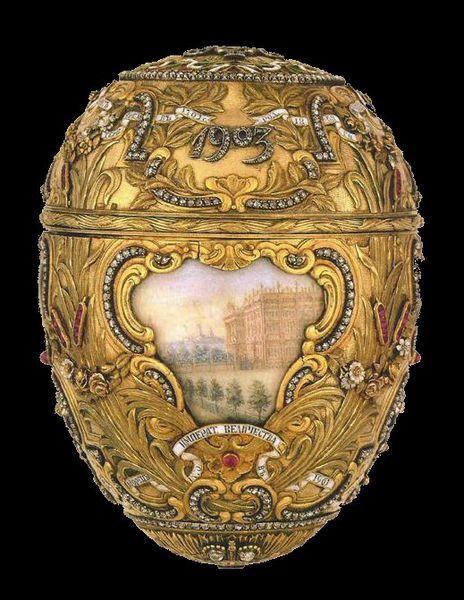
One of the most beautiful "art eggs" is any of the thousand or so made by Fabergé. The one below was commissioned by Czar Alexander III of Russia for his wife, Maria Fyodorovna...

This egg commemorates the 200th anniversary of the founding
of St. Petersburg.  It is made of red, green, and yellow gold,
platinum, diamonds, rubies, enamel, rock crystal, and watercolor
on ivory.  The paintings are by B. Baal, and the one shown is the
Winter Palace.  When the egg is opened a miniature of a famous
statue of Peter the Great appears.  Currently housed in the Virginia
Museum of Fine Arts, Richmond, Virginia.  Height:  4.37 inches.

There are many other decorating styles, and also traditions for giving decorated eggs.  Sometimes they have been given as gifts in love, friendship or as tokens of esteem.  Below are a few more from other cultures as inspiration:

From France.
From Ukraine.
From Vienna, Austria.

***************
Unless otherwise noted, images courtesy of Wikipedia.
*******************************