WELCOME TO CEREBRAL BOINKFEST!

WELCOME TO CEREBRAL BOINKFEST!

A blog about the arts, books, flora and fauna, vittles, and whatever comes to mind!

Note: Comments are moderated. If you include a link, your comment will not be published. As you will note, I do not accept ads on my website and that includes in comments.


Showing posts with label University of Padua. Show all posts

Monday, February 21, 2011

Wooden Books

Age appears to be best in four things:  old wood to burn,
old wine to drink, old friends to trust, and old authors to read.

Francis Bacon (paraphrasing Athenaeus)

Close-up of paper made from spruce, poplar, pine, and fir trees.
Image courtesy of Science Photo Library.

Well, let's not burn all the wood.  Yet.  Let's look at the connection between wood and what old authors wrote to read:  books.  Specifically, books made of paper made of wood.  The Arabs were the first to produce paper books in the 8th century after learning papermaking from the Chinese.  Europeans used paper made of rag until about 150 years ago, when it became standard to print books on paper made of wood.

Front and rear of a piece of birch bark.
Image courtesy of Wikipedia.

From an etymological standpoint,  "book" and "beech" are related.  The Germanic root of both words is *bk- from an Indo-European root which means "beech tree"; the Old English form of book is bc, from the Germanic *bk-, and it meant "book, or a written document".  This makes sense when you consider that the early Germanic people used strips of beech to write on.

A birch bark inscription from Novgorod, circa 1240-1260.  This contains
spelling lessons and drawings by a boy named Onfim, whom experts deem
to have been between 6 and 7 years old.  Image courtesy of Wikipedia.

The early Romans also used the smooth inner lining of a tree to write on.  Their word for it, which literally means "bark", is liber, which came to be the word for book, and eventually library.  Likewise the Latin word for codex, comes from caudex which means a tree trunk.

The relationship between books and wood is obvious, so news of books made of wood doesn’t seem so extraordinary.  But there are fifty-six of them that are quite exceptional.  These books are kept by the Orto Botanico di Padova.


The University of Padua, founded in 1222, is famous for many things and an all-star cast of alumni.  But another stellar thing they are famous for is their wooden books.  These books are about trees, and also made of trees.  There is a different specie of tree in each book.  The covers were made of a piece of wood from its respective tree showing radial, longitudinal, and cross profiles.  On each spine is a sample of the bark from that tree.


Inside the books are parts of the tree:  seeds, seedlings, flowers, leaves, roots, sawdust, charcoal, and ash.  Each is fastened to the insides and numbered.  Also inside are pieces of parchment with a handwritten legend identifying the samples.


These were created in the late 1700s or early 1800s, and there once was about one hundred of them.  Unfortunately so many have been lost or destroyed that only fifty-six of them remain.  Those that are extant are a much better way of recording information about their respective trees than drawings or written accounts, because the items saved serve as DNA blueprints.


If you really love wood, no doubt you are familiar with your local xylarium.  But if there isn’t one near you, don’t despair.  The World Woods Library is an ongoing project of wooden books made from woods from all over the world.  Choose your favorite tree, then buy the book: 


Graphic designer Jason Arias made up a typeface design called Ringbearer, that was influenced by tree rings.  He decided to make a book for the typeface, made of actual tree rings from a tree trunk.  Each round "sheet"  bears a letter of the font, other information about the project, and at the bottom is a niche that holds a folded poster that shows all the characters.


Not content to stick with the innovation of the somewhat eponymous book, Arias also redesigned a magazine cover using his font:


So before you chuck another log on the fire, think about what else you could do with it.  The mind you save could be your own.

*******************************


Thursday, December 23, 2010

WAY before her time!

So what does it take for a woman to earn something men have earned, even if she can run circles around said men?  Money?  Connections?  Opportunity?  Those seem to be the keywords.  For instance…..

The University of Padua, Università degli Studi di Padova, founded in 1222, has a long and illustrious history.  It has a stellar list of past professors and alumni – Copernicus, Galileo, Reginald (Cardinal) Pole, Nicolas of Cusa, Sir Francis Walsingham, and Giacomo Casanova among many others.  It was one of the earliest universities in the world, and became one of the most prominent ones in early modern Europe.  It has the oldest original botanical garden, and the oldest surviving permanent anatomical theater in Europe.
University of Padua's Palazzo del Bo.
1654 woodcut image courtesy of Wikipedia.

Men were awarded Doctor of Theology and Doctor of Philosophy degrees there since its inception.  In 1678, Elena Lucrezia Cornaro Piscopia, a Venetian noblewoman and mathematician, became the first woman in the world to earn a Doctor of Philosophy degree.  She had wanted a Doctor of Theology degree, but no, it was decided that women couldn’t do that.  The Roman Catholic Church did not deem that was proper.  They banned females from becoming priests, and granting a woman a Doctor of Theology degree was too close for comfort.  (Catholic universities did not allow women to obtain degrees in theology until the 20th century, and in the United States some schools would not allow women to pursue a PhD until the latter part of the 20th century.)

Image of Piscopia courtesy of Wikipedia Commons.

However, there were apparently enough members of the University that were upset by this that they met and decided to allow her the PhD degree.  This was remarkable because even though it was known that she was attending classes there, the general assumption was never that she would get a degree.  Most likely thoughts changed after a philosophy debate held in 1677 in which she participated, arguing in Greek and Latin with three highly respected scholars in front of the entire university, many citizens of Venice, and other scholars from all over the continent.

Mural of Elena Lucrezia Cornaro Piscopia.
The Italian Room, University of Pittsburgh.

Lady Elena was born in 1646 into the noble Venetian House of Cornaro.  Famous for the commissions of palaces, chapels, villas, theaters, paintings, church art, and much more over the years, the Cornaro family traced its ancestry back to noble Roman roots, including general Scipio Africanus and several consuls of Rome.  The family also boasted of having four Venetian Doges, a queen of Cyprus, three popes, and nine cardinals.  They were involved in the expansion of the city-state of Venice into the eastern Mediterranean areas.  It was in an erudite atmosphere of learning, study, and awareness of the family history that she grew up.  It is telling that we know of her, but not of her two elder brothers, or elder and younger sisters, who assumedly had the same advantages, but perhaps not the same abilities.

She began her studies early, beginning at age seven with the study of Latin and Greek.  After mastering these languages she went on to study Hebrew, French, Spanish, Arabic, and Chaldaic (biblical Aramaic).  Her fluency in these languages made her “Oraculum Septilingue”, a title meaning she was a master, or oracle, of seven languages besides her native Italian.  She also excelled in philosophy and theology, which she started learning at a young age as well.  Various teachers taught her grammar, dialectics, astronomy, mathematics, and science. 

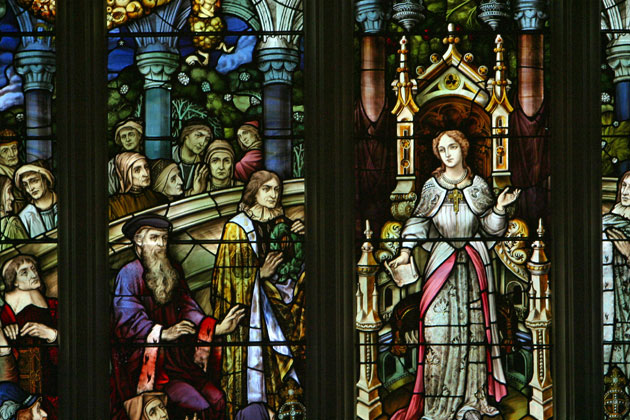
The Great Window in the Memorial Library
Building at Vassar College, showing the
doctoral examination of Piscopia.
She was also taught what were considered the more feminine arts of singing, reading and writing music, and how to play the harpsichord, clavichord, harp, and violin.  At age seventeen, she was considered to be an expert musician, and had earned a reputation as a composer.  By the time she was 19, she was considered the most educated woman in Italy, attracting some of the many learned people in Europe to the family palaces in Venice and Padua to meet and talk with her.  She learned to debate and excelled at it, which would serve her well in the future.

Detail of Vassar window.  Installed in 1906, it was the gift of Mary Clark
Thompson in memory of her husband, Frederick Ferris Thompson.
She took a vow of chastity when she was eleven, and seemingly kept it all her life.  She wanted to become a Benedictine nun, but her father refused to let her, pushing toward further studies, and clearing the path for her to attend the University of Padua.  There she flourished, and continued to attract visitors and wage debates, which became famous events throughout academic Europe. 

Detail of the Vassar window showing Piscopia.
Lady Elena’s doctoral examination was held on June 25, 1678, in the Cathedral of the Blessed Virgin in Padua, rather than at the University Hall due to the size of her audience, and was attended by the University administrators, professors of all disciplines, students, Venetian Senators, and invited guests from the universities of Rome, Naples, Bologna, and Perugia.  She spoke for an hour in Latin from selected passages of Aristotle, and answered all questions eloquently.  This event became legendary, and she was awarded her PhD, a laurel wreath was placed on her head (the Poet’s Laurel Crown), a ring placed on her finger (the Doctor’s ring), and an ermine cape (the Teacher’s Mozetta) placed on her shoulders.  This was an extraordinary event for the 32-year-old woman and the University.  It was many centuries before the University awarded a PhD to a woman again.

Detail of Vassar window showing scholars
attendant at her examination.
She was appointed that same year as a mathematics professor at the University of Padua, another big first, and lectured there until her death.  She also lectured on theology and music.  After her graduation, she did become a Benedictine Oblate, and spent the last years of her life tending to the sick and poor.  She died in 1684 of tuberculosis and was buried in the Church of Santa Giustina in Padua.  Her funeral was attended by the faculty in gowns and capes, and her casket carried by four of the professors.  She was buried in the habit of an Oblate, with her mozetta over it, wearing a wreath of lilies and laurels signifying her purity and learning.  In 1895 the Abbess of the Benedictine nuns in Rome had her tomb opened, her remains placed in a new casket, and a tablet inscribed in her memory.

Detail of Vassar Window.  The images in the
tracery (only four of eight shown in this photo)
represent Grammar, Dialectics, Music, Philosophy,
Astronomy, Medicine, Geometry, and Theology.
A statue was placed in the University, and in 1685 the University struck a medal in her honor, something they had never done before. Her writings were published in 1688, which included both academic and devotional works (not much has survived, however).  Upon receiving her doctorate, she was the recipient of praises, poems, and letters of congratulation from scholars all over Europe.  Her name was inscribed on the Roll of Honor of many academic institutions in Europe.

Statue of Piscopia in the Palazzo del Bo, University of Padua.
An extraordinary woman who led an extraordinary life, Elena Lucrezia Cornaro Piscopia became not only a remarkable woman scholar, but a remarkable scholar of either gender, creating a gold standard not easily equaled, much less surpassed.  By anyone.  Period.

*******************************