WELCOME TO CEREBRAL BOINKFEST!

WELCOME TO CEREBRAL BOINKFEST!

A blog about the arts, books, flora and fauna, vittles, and whatever comes to mind!

Note: Comments are moderated. If you include a link, your comment will not be published. As you will note, I do not accept ads on my website and that includes in comments.


Showing posts with label gardening. Show all posts

Thursday, September 22, 2011

Where There's Dirt, There's a Way!

World War I poster by James Montgomery Flagg, 1918.

Gardening is the new old trend.  With the economy being what it is, the return of consumers to real food, which we now call "organic", and the green push to eat locally harvested produce, more and more people are making the attempt to grow their own food.  This is leading to some new and inventive ways of doing it.

World War II poster from the U.S. GPO,
by artist Morley, 1945. 

In the 1940s, "victory" gardens were planted to help with war rations.  Recent figures I read claim that nine million tons were produced in the U.S., and the efforts produced 40% of the veggies consumed nationally.  In Great Britain, it is estimated that $1.2 billion worth of produce was grown by the end of the WWI, in five million gardens.  When people grew their own produce, it freed the produce on the market to be purchased by the military to feed the troops, and it was available at lower costs.

Handbook from April, 1944, image courtesy of this site

The postwar boom had housing being built with yards big enough for gardens, but most people went for lawns - the greener and more weed-free the better.  Some people grew their own produce still, but until recent years it wasn't a trend. Container gardening did become popular, both for homeowners and apartment dwellers, especially when people found they could grow some produce in containers.  Herbs were commonly grown in pots, but soon people found they could grow tomatoes, lettuce, and other veggies.

Various containers are used here - from wooden boxes to tires.

One type of container that is becoming popular to use is plastic swimming pools. They can be placed on the ground, patio or pavement, or even rooftops.  They are great for sites with poor or contaminated soil, and even in harsh climates can last 5-6 years.  Drain holes are made about 2" from the bottom to drain off too much water, while still keeping a small reservoir.

Here pools are used to create little mini-gardens.  This image and the one
above courtesy of this site, which has lots of good info.

In the 70s, community gardens started flourishing.  Today they are an important part of urban renewal in some areas, and make use of vacant land that would be wasted otherwise.  It also is less time-consuming, as the labor and costs are shared. Some are parceled off in allotments, each participant receiving their own little portion of land to grow what they wish.

A community garden in D.C. in 2006.

One of the coolest techniques is rooftop gardening.  This method uses the otherwise unused space on top of a structure's roof, which receives the sun, and provides insulation to the structure, significantly cooling it in hot months.  Roof load capacity is a critical determinant of whether this type of gardening is applicable to any structure.  Hydroponics, where plants are grown in a soilless medium and fed a special nutrient solution is the lightest option.  Accessibility and water supply are two other concerns, but if it can be done not only does it benefit the gardeners, but also birds, butterflies, and other creatures we share the earth with.

This is the rooftop garden of Eagle Street, over a warehouse in Brooklyn.

Vertical gardens were first planted by architects in the 80s to help cool buildings. Also called green walls, they are being employed to grow vegetables now.  Some have plants rooted into the soil and growing up onto a supporting structure.  Others have soil packed into a bag or shelf, then are hung on a supporting structure. These have to be replenished every year, and are not suitable in areas with seismic activities or high winds.  Access to the plants and water is also a concern.  Mat or coir fibers are often used, and new systems are being developed for consumers all the time.


I recently read of "pocket" gardens being planted in France.  These make use of posts in an urban setting, where vegetables and flowers are planted.  A Parisian artist, Paule Kingleur, worked with 600 Parisian schoolchildren to plant them and tend to them.  The planters are made of discarded milk cartons wrapped in fabric from recycled tents.  Let's see if this trend catches on!


***************
Unless otherwise noted, images courtesy of Wikipedia.
*******************************

Thursday, June 16, 2011

From Mummies to Mums

Photograph of Jane Webb Loudon taken before her
death in 1858.  Image courtesy of Wikipedia.

"In the year 2126, England enjoyed peace and tranquility
under the absolute dominion of a female sovereign."

Thus begins the novel The Mummy!:  Or a Tale of the Twenty-Second Century written in 1827 by Jane Webb.  One of the earliest works of science fiction it was published anonymously.  She was a teenager at the time.  She shifted her attention to gardening as an adult, becoming a successful horticultural writer, which may be science fiction's loss.


Although she was born to a wealthy family and raised in the lap of luxury, her father died penniless when she was 17.  To support herself she turned to writing. The Mummy! was most likely inspired by the French frenzy for anything Egyptian during Napoleon's invasion of Egypt.  No doubt it was also influenced by Mary Shelley's Frankenstein, and scholars are still trying to find links between the two women.

Kitwell House where Jane lived with her father.  Image courtesy of www.birmingham.gov.uk.

Unlike Frankenstein however, Webb's protagonist, the pharaoh Cheops, isn't running around horrifying people, but offering sage advice to those who choose to listen.  Her future Britain was not similar to her contemporary Britain with a few political changes.  She portrayed changes in society, technology, and even fashion (her ladies of the court wore pants and head bands of controlled flames).

The Ladies Companion to the Flower Garden.

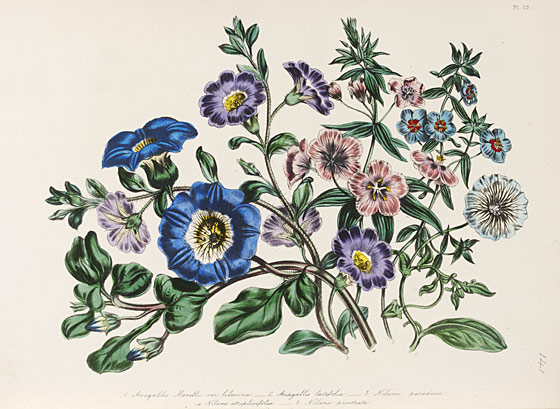
Illustration from The Ladies'Flower-Garden of Ornamental Greenhouse Plants.

One of her innovations in the book was a steam plough.  Her work intrigued John Claudius Loudon, a horticultural publisher and writer.  Because of the subject matter and the fact it was published anonymously, he thought she was male.  He arranged an introduction, they met, and within seven months they married.

Illustration from British Wildflowers.
Illustration from The Ladies Flower-Garden of Ornamental Greehouse Plants.

Although she claimed to know little about gardening, she was eager and after working with her husband she became knowledgeable enough to help him with her books.  His greatest work was an epic Encyclopaedia of Gardening, and Jane assisted him with research and note-taking.  She thought that the terms were a bit confusing and not geared toward beginners.  In fact, until recent times gardening was not thought suitable for a lady.  But with the advent of trains, people were able to move away from the city but still easily access it, and now had more room to spread out their houses.  Lawns and gardens were now possible, and she helped make gardening an acceptable activity, no longer limited to servants or the poor.

Illustration from British Wildflowers.

Jane wrote books encouraging women to take up gardening as a hobby.  Her books became the standard references for the hobby gardeners. She and John became the leading horticulturists of the era, and their social circle included Charles Dickens, and William Makepeace Thackery, among others.

A page from Plain Instructions in Gardening.

She was a self-taught artist and began to illustrate her own books.  Her illustrations became very popular to copy, and to use for decoupage on tables, trays, and lampshades.  To increase her output and make print production faster, she used chromolithography.


Both images above are pages from Botany For Ladies.

In 1843, John Loudon died.  He had always been in poor health, and in his declining years earned little money.  Jane worked as editor of The Ladies Home Companion at Home and Abroad, but wrote no more books.  According to their daughter, Agnes, she burned all her papers, so little is known about her. But assuming she never lost the feminist leanings exhibited in The Mummy, and with her promotion of the new lady-like hobby of gardening and her flower illustration, she is the feminine feminist.  Or perhaps one of the first earth mothers.

***************
Unless otherwise stated, images courtesy of the Victoria & Albert Museum.
*******************************
Tuesday, January 11, 2011

To Dream, Perchance to Plant...


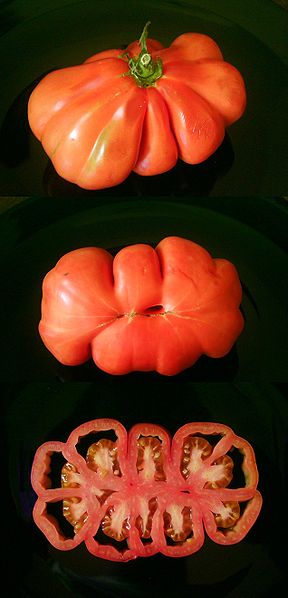
Not your typical market tomato!
Image courtesy of Wikipedia

This is the time, when closeted indoors and dreaming of spring and warmer temperatures, that gardeners start planning.  Many keep records of what was planted each year and where, what was successful and what might be done differently, what standard plants to use and what new ones to try.  This planning stage is a dream of what is to come.

Some gardeners keep seeds from what they grow – taking from the best fruits of their labors.  Others order fresh each year.  Many like to try different things, and a growing number of gardeners are turning to heirloom seeds.

Heirloom plants are ones that were commonly grown at one time, but never in large commercial ventures.  At one time there were a diverse number of the same kind of plants, and people ate many different types of the same food.  Think of tomatoes, that come in all shapes, sizes, and colors.  There are hundreds of kinds you could plant, but the average grocery store only stocks a few kinds.

Image courtesy of Wikipedia

The industrialization of agriculture led to monoculture – the practice of growing very few varieties of a plant in order to get consistent, marketable crops.  The varieties chosen are further developed to be resistance to disease, produce an abundance of the crop, and have a long shelf life.  A plant’s ability to tolerate pesticides and weather fluctuations, mechanical picking and packaging, and being shipped long distances comes into play.  This, however, doesn’t mean the fruit of that plant is tastier or healthier.  On the contrary, many plants lose both nutrients and taste from selective breeding and the marketing process.

Gardeners have different reasons for planting heirloom seeds.  Some plants have historical interest, some have slightly different tastes, some want to preserve the plants for future generations and to widen the gene pool.  A more political motive is that gardeners don’t want seed companies or the government to control seed distribution.  Since hybrid seeds will not be the same as the original plant, this creates a dependency on seed distributors for future crops.  

Image courtesy of Wikipedia

This is not to say that some seeds you have from Grandma’s prize tomatoes will taste just like hers.  Unfortunately with so many developed seeds being planted everywhere, it’s hard to avoid cross-pollination with other types of the plant.  But depending on where you are growing, you have a chance to produce something much more akin to what used to be grown.

As the trend is catching on, especially with organic gardeners, there are a growing number of seed companies that carry a diverse variety of types of plants.  One day I hope to have a large area of tomatoes – at least a hundred kinds – to sample and dine on.  In the meantime, here are some of the companies that I have bought seeds from and continue to patronize.


Number one in my book is the Seed Savers Exchange.  This non-profit group of gardeners has been dedicated to both saving and sharing heirloom seeds since 1975.  Although they concentrate on preserving North American seeds, they offer seeds from many different countries around the world.  They have a 890 acre farm near Decorah, Iowa, where they maintain and grow approximately 25,000 endangered heirloom plants – veggies, flowers, and herbs.  Although you don’t need to be a member to purchase from them, membership allows you a 10% discount and the knowledge that you are funding their worthy endeavor.  We are proudly life members.  They also publish a yearbook for members, which last year offered over 20,000 seeds member-to-member.  This makes Seed Savers one of the greatest sources of heirloom varieties in the world.


Seeds of Change began in 1989, and they offer seeds produced from a network of certified organic family farms and professional growers.  They also offer original varieties, created through traditional plant breeding techniques, which are hybrids but not bred with commercial interests in mind.  Their catalogs are gorgeous, with pictures that will make you salivate.


Bountiful Gardens in Willits, California, is a project of Ecology Action, who also works with projects all over the world.  EA is devoted to ending world hunger by teaching sustainable agriculture.  They have developed a system of gardening that allows for large yields from small spaces, while improving the soil each year, called GrowBiointensive™.  Their selection is great, sometimes unique, and they offer great gardening tools as well.


For varieties that produce best in the Mid-Atlantic and Southeast, although most do well anywhere, there is the Southern Exposure Seed Exchange.  They offer more than 700 varieties, specializing in heirloom and, specifically, open-pollinated (or non-hybrid) seeds.  Their seeds come from growers.  A percentage of their profits on some things are donated.  Their website offers lots of information and includes a blog.

These are just a few of the many companies that offer heirloom seeds.  Most have excellent and informative websites, and offer valuable information, books, dvds, tools, and other things of interest to gardeners.  Remember, you don't have to have a large plot of land to garden.  One of our friends has a wonderful container garden on the balcony of his condo, and keeps a steady supply of lettuces, tomatoes, herbs, and squash.  Another friend, who does have plenty of space, grows her own popcorn.  (Corn that produces eating corn, and corn that produces popcorn have to be kept well apart.)

Part of the delight of being a gardener, besides eating great tasting and healthy produce, is looking through catalogs and choosing what to grow.  On a cold winter’s day, drinking some herb tea by the fire, surrounded by catalogs and some graph paper and a pencil – it doesn’t get much better than this.