WELCOME TO CEREBRAL BOINKFEST!

WELCOME TO CEREBRAL BOINKFEST!

A blog about the arts, books, flora and fauna, vittles, and whatever comes to mind!

Note: Comments are moderated. If you include a link, your comment will not be published. As you will note, I do not accept ads on my website and that includes in comments.


Showing posts with label Art Deco. Show all posts

Tuesday, December 27, 2011

Art Deco's Most Famous Artist

A part of "Wisdom, with Light and Sound" that is over
the entrance of the GE Building in New York City.
(30 Rockefeller Center.)  Image courtesy of Wikipedia.

Art Deco was an art movement that began in Paris in the 1920s, and became internationally popular up until WWII.  It was a style that encompassed all areas of design, from fashion to graphic arts to architecture.  It was notably different from the curves and organic forms of Art Nouveau, the movement that preceded it.  A hallmark of Art Deco was symmetry and linear forms.  Drawing from ancient art and cubism and modernism, it was purely decorative without philosophical or political import.  There is one artist who embodied and defined the ornamental style of Art Deco.

L'arc en Ciel, 1929.  Harper's Bazaar cover design.

His name was Romain de Tirtoff, although he was called Roman Petrovich Tyrtov in his native Russia.  He was born in St. Petersburg in 1892 to an admiral of the Russian fleet.  He became famous as an artist with the pseudonym of Erté - the French pronunciation of his intials, R. T.  He used the pseudonym to avoid disgracing his family, which expected that he become a naval officer.

Costume design, 1923, for "The Marriage of Figaro"
for the Chicago Opera Company.
Costume design, 1923, "Woman with Wings"
for the Folies Bergère.

When he was a young boy he became intrigued with Persian miniatures he found in his father's library.  He created his first costume when he was five. The exotic and brightly-colored patterns and designs influenced his style.  He had a profound influence on the entire Art Deco movement.  He forged a new path when he was 75, working in bronze and serigraphy.  This brought about a rebirth in popularity of Art Deco in the 1960s, which was a boost for him as he had become relatively obscure in the 1940s and 1950s.  This was the time of WWII, and people sought more practical things.

"Cleopatre" produced in 1986.

"Samson and Delilah" produced in 1980.

He moved to Paris to begin a career as a designer in his twenties.  His career took off with his work for Harper's Bazaar magazine, where he designed over 200 covers between 1915 - 1937.  He also did illustrations for other magazines, including Vogue, Cosmopolitan, and Ladies Home Journal.


"Aquarium", 1923, cover for Harper's Bazaar.

"Seagulls", 1938, cover for Harper's Bazaar.


Soon he was doing fashion design and creating stage sets.  His costumes and program designs were featured in the Folies Bergère and the Ziegfield Follies.  This was the 1920s and the Art Deco movement was in full swing.  His work captures the giddy spirit of the "Roaring Twenties".

"Mermaids" from 1926.

Curtain design from "The Oriental Ballet", 1925, while at MGM.

In 1920 he designed the costumes and set for a Marion Davies movie financed by William Randolph Hearst.  He went to Hollywood in 1925, to design sets and costumes for a silent film by Louis B. Mayer.  This film - Paris - had many problems with the script, so while this was being sorted out Erté worked on other projects, one of which was the film Ben-Hur.


"Ebony" a 1982 graphic.

The letter "L" from his alphabet, 1976.


During his "second career" in the 1960s, he also did jewelry, furniture, fabrics, interior designs, sculpture and produced limited edition prints.  His flamboyant style and his talents assured him longevity as an artist.  He died in 1990 at the age of 97, being one of those artists who knew fame and acclaim during his lifetime.  His work can be seen in museums and galleries all over the world.

His famous signature, courtesy of Wikipedia.

***************
Unless otherwise noted, images courtesy of www.erte.com.
*******************************

Thursday, June 23, 2011

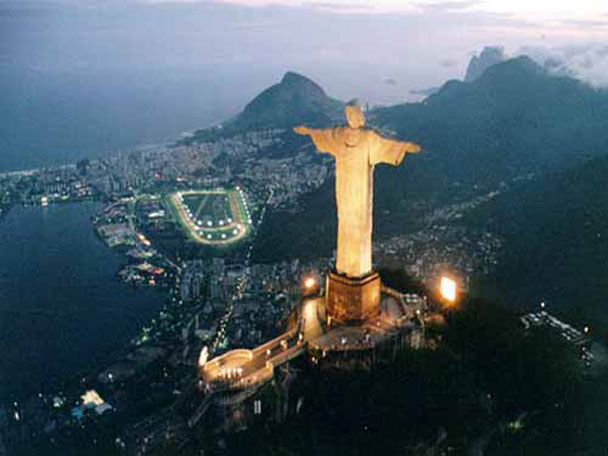
O Cristo Redentor

Image courtesy triptourism.com.

On July 7, 2007, Brazil's internationally known icon - the statue of Christ the Redeemer - was chosen as one of the New Seven Wonders of the World by the New Open World Corporation.  Two years later it was declared a monument protected by IPHAN, the Institute of Historical and Artistic Heritage, a government agency of Brazil.

Image courtesy NewOpenWorld Foundation.

The largest art deco statue in the world stands 130 feet tall (including the 31-foot pedestal) and is 98 feet wide and 699 tons.  It stands on the peak of 2,300 foot Corcovado Mountain in Tijuca Forest National Park in Rio de Janeiro.  From this vantage point, one can see downtown Rio de Janeiro, Sugarloaf Mountain, and the beaches of Copacabana and Ipanema.

Image courtesy of triptourism.com.

The idea of erecting a statue there was introduced in the mid-1850s.  Pedro Maria Boss, a Catholic priest, proposed to Princess Caroline that she fund a large religious monument, but she wasn't interested.  It became a moot point in 1889, when Brazil became a republic country with laws mandating the separation of church and state.

Image courtesy of Emesbe/Wikipedia.

In 1921 the Catholic Circle of Rio proposed again that a landmark statue be erected on the mountain.  They organized Semana do Monumento, Monument Week, to gather donations and collect signatures in support of the idea.  Brazilian Catholics responded.

Comparison in height:  Spring Temple Buddha, Statue of Liberty, The Motherland
Calls, Christ the Redeemer, and David.  Image courtesy of Anna Frodesiak/Wikipedia.

Among the designs submitted for the monument were a giant cross and a statue of Jesus with a globe in his hand, but Christ the Redeemer with open arms was selected.  Heitor da Silva Costa, a local engineer, designed it.  It was sculpted by Paul Landowski, a Frenchman.  It was decided that it would be built out of reinforced concrete, with the outer layers from soapstone.  The cost was U.S. $250,000 (about $3,000,000 today).

Image courtesy copacabana.com

The monument was unveiled on October 12, 1931.  Floodlights aimed at the statue were meant to be turned on remotely by Guglielmo Marconi, the shortwave pioneer, in Rome, but due to bad weather it had to be lit locally.

Image courtesy triptourism.com

October 2006 was its 75th anniversary.  Cardinal Eusebio Oscar Scheid consecrated a chapel that holds 150 people under the statue, which allow Catholics to hold baptisms and weddings there.  The chapel was named Nossa Senhora Apareicida - Our Lady of the Apparition.

Image courtesy of triptourism.com

On February 10, 2008, the statue was struck by lightening, suffering damage to the fingers, head, and eyebrows.  Restoration was made by the government and the archdiocese to replace some of the soapstone and repair the lightening rods installed on the statue.

Image courtesy triptourism.com.

Last April the statue was vandalized and graffiti was left on the head and right arm. Restoration work is ongoing.  Maintenance is also ongoing due to the strong winds and rain in the area.  Arms held out to embrace the world, this statue is ready for anything.

***************